Hi, what do you want to do?






Curated OER
Becoming Whales: Experiencing Discoveries of
Students experience, through a "dig," the historical discovery of fossils which increasingly link whales to earlier land-dwelling mammals. They encounter the intermediate forms which show changes that lead to the modern whale.

ARKive
Biodiversity and Evolution
Why is diversity in biology so important for an ecosystem? Explore biodiversity, evolution, and natural selection with a presentation for your biology class. It features clear information, activities for further understanding, and...

Curated OER
What is the Evidence for Evolution?
Students identify one object that would tell the story of their lives. In groups, they determine what can and cannot be told from objects left behind. After watching a video, they compare and contrast chicken bones to human bones. To...

Curated OER
Whale Adaptations
Students explore whales and how they have adapted to survive in the ocean. In this whale adaptations lesson plan students complete several activities that allow them to investigate animal adaptations.

Curated OER
Investigating Evolutionary Questions: Bats, Whales, Reptiles, Birds, Animal Classification
Students are guided through a process in which three questions are addressed by retrieving beta hemoglobin sequences from online databases, and using online tools to compare those sequences in student-selected animals.

Curated OER
Evolution Number Two
Are you looking for evidence that your high schoolers are adapting to the concepts of natural selection and evolution? Assess their knowledge with a pretest and posttest. Naturally, you can select and adapt the worksheet to be the...

Curated OER
What is Cultural Evolution?
Students comprehend what is meant by Cultural Evolution and that it primarily applies at Human Evolution, but that there are examples in higher mammals such as a killer whales, dolphins and great apes of particular groups by exploring...

Curated OER
A Star Sheds a Comet Tail!
In this comet tails and stars activity, students read about the star Mira and the vast clouds of gases it emits. They use a photograph from the Galaxy Evolution Explorer satellite to solve 5 problems about the scale of the image, the...

Discovery Education
Sonar & Echolocation
A well-designed, comprehensive, and attractive slide show supports direct instruction on how sonar and echolocation work. Contained within the slides are links to interactive websites and instructions for using apps on a mobile device to...

University of Southern California
What Lives In The Ocean?
One of the most diverse environments on Earth is the ocean. Young scientists explore the living things found in the ocean during an exciting seven-lesson unit. Their study includes organisms from plankton to invertebrates...

Sea World
Marine Animal Husbandry and Training
Step into the role of a zoo director with several activities about animal training and running a zoo. Kids calculate the amount of food each animal needs, design a habitat for penguins, decide how to breed bottlenose dolphins, and train...

Curated OER
The Chordates
Young scholars study the characteristics of organisms that are a part of the phylum Chordata. In this organisms lesson students identify mammals that are native to Saskatchewan.

PBS
Pbs Learning Media: Whales in the Making
This graphic from Evolution, traces the evolution of whales from land-dwelling mammals to the aquatic creatures we know today. A PDF is included that diagrams the evolutionary process that is believed to have taken place.
Science Buddies
Science Buddies: Use Dna Sequencing to Trace the Blue Whale's Evolutionary Tree
Around 50 million years ago, the mammalian ancestor of today's whales returned to the ocean. In this genomics science fair project, you will use mitochondrial protein sequencing to trace the evolution of whales and identify their closest...
MarineBio Conservation Society
Marine Bio: Humpback Whales
Discover useful information about humpback whales including description, behavior, evolution, communication, range, habitat, diet, mating, and conservation status.
Enchanted Learning
Enchanted Learning: All About Whales
This site provides a great deal of information about whales.
American Institute of Biological Sciences
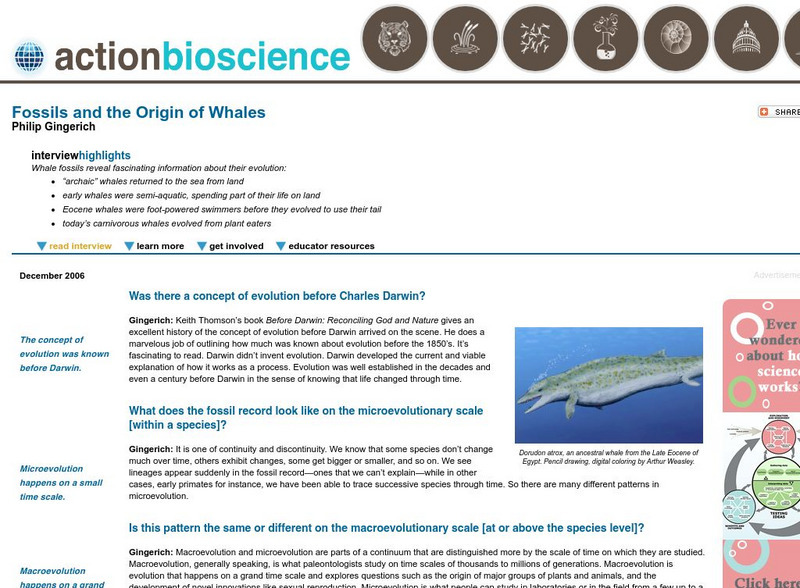
Action Bioscience: Fossils and the Origin of Whales
Through fossils scientists have been able to study the evolution of whales. Read this article to take a closer look at the details.
Defenders of Wildlife
Defenders of Wildlife: Killer Whale
A concise site from that looks at the size, population, lifespan, range, habitat and diet of the Killer Whale.
Defenders of Wildlife
Defenders of Wildlife: Humpback Whales
This concise site looks at the size, population, lifespan, habitat, range, and diet of the humpback whale.

PBS
Pbs: Nova: Shark Attack!
An informative site that touches on evolution, life cycle and interesting facts about sharks.
Smithsonian Institution
National Museum of Natural History: Paleobiology: Geologic Time: The Oligocene
Travel through Earth's history to learn about the Oligocene time period, which is characterized by the appearance of most of the living families of mammals.