
Curated OER
Pauli's Magical Water
Students predict the shape of molecules using VSEPR theory. In this chemistry instructional activity, students differentiate a polar and nonpolar molecule. They discuss why water's polarity is very important.

Curated OER
Refining and Reasoning Behind Scale Drawings
Students discuss accuracy and the need for it in blueprints in order to create the final project. They further refine and perfect drawings as part of the school drawing project. Students create a blueprint for the new school building...

Curated OER
Exploring Geometric Patterns and Relationships
Sixth graders explore different geographic relationships in like drawing lines, rays, and parallelograms. This instructional activity could be used for review because it covers more than one concept. The students should have prior...

Curated OER
Geo Jammin' By DeSign - Day 3, Lesson 12: Jammin
Students review definitions of word wall words using songs, movement and sharing.

Curated OER
Making Sense of the Census
In this unit of lessons, students make sense of the Census. They examine why a census is taken and participate in activities.

Curated OER
Circle the Earth - Explore Surface Types on a Journey around Earth
Learners use CERES percent coverage surface data with a world map in locating landmasses and bodies of water at Earth's Equator.

Curated OER
Prime and Composite Numbers
Sixth graders inspect prime and composite numbers. Using graph paper, they draw as many different shaped rectangles as possible. They use the dimensions of the rectangles to discuss prime and composite numbers. Students create a chart...

Curated OER
The Box with the Greatest Volume
Young scholars use measurement tools to measure the nearest 16th of an inch. They connect fractions and their decimal equivalents and compare this with other decimals. Finally, the class uses algebraic concepts and formulas to solve...

Curated OER
Angles and Parallel Lines
Sixth graders draw parallel and intersecting lines to observe and examine the characteristics of alternate interior angles, vertical angles, corresponding angles, and supplementary angles. Through observation, they discover the...
Wolfram Research
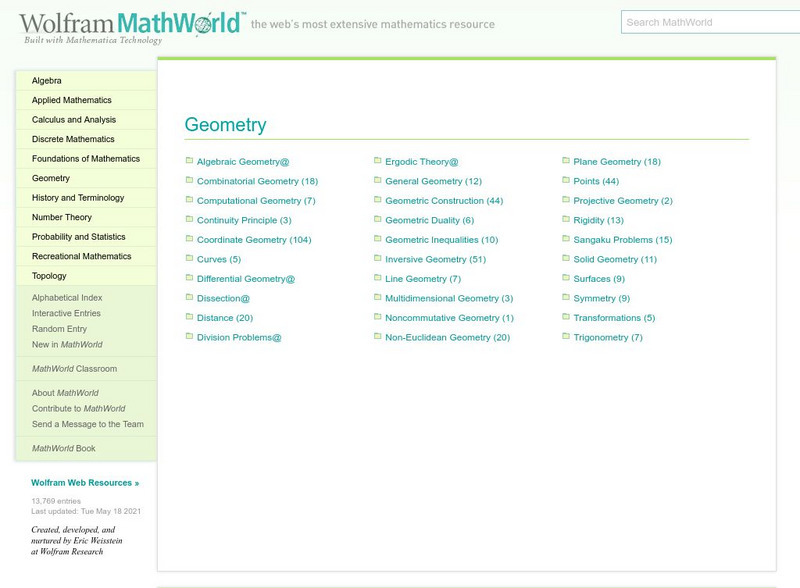
Wolfram Math World: Geometry
This MathWorld tutorial provides detailed overviews of the concepts and theorems associated with geometry. Most of the Math World sites are extensive and some require higher math knowledge to understand, links to terms and topics are...

Math Is Fun
Math Is Fun: Regular 2 D Shapes
This tutorial provides illustrations for regular 2-D shapes as well as a definition for polygons and for regular polygons.
Khan Academy
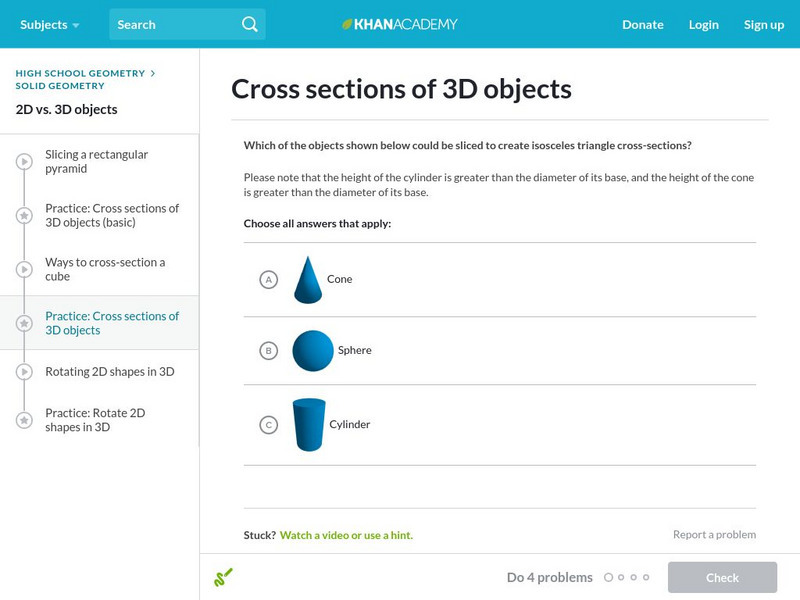
Khan Academy: Cross Sections of 3 D Objects
Practice your knowledge of all possible cross-sections of common 3D objects. Students receive immediate feedback and have the opportunity to try questions repeatedly, watch a video or receive hints.

Illustrative Mathematics
Illustrative Mathematics: A rei.d.10: Collinear Points
This task leads students through a series of problems which illustrate a crucial interplay between algebra and geometry. Aligns with A-REI.D.10.
Illustrative Mathematics
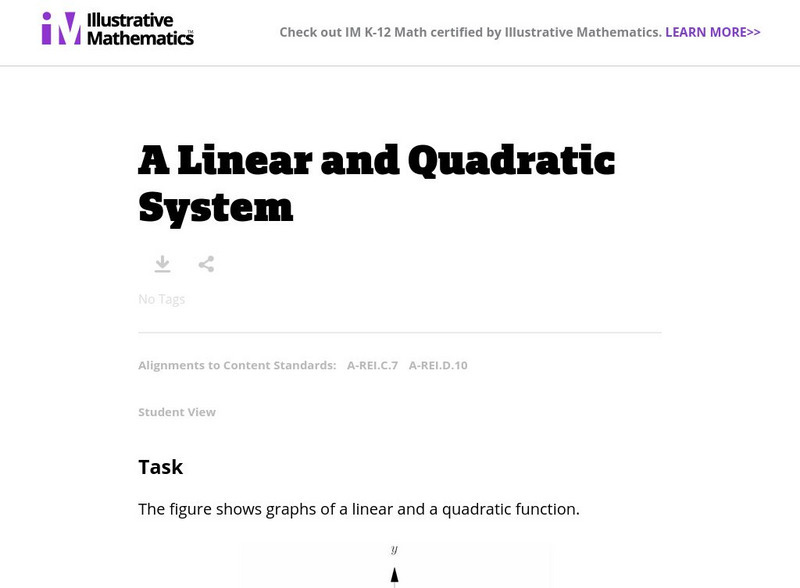
Illustrative Mathematics: A rei.c.7 & a rei.d.10: A Linear and Quadratic System
The purpose of this task is to give young scholars the opportunity to make connections between equations and the geometry of the graphs. Aligns with A-REI.C.7and A-REI.D.10.

E-learning for Kids
E Learning for Kids: Math: Market Place: 2 D Space
At the Food Market there are a lot of shapes. Help Afia find and name the shapes.

NumberNut
Number Nut: Shapes, Symbols, and Colors: 2 D Shapes
Did you know that two-dimensional shapes are also called polygons? This lesson describes the various 2-D shapes and includes two interactive games to reinforce skills.
CK-12 Foundation
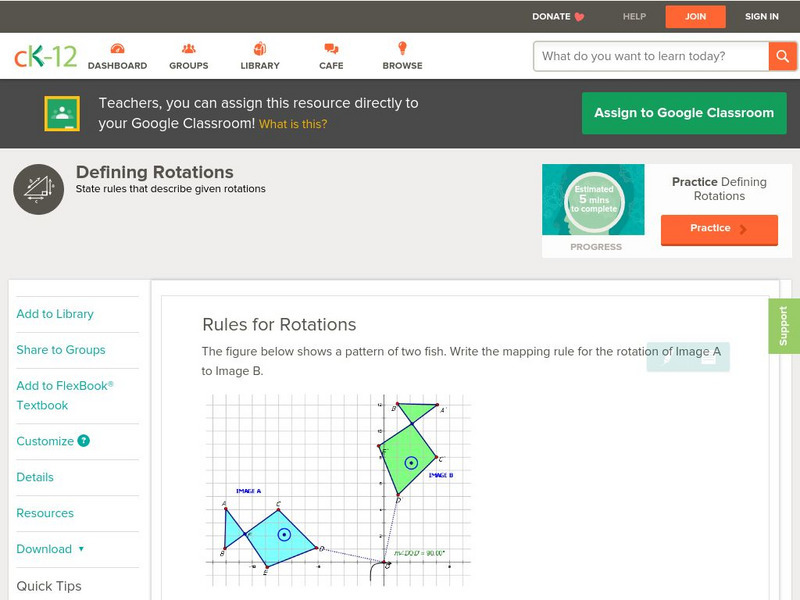
Ck 12: Defining Rotations
[Free Registration/Login may be required to access all resource tools.] In this tutorial, students learn about the rules that operate in the rotation of 2-D figures on a coordinate grid. Includes video, lots of examples, review...
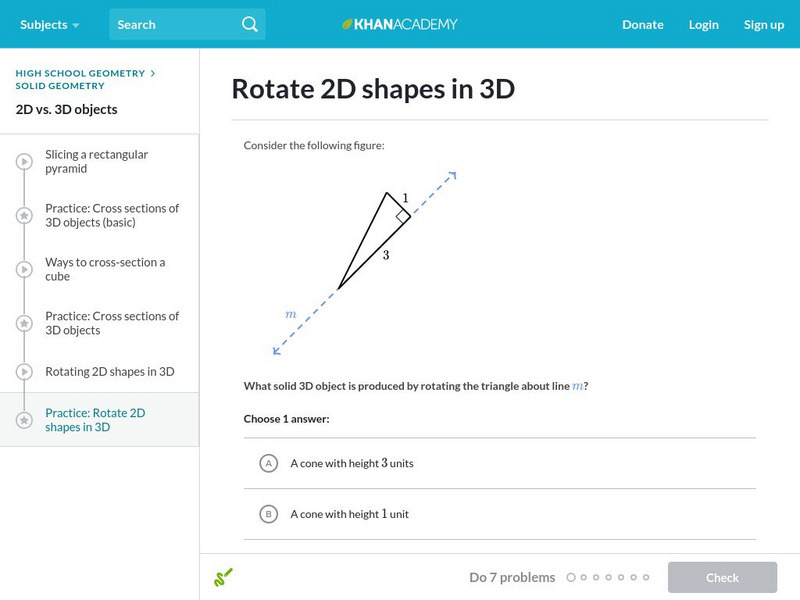
Khan Academy
Khan Academy: Rotate 2 D Shapes in 3 D
Practice your 3D visualization skills by rotating 2D shapes. Students receive immediate feedback and have the opportunity to try questions repeatedly, watch a video or receive hints.
Harvard University
Harvard Smithsonian: Everyday Classroom Tools
The focus of this series of lessons is to engage students in an exploration of the world around them. The emphasis is on inquiry as students learn about the earth, sun, light, shapes and more.