
Henry Ford Museum
Physics, Technology and Engineering in Automobile Racing
Start your engines! This five-lesson unit introduces physics and Newton's laws through automobile racing. Each lesson includes background information, a student worksheet, and an answer key. There are also culminating...

Curated OER
Aerospace Engineering
Students are introduced to aviation history and aerospace engineering achievements. They assemble a class aviation history timeline from individual student research on people and events.

Curated OER
Want to Drag?!
Students use the Metric system and engineering software to design a scale model car. In this scale model car making lesson, students design a scale model car using computer software, the Metric system, and properties of aerodynamics....

Curated OER
Aviation, Aeronautics and Aerodynamics
Students investigate the physics of flight through various experiments. In this physics lesson, students construct different flying objects. They explain the dynamics that make these object fly.

Curated OER
TE Activity: Heavy Helicopters
Students study the concepts of weight and drag while making paper helicopters. They measure how adding more weight to the helicopter changes the time for the helicopter to fall to the ground. They apply what they examine to the work of...

Curated OER
Aerodynamics of a Boomerang
Pupils examine how aerodynamic forces affect the flight of aircraft, animals and sports balls and projectiles (like a javelin or boomerang). They discover the origins of the boomerang and early usage in hunting.

Curated OER
Aerodynamics of Cycling
High schoolers study aerodynamic forces - lift and drag - and see how those forces affect cycling performance. They see how those forces are calculated and how

Teach Engineering
Take Off with Paper Airplanes
Let's go fly a kite ... oops, a paper airplane! The 13th segment in an aviation unit of 22 relates the parts of an airplane to paper airplanes. Pupils learn the functions of the control surfaces of a plane to really make their knowledge...

Teach Engineering
Airplane Tails and Wings: Are You in Control?
Keep everything under control. The lesson, the 16th segment in a 22-part unit, provides a more detailed look at the parts of a plane, specifically the control surfaces. Pupils learn about the construction of the wings and the tails and...

Curated OER
Forces, Controls And Aircraft Systems
Learners are introduced to the physics of flight through video and PowerPoint presentations. They construct and fly model gliders and compete for height, distance, time, etc.

Curated OER
Harnessing Wind
Students explore the ways that engineers study and harness the wind. They study the different kinds of winds and how to measure wind direction. In addition, students learn how air pressure creates winds and how engineers build and test...

Curated OER
Design a Parachute
Students engage in a discussion about what a parachute is and how it works. They create a parachute using different materials that they think will work best. The students test their designs, which will be followed by a class discussion...

Curated OER
What a Drag
Students learn examples of friction and drag, and suggest ways to reduce the impact of these forces. The equation that governs common frictional forces is introduced, and during a hands-on activity, students experimentally measure a...

Teach Engineering
May the Force Be With You: Drag
Do not let friction drag you down! The 11th segment in a series of 22 focuses on the fourth force acting upon an airplane—drag. Pupils learn about the effects and causes of drag.

Teach Engineering
What a Drag!
Stop and drop what is in your hand! Pupils investigate how form effects drag in the 12th part of a 22-part unit on aviation. Groups create equally weighted objects and determine which one falls the fastest by collecting data.

Curated OER
How Do Things Fall?
Students observe falling objects. They discover the rate of falling is based on air resistance and not the weight of the objects. They discuss how engineers use this type of information to design aerodynamic shapes.

Teach Engineering
Archimedes' Principle, Pascal's Law and Bernoulli's Principle
What do Pascal's law, Archimedes' Principle, and Bernoulli's Principle have to do with fluid mechanics? The included PowerPoint presentation provides the basic definitions and equations associated with the three. A set of homework...

Curated OER
Canada's Role in Astronomy and Space Science
Ninth graders, in groups, research a Canadian astronaut, developing a profile of their astronaut for presentation in a learning center. They visit the other groups' centers to explore more astronauts.

Curated OER
Geometry and Shapes in the X-36
Students describe, draw, and classify shapes. They use the internet to research the X-36 aircraft. Students identify the geometric shapes in the aircraft. They calculate the number of sides in an x-36.
Science Buddies
Science Buddies: The 'Ultimate' Science Fair Project: Flying Disk Aerodynamics
Tossing a Frisbee with your friends is a great way to have fun in the sun. As you practice your throws and become more accurate, you're learning about the aerodynamics of Frisbee flight intuitively. You're learning the body mechanics...
TeachEngineering
Teach Engineering: Rockets on a Shoestring Budget
In this activity, students revisit the Pop Rockets activity from Lesson 3. This time, however, the design of their pop-rockets will be limited by budgets and supplies. They will get a feel for the limitations of a real engineering...
Science Buddies
Science Buddies: Project Ideas: Whirl Y Bird vs. Whale Y Bird
Improve the design of a very simple aircraft, the whirlybird, and learn about hydrodynamics and biomimicry in this science experiment. The Science Buddies project ideas are set up consistently beginning with an abstract, objective, and...
TeachEngineering
Teach Engineering: Cars: Engineering for Efficiency
Students learn how the aerodynamics and rolling resistance of a car affect its energy efficiency through designing and constructing model cars out of simple materials. As the little cars are raced down a tilted track (powered by gravity)...
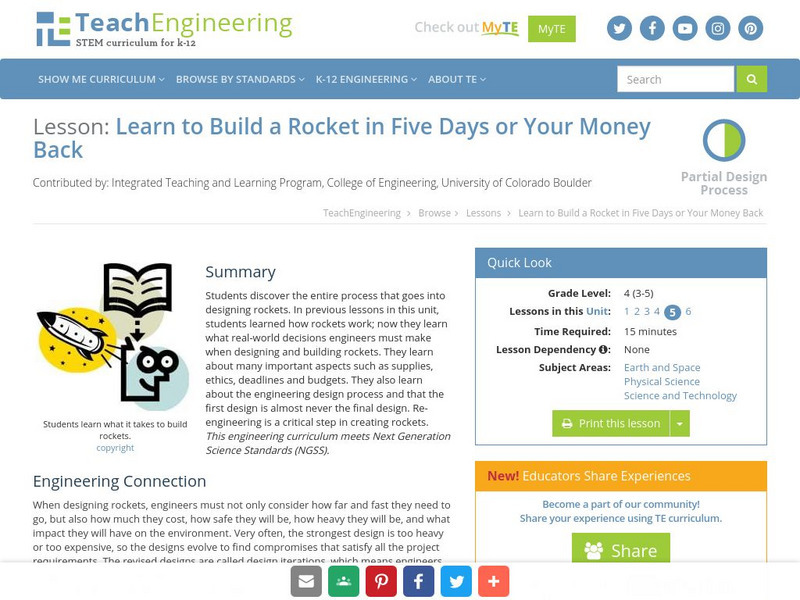
TeachEngineering
Teach Engineering: Learn to Build a Rocket in 5 Days or Your Money Back
In this lesson, students discover the entire process that goes into designing a rocket for any customer. In prior lessons, students learned how rockets work, but now they learn what real-world decisions engineers have to make when...