Hi, what do you want to do?




University of Canterbury
University of Canterbury: Cs Unplugged: Searching Algorithms
Explore the main algorithms that are used as the basis for keyword searching on computers, using different variations on the game of battleships.
TeachEngineering
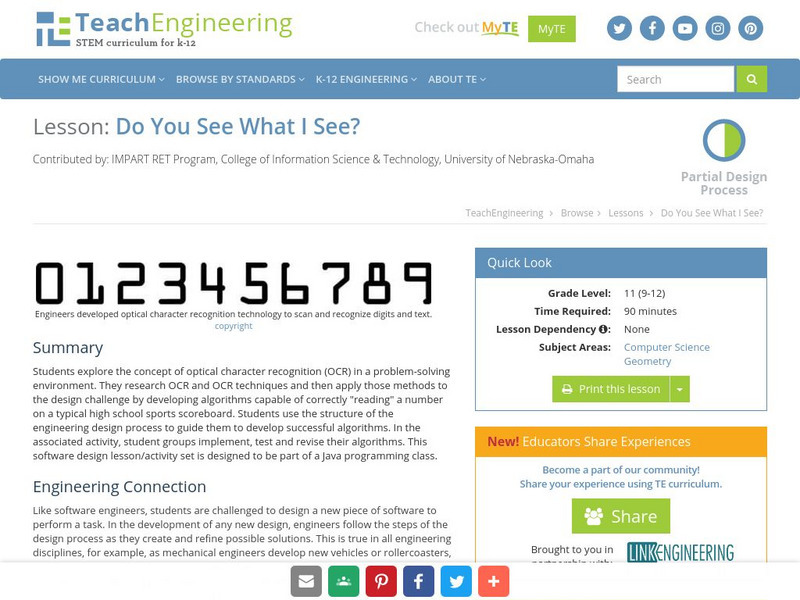
Teach Engineering: Do You See What I See?
Students research OCR and OCR techniques and then apply those methods to the design challenge by developing algorithms capable of correctly reading a number on a typical high school sports scoreboard.

Other
Lesson Plan Mental and Written Multiplication Algorithms
This lesson plan offers a variety of algorithms and systematic errors that occur in written multiplication problems.
Code.org
Code.org: Cs Fundamentals: Happy Maps
The bridge from algorithms to programming can be a short one if students understand the difference between planning out a sequence and encoding that sequence into the appropriate language. This activity will help students gain experience...
Google
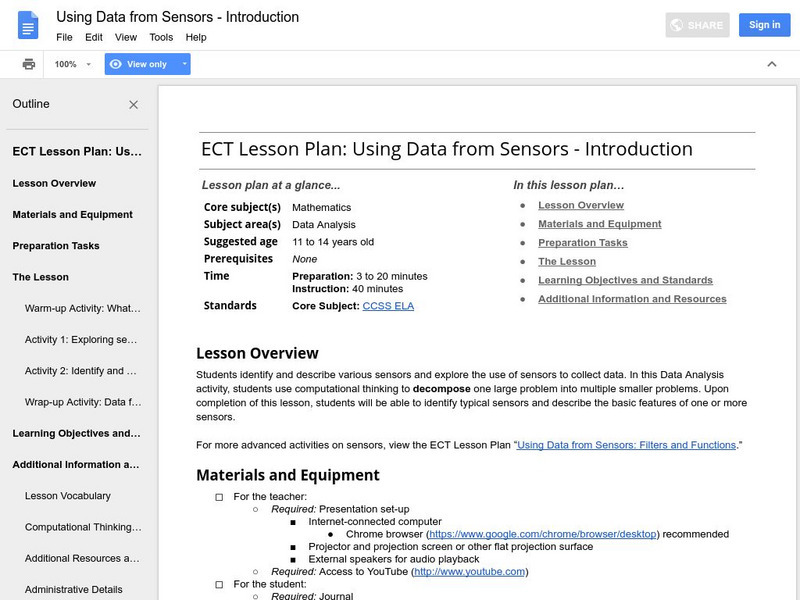
Google for Education: Using Data From Sensors
Students analyze data gathered from sensors and develop filtering algorithms for anomalies and outliers, then use these algorithms to make decisions on sensor data as it is being collected.

Utah Education Network
Uen: Partial Quotient
Detailed lesson plan explains how to use the partial quotients algorithm for solving division problems and understanding the process involved.
University of Canterbury
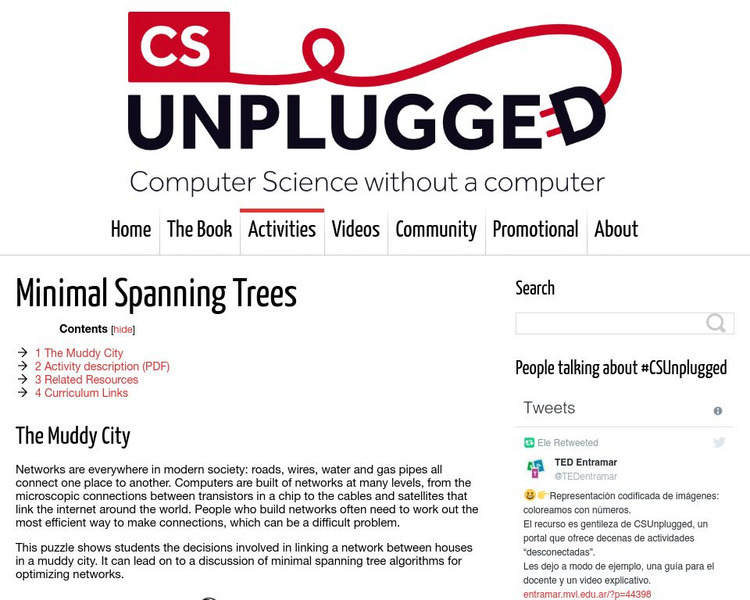
University of Canterbury: Cs Unplugged: Minimal Spanning Trees
This puzzle shows students the decisions involved in linking a network between houses in a muddy city. It can lead on to a discussion of minimal spanning tree algorithms for optimizing networks.

Other
Nearpod: Subtraction With Regrouping: Three Digit
In this lesson on subtraction, students will use the break apart strategy, draw a model, or the standard algorithm to subtract 3-digit numbers.

Alabama Learning Exchange
Alex: Multiplication My Way
In this lesson, students will explore the US Algorithm Method of multiplication using a unique way of describing it known as the Turtlehead Method. Students will collaboratively work together to complete story problems using the US...

Alabama Learning Exchange
Alex: Area Model of Multiplication Base 10 Manipulatives
Students will use base 10 manipulatives to build a rectangular array to represent double digit multiplication. Students will make the connection between the standard algorithm and the rectangular array.This lesson plan was created as a...

Alabama Learning Exchange
Alex: Why Do We Carry the One?
The students will critically think through the traditional algorithm for addition and compare to an alternative strategy.
Better Lesson
Better Lesson: Fraction by Fraction Division
Sixth graders will be able to model division of fractions by another fraction. Students will be able to divide a fraction by a fraction using the standard algorithm.
Better Lesson
Better Lesson: Adding and Subtracting With Decimals
Sixth graders fluently add and subtract money with decimals using the standard algorithm.

Khan Academy
Khan Academy: Start Here! Animation
Overview of this instructional activity on animation. In this instructional activity we are going to uncover a really useful way to construct Bezier curves of various degrees using de Casteljau's algorithm.
Other
Nearpod: Subtraction With Regrouping: Two Digit
In this lesson on subtraction, students will use the break apart strategy, draw a model, or the standard algorithm to subtract 2-digit numbers.
Curated OER
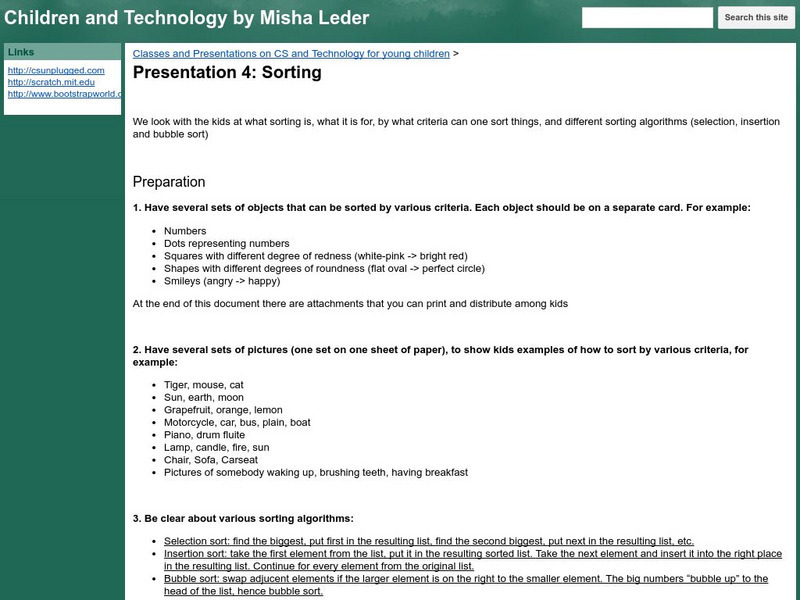
Google for Education: Children and Technology: Sorting
Young scholars learn about data sorting, and by what criteria can one sort things by different algorithms such as selection, insertion and bubble sort.
Illustrative Mathematics
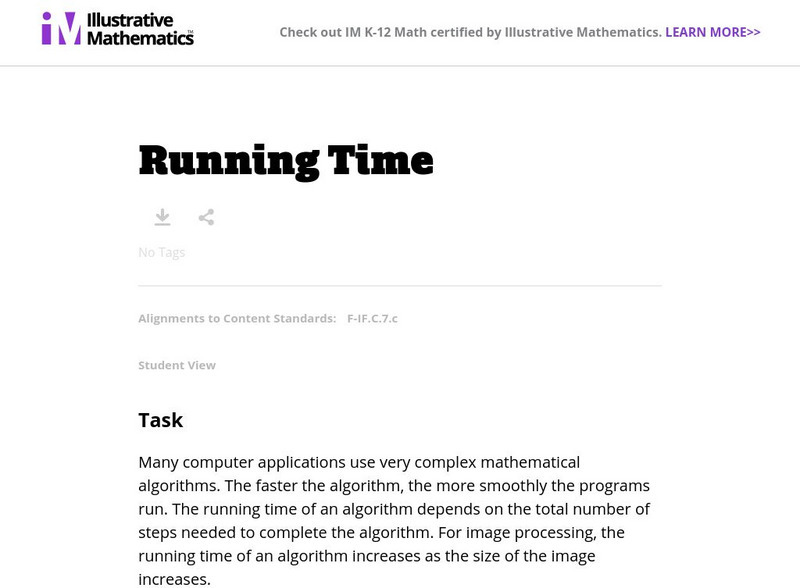
Illustrative Mathematics: F if Running Time
This task provides an application of polynomials in computing. Students are asked to calculate the running time of algorithms for loading images of different sizes. They then graph the running time polynomials and decide which is more...

Code.org
Code.org: Cs Fundamentals: My Robotic Friends
This unplugged lesson brings the class together as a team with a simple task to complete: get a "robot" to stack cups in a specific design. This activity lays the groundwork for the programming that students will do throughout the course...

Code.org
Code.org: Cs Fundamentals: Lesson 4: Debugging With Laurel
Learners will practice debugging in the "collector" environment. Students will get to practice reading and editing code to fix puzzles with simple algorithms, loops and nested loops.

George Mason University
Lesson Plans: Whole Number Algorithms Base Ten Blocks
Brief lesson plans that show how to use base ten blocks to do all four operations and a little bit of algebra.
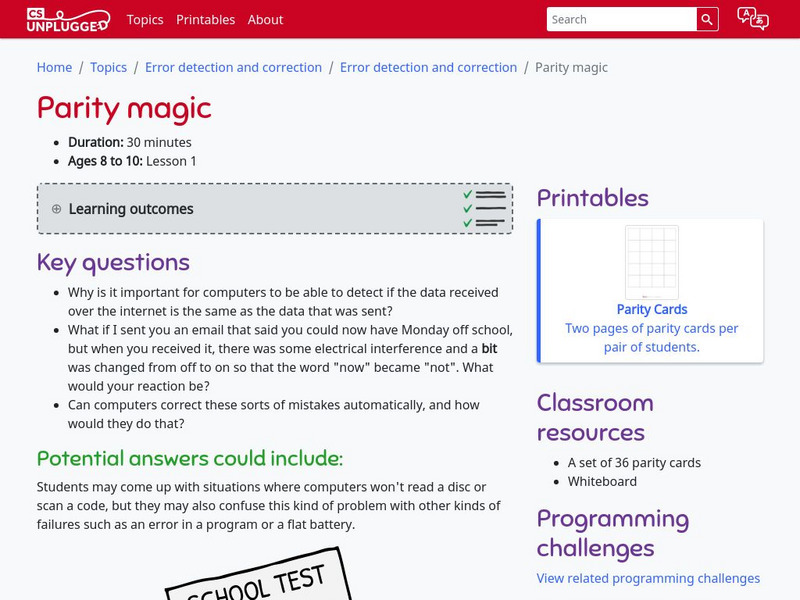
University of Canterbury
Cs Unplugged: Parity Magic
This activity will look at how computers correct errors automatically.

Code.org
Code.org: Cs Fundamentals: Lesson 8: Changing Variables With Bee
This lesson plan will help illustrate how variables can make programs more powerful by allowing values to change while the code is running.

Code.org
Code.org: Cs Fundamentals: Lesson 7: Variables With Artist
n this lesson, students will explore the creation of repetitive designs using variables in the Artist environment. Students will learn how variables can be used to make code easier to write and easier to read, even when the values don't...
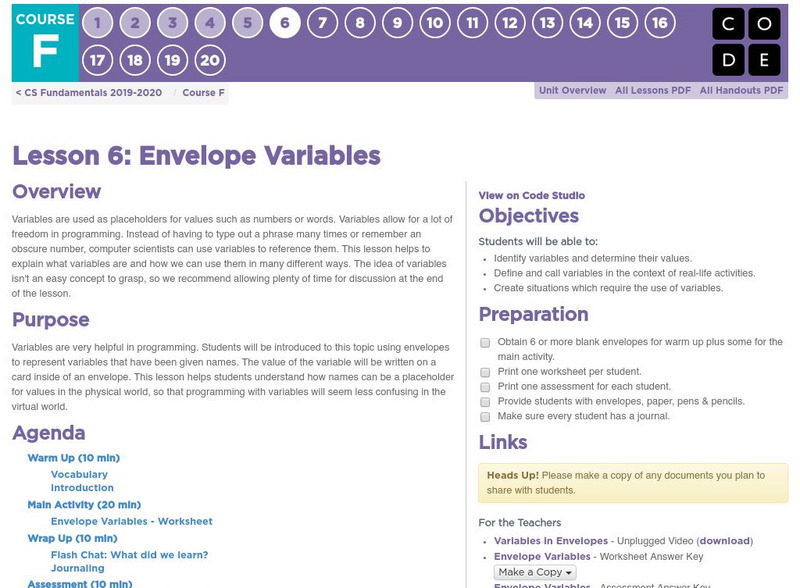
Code.org
Code.org: Cs Fundamentals: Lesson 6: Envelope Variables
This instructional activity helps to explain what variables are and how we can use them in many different ways.
Other popular searches
- Numerical Algorithms
- Division Algorithm
- Multiplication Algorithms
- Addition With Algorithms
- Addition Algorithms
- Subtraction Algorithms
- Standard Algorithm
- Math With Algorithms
- Partial Products Algorithm
- Partial Sums Algorithm
- Adding Integers Algorithm
- Dividing Algorithm