Hi, what do you want to do?



Google
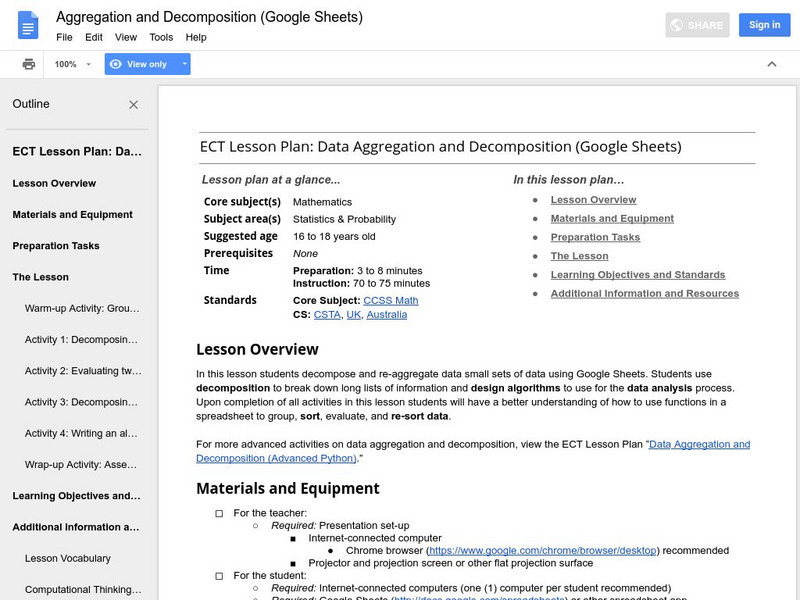
Google for Education: Data Aggregation and Decomposition (Excel)
By using Microsoft Excel, students collect, decompose, and re-aggregate class data. Students use computational thinking skills by decomposing long lists of information and writing basic algorithms to help analyze data.
Google
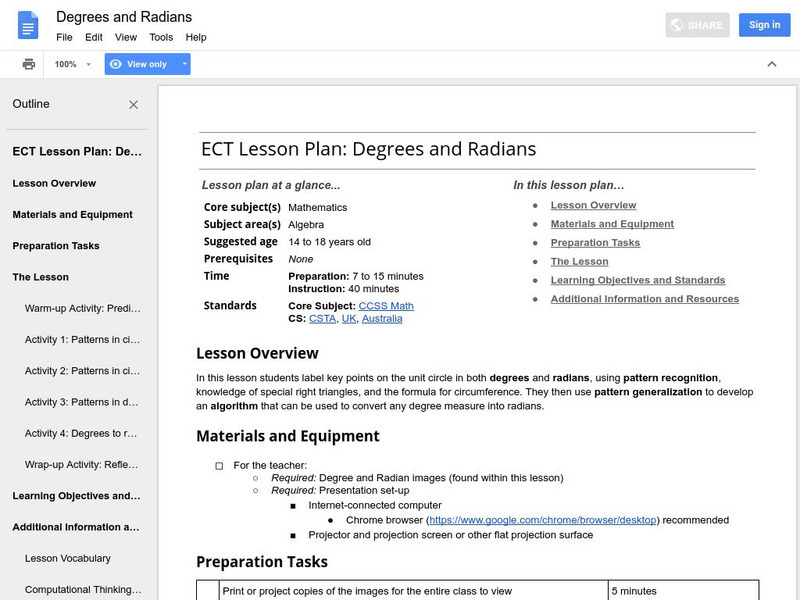
Google for Education: Degrees and Radians
Learners label key points on the unit circle in both radians and degrees. They count their way around the circle in 30-degree increments, and then again in increments of radians. Finally, students go through a similar process for angles...
Google
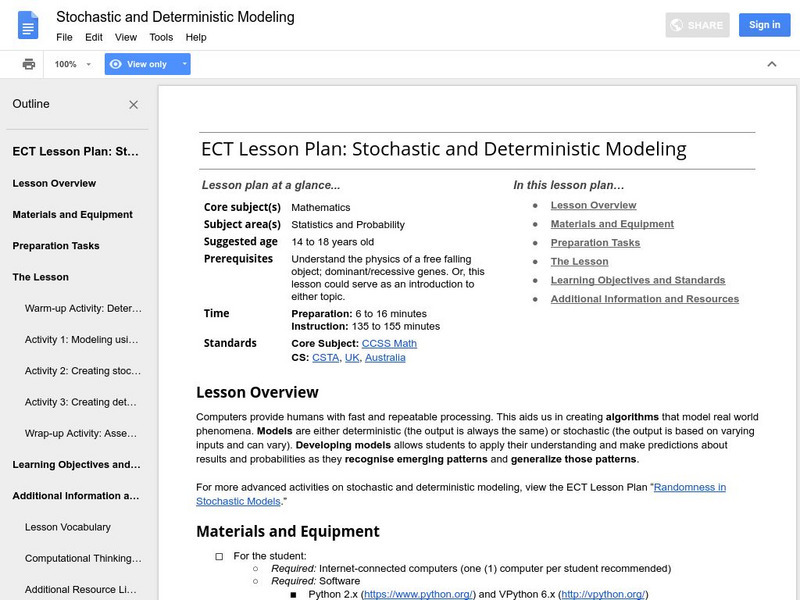
Google for Education: Stochastic and Deterministic Modeling
Computers provide humans with fast and repeatable processing to create algorithms that model real world phenomena. Developing models allows young scholars to apply their understanding and make predictions.
Google
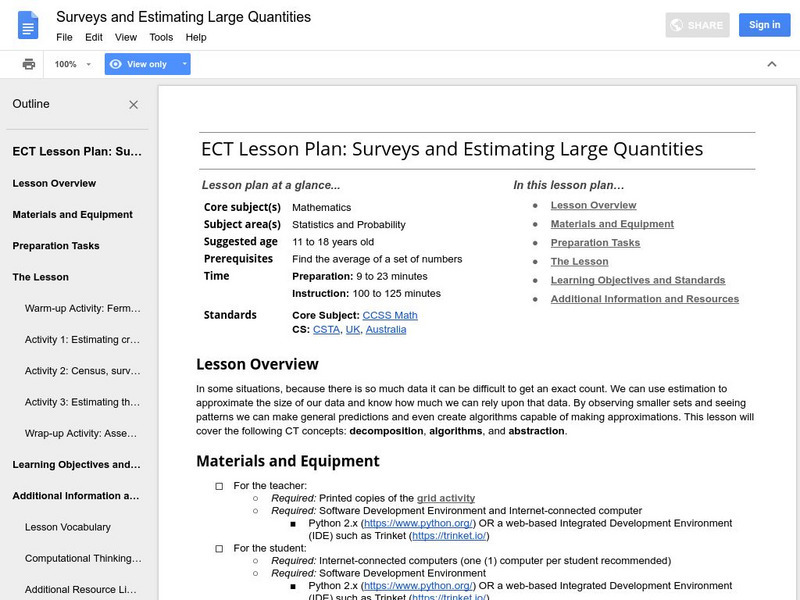
Google for Education: Surveys and Estimating Large Quantities
Students use estimation to approximate the size of a large set of data. By observing smaller sets and seeing patterns they make general predictions and even create algorithms capable of making approximations.
TeachEngineering
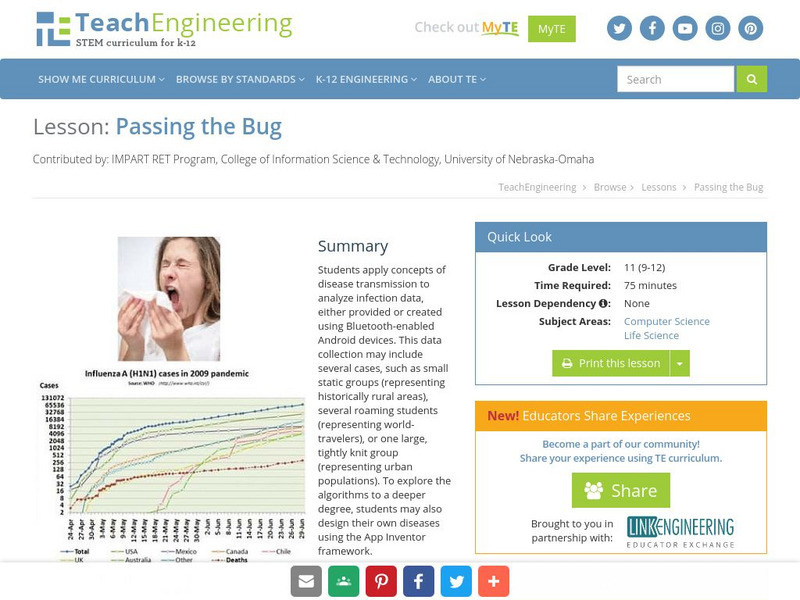
Teach Engineering: Passing the Bug
Students apply concepts of disease transmission to analyze infection data, either provided or created using Bluetooth-enabled Android devices. This data collection may include several cases, such as small static groups (representing...
TeachEngineering
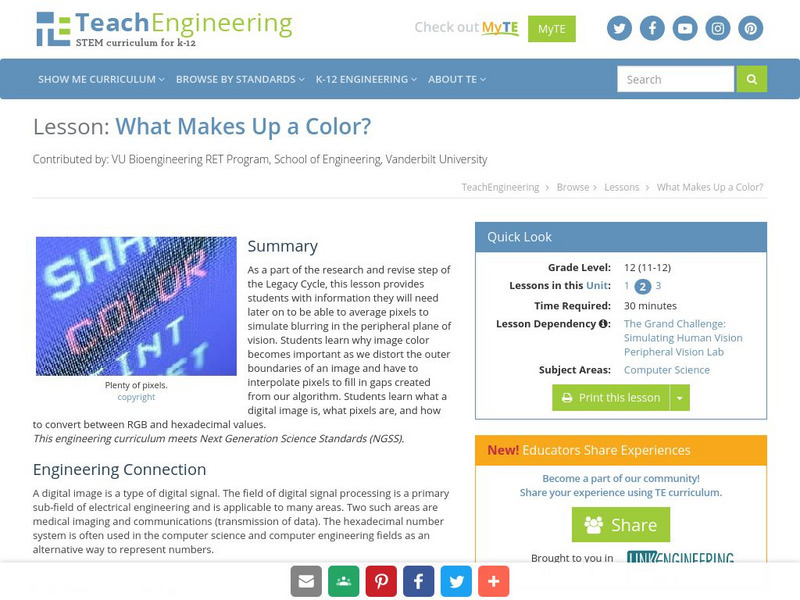
Teach Engineering: What Makes Up a Color?
As a part of the research and revise step of the Legacy Cycle, this lesson provides students with information they will need later on to be able to average pixels to simulate blurring in the peripheral plane of vision. Students learn why...

Shodor Education Foundation
Shodor Interactivate: Solving Equations
Introduction to various algorithms for solving single-variable, linear equations.

Other
Nearpod: Adding Integers: Visual Approaches
In this lesson, students learn several methods to adding integers, including visual approaches and the standard algorithm.
Other
Elmwood Park High School: Vertex Edge Graphs
In this Unit, you will use vertex-edge graphs and Euler Circuits to help find optimum paths. Included are two lessons that help you develop the understanding and skill needed to solve problems about optimum paths and conflicts.
University of Texas
Inside Mathematics: Bikes and Trikes [Pdf]
This task challenges a student to demonstrate understanding of concepts involved in multiplication.
Other
Ohio Department of Education: Models for Dividing Fractions [Pdf]
This resource consists of a detailed, hands-on lesson plan for dividing fractions using manipulatives such as fraction bars.
TeachEngineering
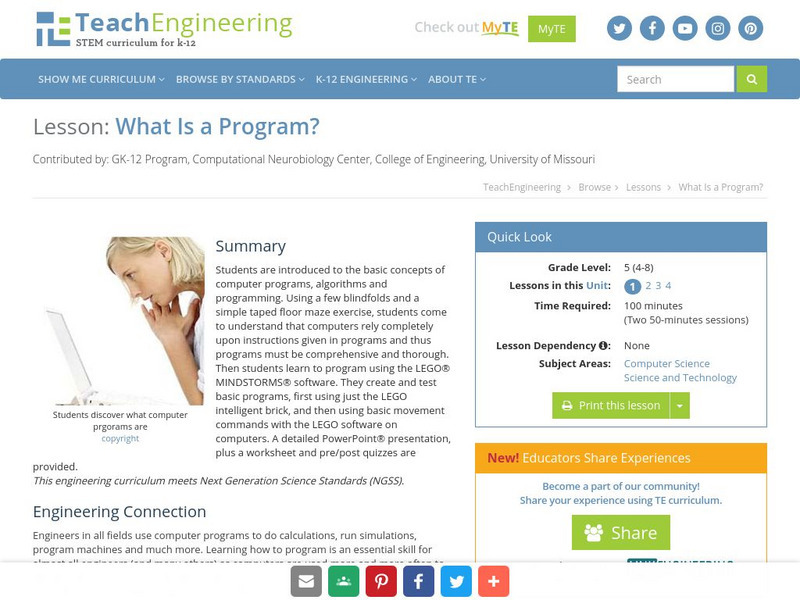
Teach Engineering: What Is a Program?
Using a few blindfolds and a simple taped floor maze exercise, students come to understand that computers rely completely upon instructions given in programs and thus programs must be comprehensive and thorough. Then students learn to...
TeachEngineering
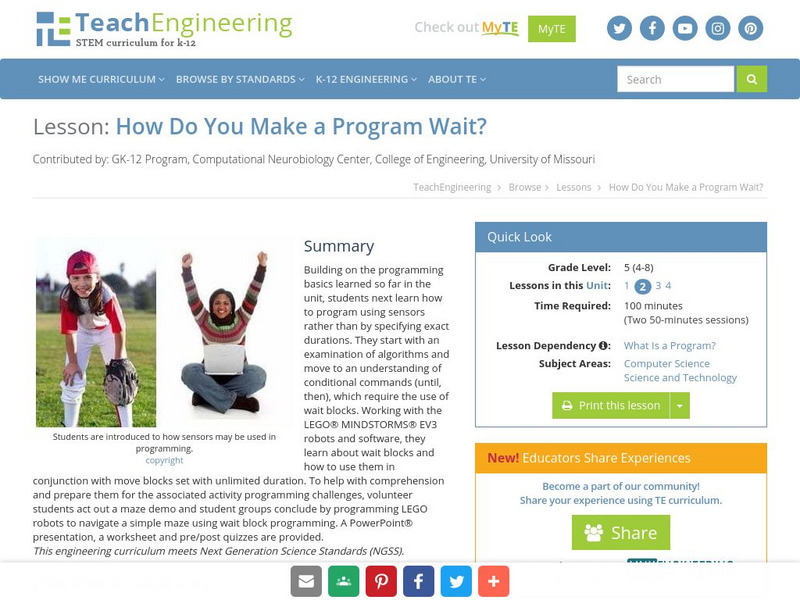
Teach Engineering: How Do You Make a Program Wait?
Building on the programming basics learned so far in a corresponding Robotics unit, students learn how to program using sensors rather than by specifying exact durations. Working with the LEGO MINDSTORMS NXT robots and software, they...
TeachEngineering
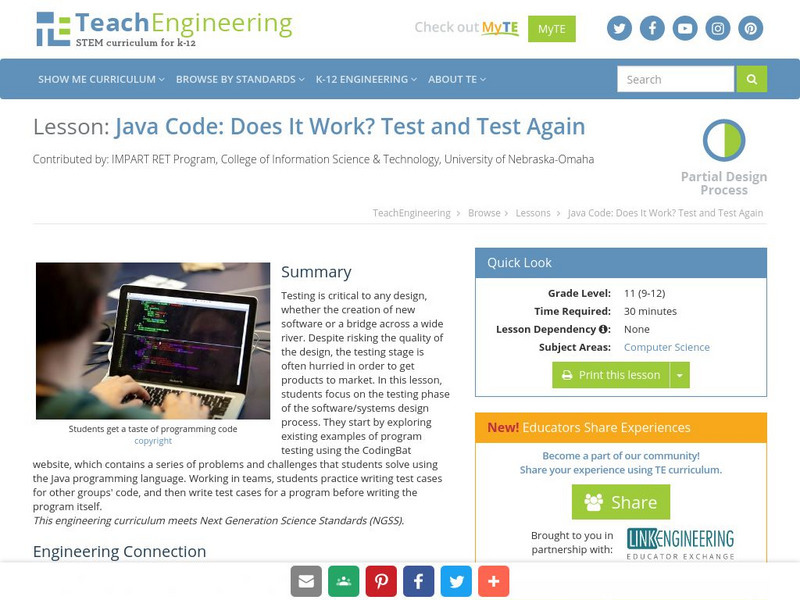
Teach Engineering: Does It Work? Test and Test Again
Testing is critical to any design, whether it be in the creation of new software or building a bridge across a wide river. Despite risking the quality of the design, the testing stage is often hurried in order to get products to market....
University of Canterbury
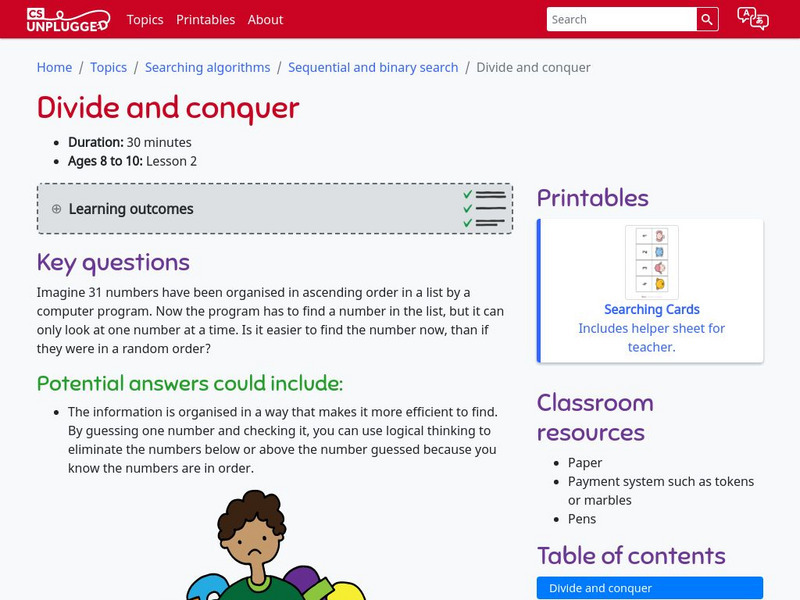
Cs Unplugged: Divide and Conquer
Imagine 31 numbers have been organized in ascending order in a list by a computer program. Now the program has to find a number in the list, but it can only look at one number at a time. Is it easier to find the number now, than if they...

University of Canterbury
Cs Unplugged: The Great Number Hunt (Sorted)
How would you look for a book in a library if the books were sorted in alphabetical order? Is that easier than if they were out of order?
Google
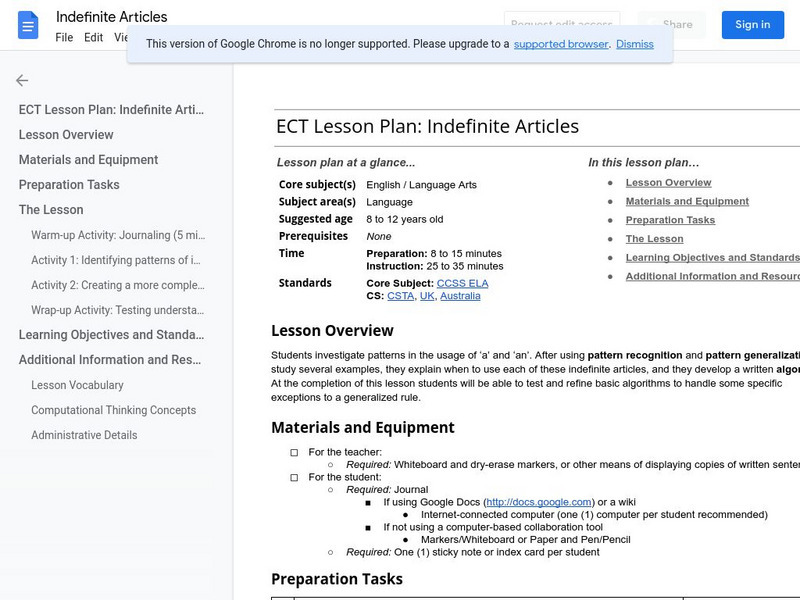
Google for Education: Indefinite Articles
Students identify a pattern in the usage of the articles 'a' and 'an' and then write an algorithm that others can follow to correctly use these two indefinite pronouns, and they identify possible exceptions the general rule.
Better Lesson
Better Lesson: Representing Fraction Multiplication Day 2
What does it mean when you multiply fractions? How can you multiply fractions without drawing a diagram? Students build on their skills for multiplying fractions and they work to develop an algorithm.

Code.org
Code.org: Cs Fundamentals: The Big Event
Young scholars will soon learn that events are a great way to add flexibility to a pre-written algorithm. Sometimes you want your program to be able to respond to the user exactly when the user wants it to. Events can make your program...
Better Lesson
Better Lesson: Division of Multi Digit Numbers
Practice makes perfect and in this lesson students will be practicing long division using the standard algorithm plus they will be interpreting remainders!
Better Lesson
Better Lesson: Multiplying With Decimals Day 2
If 24 x 63 =1512, then what will be the product for 0.24 x 6.3? Students work on answering these questions and solidifying an algorithm for multiplying decimals.
Better Lesson
Better Lesson: Multiplying With Decimals
How do you multiply decimals? Where does the decimal point go? Students work on answering these questions and developing an algorithm for multiplying decimals.
Better Lesson
Better Lesson: Dividing With Fractions
Sixth graders model division using whole numbers and fractions and divide whole numbers and fractions using the standard algorithm.
Better Lesson
Better Lesson: Review 7: Painting Tables Dividing With Fractions
How do you visually represent dividing with fractions? When you have a remainder, what does it actually mean? Students look for patterns and create algorithms for dividing with fractions.
Other popular searches
- Numerical Algorithms
- Division Algorithm
- Multiplication Algorithms
- Addition With Algorithms
- Addition Algorithms
- Subtraction Algorithms
- Standard Algorithm
- Math With Algorithms
- Partial Products Algorithm
- Partial Sums Algorithm
- Adding Integers Algorithm
- Dividing Algorithm