Georgia State University
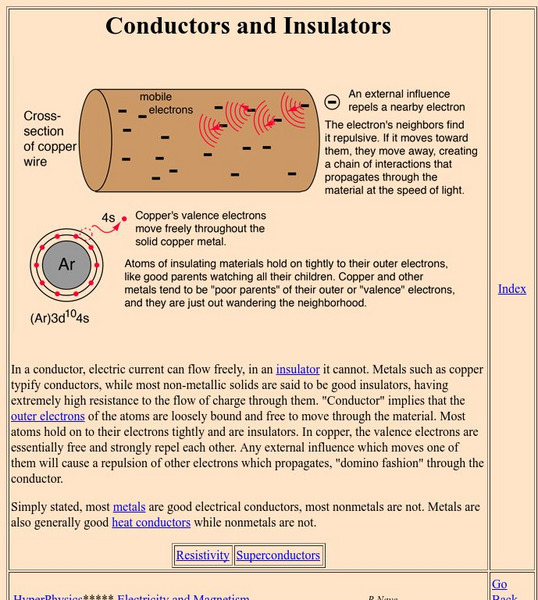
Georgia State University: Hyper Physics: Conductors and Insulators
This site from Georgia State University provides information on the distinction between conductors and insulators. Factors contributing to the insulating ability of materials are discussed.

Intel Corporation
Intel Education: Circuits and Switches
By comparing household electricity to household plumbing, this tutorial makes the concepts of electricity easier to understand. Includes video clips and interactive activities; click on "Instructional Strategies" for teacher resources...
Channel 4 Learning
4 L: Science Essentials: Get Physical
Find a review of many aspects of the physical world. Simple explanations of electricity, gravity, and the solar system. Included are materials for teachers to use for enrichment.
Physics4kids
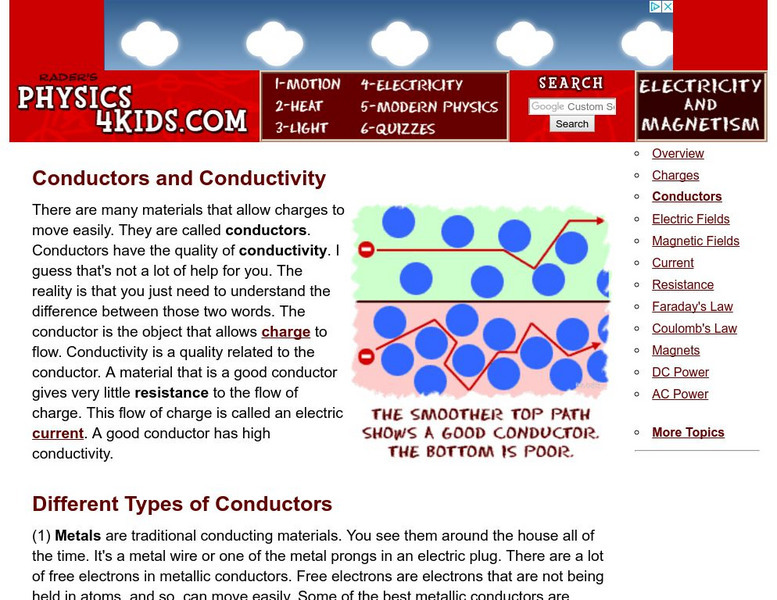
Physics4 Kids: Electricity and Magnetism: Conductors and Conductivity
A brief overview of several type of conductors.
Science and Mathematics Initiative for Learning Enhancement (SMILE)
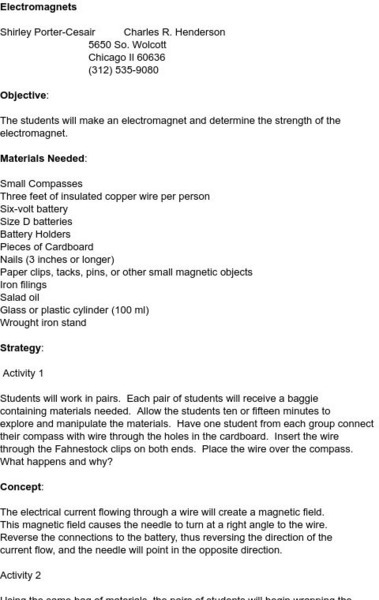
Smile: Electromagnets
This lesson plan contains several activities designed to help the student understand the magnetic effects of an electrical current.

ClassFlow
Class Flow: Circuit Conductors
[Free Registration/Login Required] This unit builds on children's previous practical experience of making circuits and extends their understanding of circuits, conductors and insulators and the need for a complete circuit in order for a...
Science4Fun
Science4 Fun: Copper
Fun and interesting information about Copper, the second best conductor of electricity. Learn about its characteristics, uses, where it is found, and discovery.
Concord Consortium
The Concord Consortium: Molecular Workbench: The Hall Effect
Adjust the magnetic field in this simulation to see how the flow of electricity is affected.
CK-12 Foundation
Ck 12: Forces on Charged Objects
[Free Registration/Login may be required to access all resource tools.] Students learn which subatomic particles contribute to static electricity, and determine the charge of an object based on what particles it has gained or lost.
Science Buddies
Science Buddies: Build Your Own Windmill Generator
Build your own windmill and see how the wind can be converted into energy to produce electricity. This science fair project should help you understand the use of wind as a source of alternative energy. The Science Buddies project ideas...

ClassFlow
Class Flow: Turning on the Lights
[Free Registration/Login Required] In this lesson students learn the parts of a circuit, build series and parallel circuits, learn about insulators and conductors, and more in this interactive multimedia flipchart.
Science and Mathematics Initiative for Learning Enhancement (SMILE)
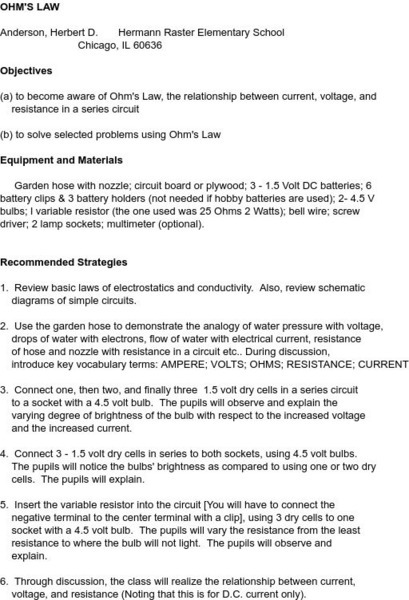
Smile: Ohm's Law
For the teacher planning a lesson plan or for the student preparing for a project or presentation. This page describes a series of simple activities related to the voltage-current-resistance relationship.
Wolfram Research
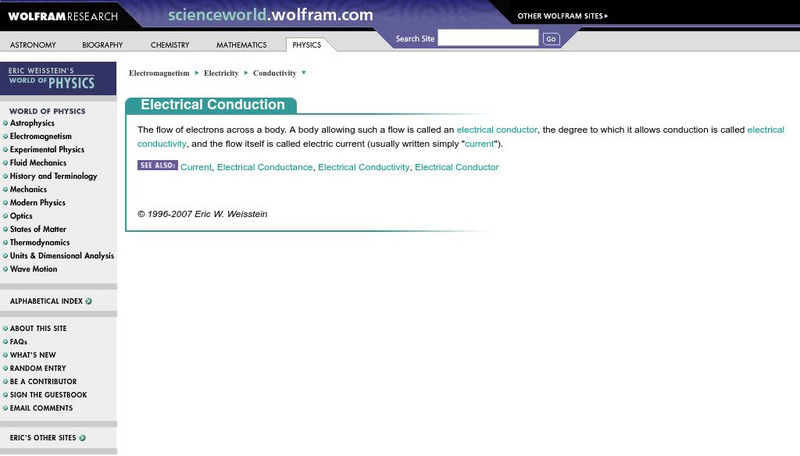
Wolfram Science World: Eric Weisstein's World of Physics: Electrical Conduction
A brief definition for what electrical conduction is. Also provides the definition for related terms.
CK-12 Foundation
Ck 12: Physics Simulation: Power Lines
[Free Registration/Login Required] Learn about the relationship between electric potential, current, and resistance in the context of high-voltage AC power lines using this interactive simulation. A PDF worksheet and a video tutorial are...
Science Education Resource Center at Carleton College
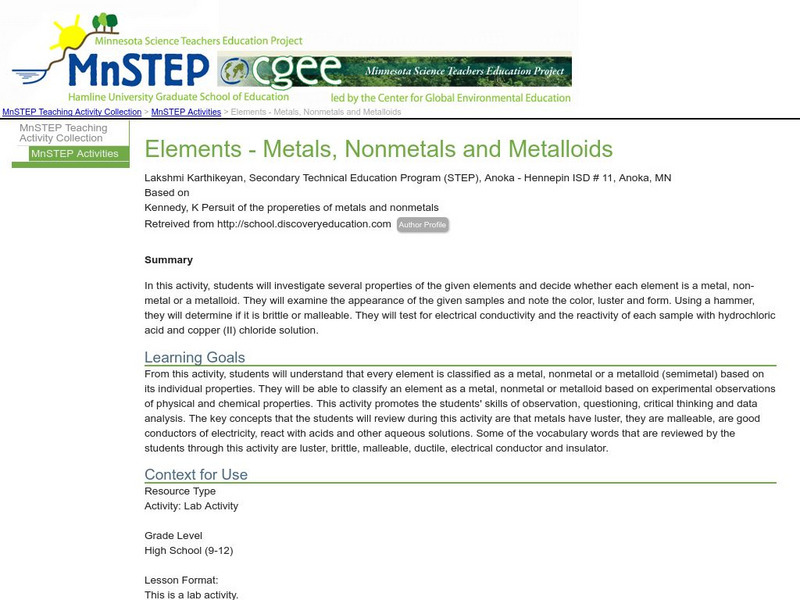
Serc: Elements Metals, Nonmetals and Metalloids
Students investigate several properties of the given elements and decide whether each element is a metal, non-metal, or a metalloid.
Michigan State University
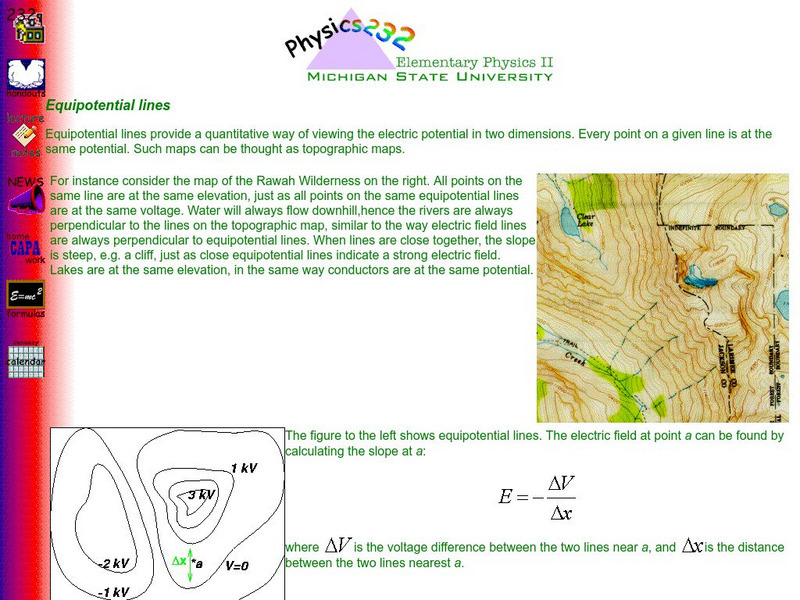
Michigan State University: Equipotential Lines
This site is from Michigan State University's Elementary Physics II class and details equipotential lines. The site displays maps and diagrams as well as formulas and rules for these types of lines.

ClassFlow
Class Flow: Changing Circuits
[Free Registration/Login Required] The teacher will use this lesson plan flipchart to review circuits. This unit consolidates Children's knowledge of materials which are electrical conductors, extends understanding of ways in which the...