Hi, what do you want to do?






Curated OER
Earthquakes: Sixth Grade Lesson Plans and Activities
Young seismologists learn more about plate tectonics with a set of pre-lab, lab, and post-lab lessons plans on earthquakes. After exploring how waves travel through various materials, sixth graders record their observations and...

Curated OER
Earthquakes: Third Grade Lesson Plans and Activities
Introduce third graders to energy waves with a hands-on geology activity, in which they answer questions and compare seismograms in the San Francisco Bay area. After a demonstration that shows how bigger waves indicate a...

Columbus City Schools
Making Waves
Learning about waves can have its ups and downs, but a demo-packed tool kit has the class "standing" for more! Learners gain experience with several different wave types, organizing observations and data, and wave...

Curated OER
Earthquakes: Fourth Grade Lesson Plans and Activities
Examine earthquake intensities and ways to measure an earthquake through the comparison of the Mercalli and Richter scales. After completing the pre-lab worksheet, fourth graders compare high and low intensity quakes by testing...

NASA
The Electromagnetic Spectrum
Did you realize the visible light spectrum is less than three percent of the electromagnetic spectrum? A hands-onlesson includes five activities and experiments for scholars to explore and discover many advanced science concepts. They...

Curated OER
Quantum Mechanics and Atomic Physics
Students will discuss the de Brogile Hypothesis and state the circumstances under which the wave nature of matter is observed. They will also calculate the wavelengths of matter waves.

Curated OER
Physical Optics: The Wave Nature of Light
Students are introduced to the wave nature of light. In groups, they discuss Young's experiment and how diffraction and interference demonstrate the wave nature of light. Using examples, they show constructive and destructive...

Curated OER
Geometrical Optics: Reflection and Refraction of Light
Students define and discus the concepts of wave fronts and rays. In groups, they distinguish between specular and diffuse reflections and use Snell's Law to predict the path of light rays. They calculate the speed of light through...

Curated OER
The Motions of the Oceans
Students examine the topics of ocean waves, currents, and tides. They locate and label ocean currents on a world map, conduct experiments, analyze key vocabulary, view demonstrations and record the data, and complete handouts.

Curated OER
Quantum Physics
Students discuss the mass-energy relationship based on Einstein's work. They calculate the energy released in various scenerios and sketch diagrams for the Lyman, Balmer and Pfund Series. In groups, they discuss the role of photons and...
Vision Learning
Vision Learning: Physics: Waves and Wave Motion
Instructional module focusing on waves and wave motion. Discussion includes wave theories, wave basics, and wave speed. The site also includes an interactive practice quiz and links relating to the topic.
Georgia Department of Education
Ga Virtual Learning: Ap Physics 1: Waves and Sound
Students will understand and predict wave phenomena, and investigate the energy contained in waves. They will gain a deeper understanding of waves and wave interference that will enable characterization and engineering of matter from the...
Georgia Department of Education
Ga Virtual Learning: Physical Science: Waves and Sound
In this module, students investigate the properties and behavior of different types of waves.
Texas Education Agency
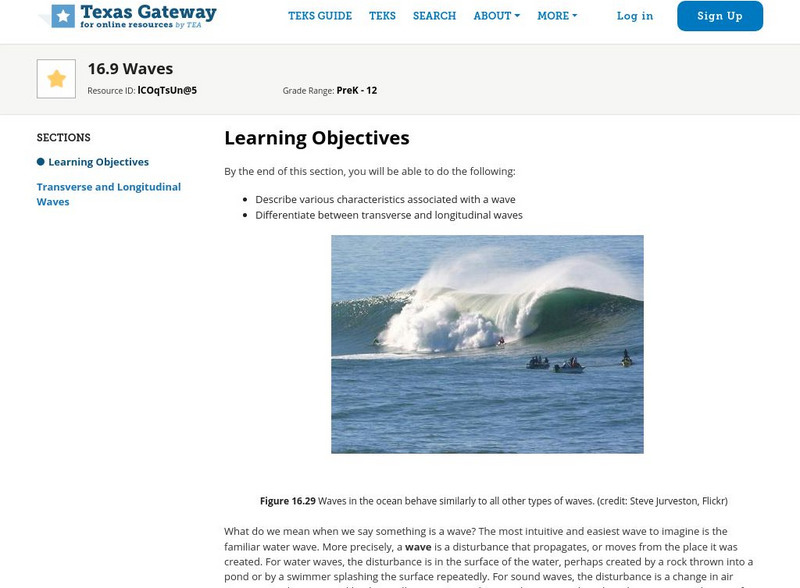
Texas Gateway: Oscillatory Motion and Waves: Waves
By the end of this section, you will be able to describe various characteristics associated with a wave and differentiate between transverse and longitudinal waves.
CK-12 Foundation
Ck 12: Physical Science: Properties of Electromagnetic Waves
[Free Registration/Login may be required to access all resource tools.] The speed of electromagnetic waves, their wavelengths and frequencies and how to calculate wavelength or wave frequency.
BBC
Bbc: Gcse Bitesize: General Properties of Waves
Light travels as waves. Waves can be described by their amplitude, wavelength and frequency. The speed of a wave can be calculated from its frequency and wavelength.
CK-12 Foundation
Ck 12: Wave Speed Calculations
[Free Registration/Login may be required to access all resource tools.] Students investigate and analyze characteristics of waves, including velocity, and calculate the relationship between wave speed, frequency, and wavelength.

Physics Classroom
The Physics Classroom: Nodes and Antinodes
In this thorough lesson, nodes and antinodes are explained and compared to crests and troughs. A "Check Your Understanding," set of questions is included at the end of the lesson with answers.
Miss Bupp's Class
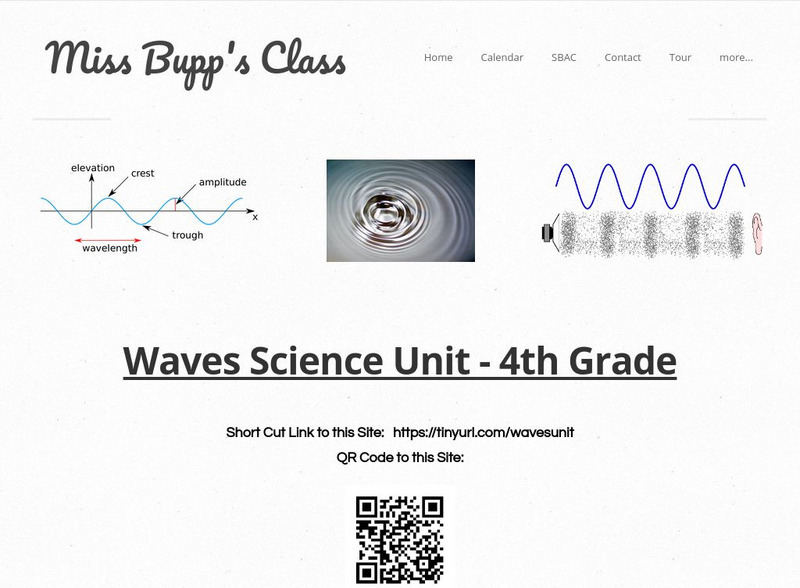
Miss Bupp's Class: Waves Science Unit
Enter Miss Bupp's class as she teaches a unit on waves. This extensive unit includes lesson plans, videos, assessments, and hands-on activities to make learning about waves and their characteristics fun and engaging.
Physics Classroom
The Physics Classroom: Formation of Standing Waves
How are standing wave formations formed? Why are they only formed when the medium is vibrated at specific frequencies? What makes these so-called frequencies so special and magical? These questions are answered in this exploration of...
Physics Classroom
The Physics Classroom: Behavior of Waves
Boundary behavior, incident pulse, reflected pulse,and transmitted pulse are explained in this thorough tutorial. Animation and drawings are used to clarify the concepts.
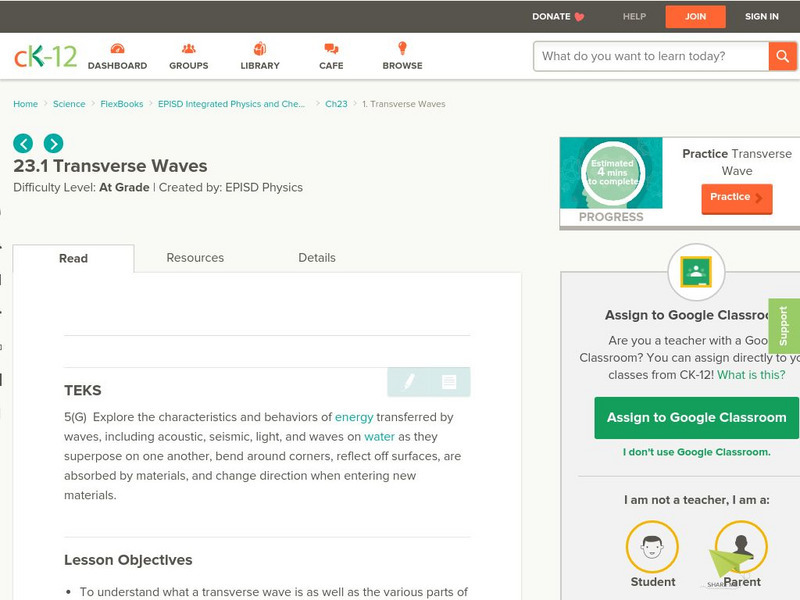
CK-12 Foundation
Ck 12: Transverse Waves
[Free Registration/Login may be required to access all resource tools.] Explore the characteristics and behaviors of energy transferred by transverse waves.
Physics Classroom
The Physics Classroom: Traveling Waves vs. Standing Waves
Traveling and standing waves are thoroughly explained through the use of drawings and animation.

BBC
Bbc: Gcse Bitesize: Why Do Scientists Think That Light and Sound Are Waves?
Light travels as transverse waves and can travel through a vacuum. Sound travels as longitudinal waves and needs to travel through a solid, liquid or gas. Read about the properties of light and of sound, and learn the differences between...