Hi, what do you want to do?






South Carolina Educational Television
Know It All: Lift | Nasa Online
An upward force called lift acts on the airplane and opposes the downward forces of gravity. The lift force allows the airplane to get off the ground and stay in the air. Watch the simulation to see how this works.
PBS
Pbs Learning Media: Aerodynamics: What Causes Lift?
How does an airplane stay aloft when upside down? This media-rich essay from the NOVA Web site offers an explanation based on Newton's third law of motion.
NASA
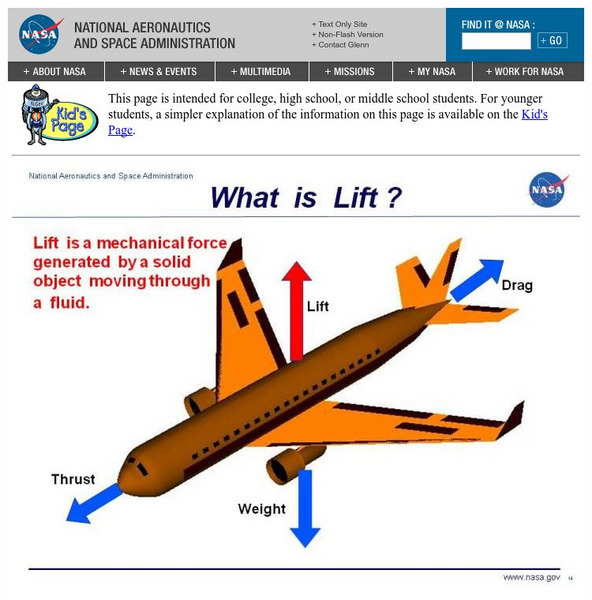
Nasa: Flight: What Is Lift?
An explanation of the role lift plays in airplane take-off and flight.

NASA
Nasa: What Is Lift?
A description of how lift is a mechanical force that requires a fluid moving through a solid object and a change in velocity.
Science Buddies
Science Buddies: Which Wing Design Creates the Greatest Lift?
Airplane wings do not all have the same design. With this Science Buddies project you can design your own wings to see which offers the greatest lift. The Science Buddies project ideas are set up consistently beginning with an abstract,...
TeachEngineering
Teach Engineering: May the Force Be With You: Lift
Students revisit Bernoulli's Principle (Lesson 1 of the Airplanes unit) and learn how engineers use this principle to design airplane wings. Airplane wings create lift by changing the pressure of the air around it. This is the first of...
TeachEngineering
Teach Engineering: Up, Up and Away! Airplanes
The airplanes unit begins with a lesson on how airplanes create lift, which involves a discussion of air pressure and how wings use Bernoulli's Principle to change air pressure. Following the lessons on lift, students explore the other...
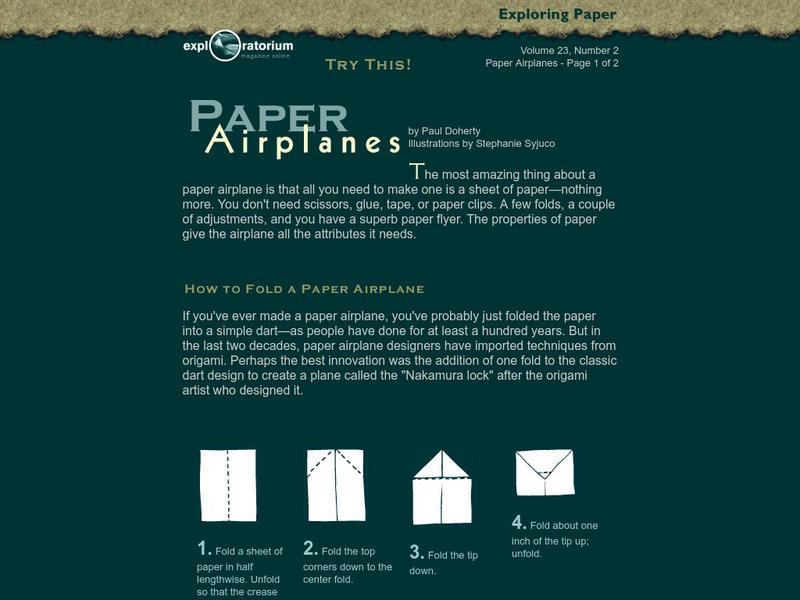
Exploratorium
Exploratorium: Paper Airplanes
At this site students will use origami to fold a paper airplane that fly better than the classic dart airplane.
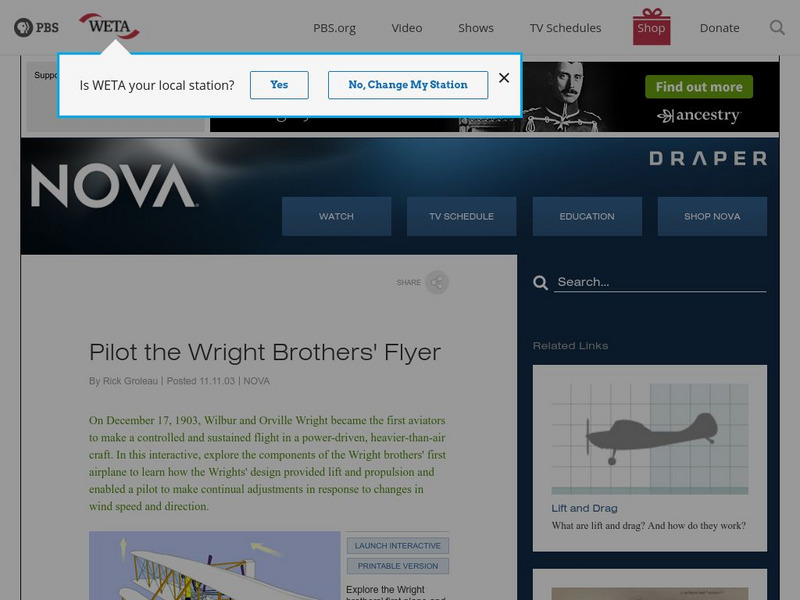
PBS
Pbs Nova: Pilot the Wright Brothers' Flyer
In this interactive, find out how the Wright brothers' design of the first flyer provided lift and speed, and allowed the pilot to make adjustments in response to changes in wind speed and direction.
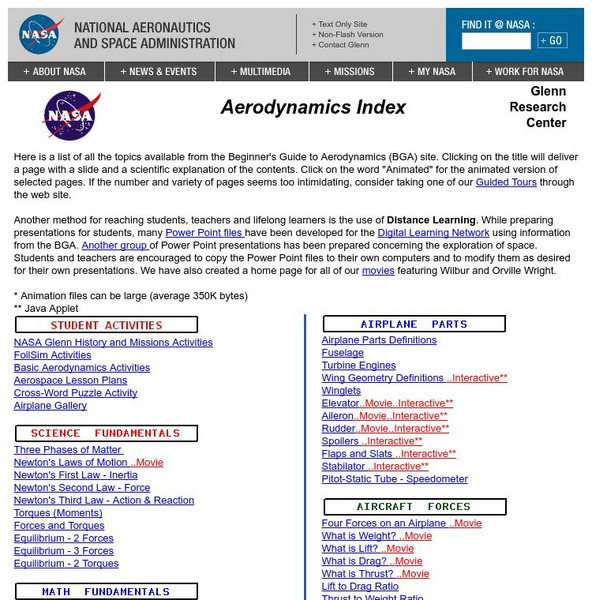
NASA
Nasa: Aerodynamics Index
Are you studying or teaching Aerodynamics? This page acts as an index to all the terminology related to this topic. Clicking on any title will open a page with a colored slide and a scientific explanation of the contents. Animated,...
Smithsonian Institution
National Air and Space Museum: Wright Brothers: Engineering the Wright Way
Great interactive provides students with an opportunity to use engineering skills to design and test airplane wings based on the methods of the Wright brothers. Step into the workshop and design a set of wings that will fly your glider...
Science Buddies
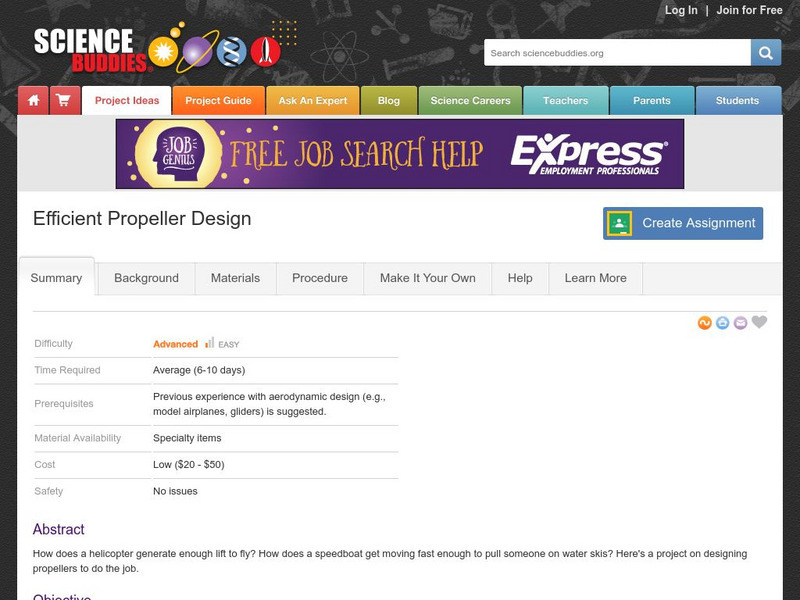
Science Buddies: Efficient Propeller Design
There's a lot to understand about the simple propeller to see how it affects lift and thrust in an airplane or helicopter. This Science Buddies project gives you lots of ideas on how to change the design of the propeller to achieve...
Technovation
Curiosity Machine: Challenges: Engineer an Airfoil
Do you know how an airplane flys? Use this challenge to learn about flight by building a wing that can generate lift from a fan while carrying weight. Find details about the challenge, tips, and a lesson plan on this site. Also, students...
Science Buddies
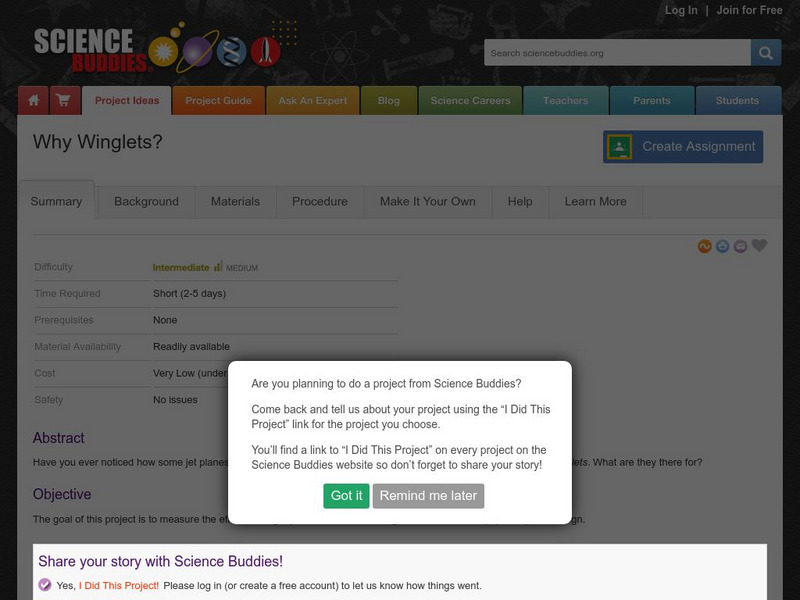
Science Buddies: Why Winglets?
Make a paper airplane and experiment with adding winglets to it to test its performance. The Science Buddies project ideas are set up consistently beginning with an abstract, objective, and introduction, followed by a section on terms,...
The Franklin Institute
Franklin Institute Online: Working Wing
This lesson plan provides a brief demonstration of how airplane wings lift a heavy airplane into the air. This activity would be an excellent example of how science and technology have positively impacted our lives. Prediction and...
Smithsonian Institution
Smithsonian Learning Lab: How Things Fly: Activities for Teaching Flight
Through this series of three lessons, students will gain an understanding of the basics of flight. They will learn about the four forces of flight and practice their observation skills through a number of fun experiments. In addition,...
NASA
Nasa: Model Rocket
A comprehensive tutorial that depicts the parts of a subsystem within a system. This tutorial dissects a rocket and explains how each part is integral to its actual functioning. Excellent links to otherresources dealing with aerodynamics.

NASA
Nasa: Beginner's Guide to Aerodynamics
Includes exhaustive information and a wealth of activities pertaining to aerodynamics and the physics of flight.
Michigan Reach Out
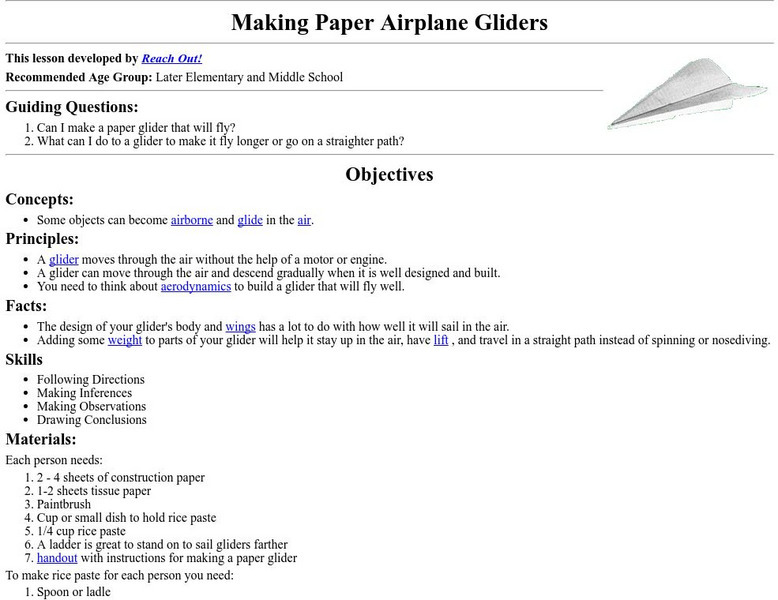
Reach Out!: Making Paper Airplane Gliders
Students learn the fundamentals of aerodynamics in this hands-on exercise.
Other
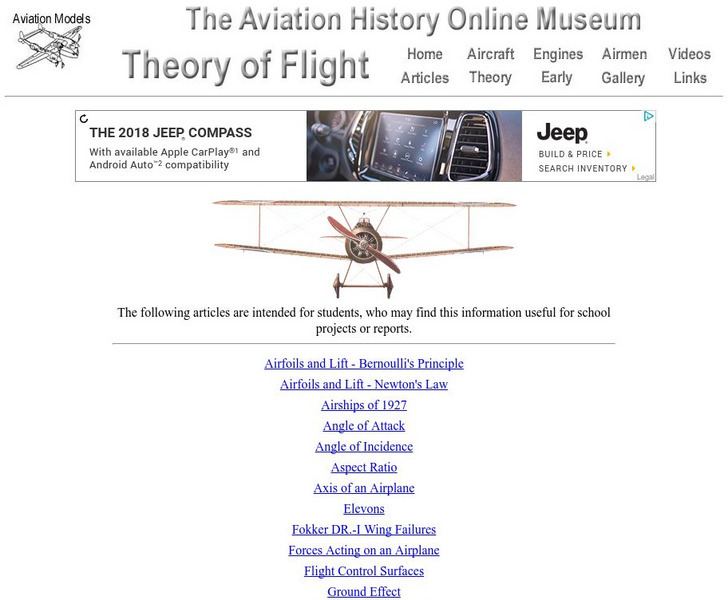
Aviation Internet Group: Aviation Theory
Collection of articles ranging from basic to advanced on aerodynamics theory.
Science and Mathematics Initiative for Learning Enhancement (SMILE)
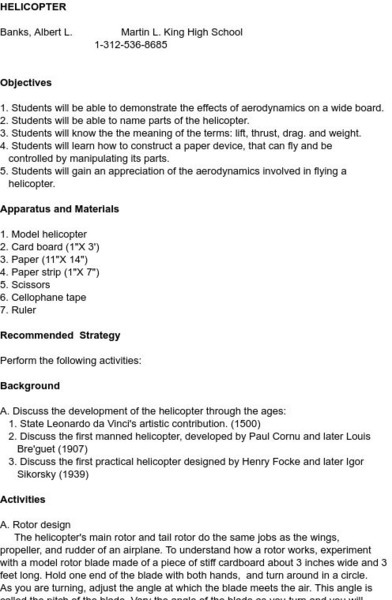
Smile: Lab Activity: Helicopter
The Illinois Institute of Technology lets learners investigate the aerodynamics of a helicopter, focusing on the variables which effect the lift, thrust, drag, and weight. Students investigate the effects of aerodynamics on a wide board.
Science and Mathematics Initiative for Learning Enhancement (SMILE)
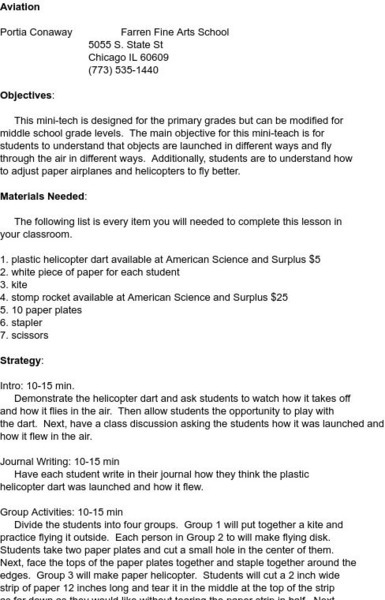
Smile: Lab Activity: Aviation
This site from the Illinois Institute of Technology provides a student lab activity in which the flight of a paper airplane is investigated and studied. Designed for primary grades, but easily adaptable for junior high learners.
MadSci Network
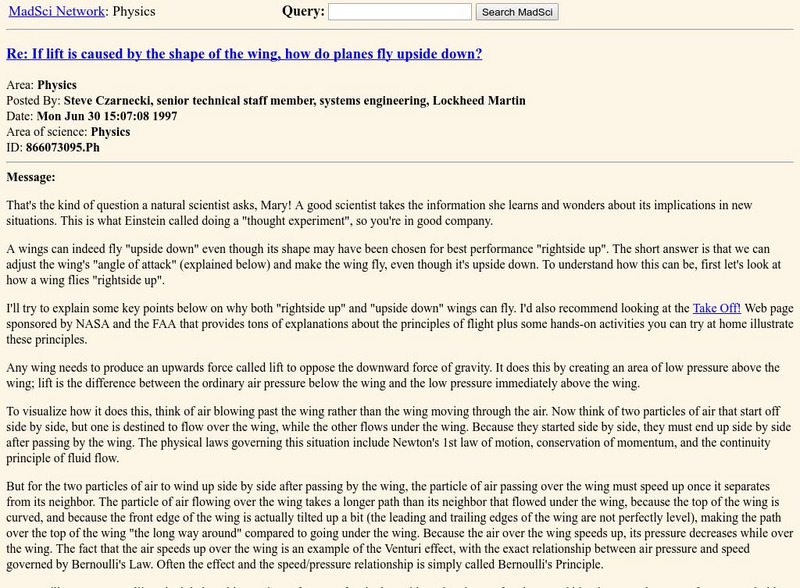
Mad Scientist Network: How Do Planes Fly Upside Down?
Question and answer regarding the physics principles that apply to a plane flying upside down.

Michigan Reach Out
Nasa Trc: Flying Wing
In this lesson plan students can make a flying wing and trouble-shoot until the wing glides smoothly.