Hi, what do you want to do?





Illustrative Mathematics
Illustrative Mathematics: G Mg Tilt of Earth's Axis and the Four Seasons
This task gives students a chance to explore the effects of the Earth's tilt and rotation using a simple geometric model of Earth-Sun interaction that shows why the seasons occur. Aligns with G-MG.A.1.

NASA
Planetary Geodynamics Laboratory: Ocean Tides and the Earth's Rotation
An explanation of the effect that the tides have on the Earth's rotation.

E-learning for Kids
E Learning for Kids: Mediterranean Sea: How Long Does It Take for the Earth to Go Around the Sun?
Learn about the Earth's revolution and rotation in this module.

TED Talks
Ted: Ted Ed: Reasons for the Seasons
Why do some regions experience full-time heat while others are reckoning with frigid temperatures and snow? And why are the seasons reversed in the two hemispheres? Rebecca Kaplan explains how the shape of the Earth's orbit around the...
Science Buddies
Science Buddies: A Matter of Degrees: Tilt of Earth's Axis Affects the Seasons
In this science fair project, use a globe and a heat lamp to investigate how the angle of the Sun affects global warming. This project includes the objective, background questions, a list of all the materials you'll need, and the...
Harvard University
Eyes on the Sky, Feet on the Ground: The Earth's Rotation
Plenty of cool activities about the Earth's rotation can be found here, such as tracing shadows, observing shadows during different times of the day, and tracking the sun's path in the sky to understand the rotation of the earth.

TED Talks
Ted: Ted Ed: What if the Earth Stopped Spinning?
Michael Stevens of Vsauce looks at what would happen if the Earth stopped spinning. He also explores how we construct time as a function of the Earth's rotation and why atomic clocks are so precise. [9:44]
Beacon Learning Center
Beacon Learning Center: As the Earth Turns
Join Audrey on her learning adventure as she discovers how the Earth's rotation causes day and night.
Scholastic
Scholastic: Study Jams! Science: Our Solar System: A Day on Earth
A video and a short multiple-choice quiz on how the Earth's tilt on its axis, its rotation, and its orbit around the Sun give us a 24-hour day, a 365-day year, and our seasons.
Khan Academy
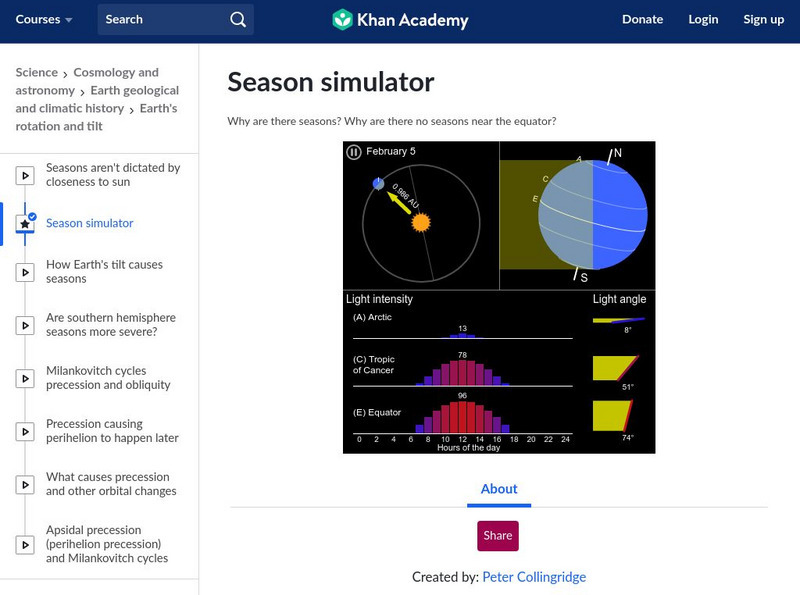
Khan Academy: Cosmology and Astronomy: Season Simulator
This season simulator takes Earth through an entire year cycle allowing the viewer to observe the tilt of the Earth and the intensity of the sunlight.
![Mc Rel: Earth's Axis [Pdf] Unknown Type](https://static.lp.lexp.cloud/images/attachment_defaults/resource/large/FPO-knovation.png "Mc Rel: Earth's Axis [Pdf] Unknown Type")
McREL International
Mc Rel: Earth's Axis [Pdf]
A worksheet regarding the path of the Sun around the Earth and the Earth's tilt on its axis.
CK-12 Foundation
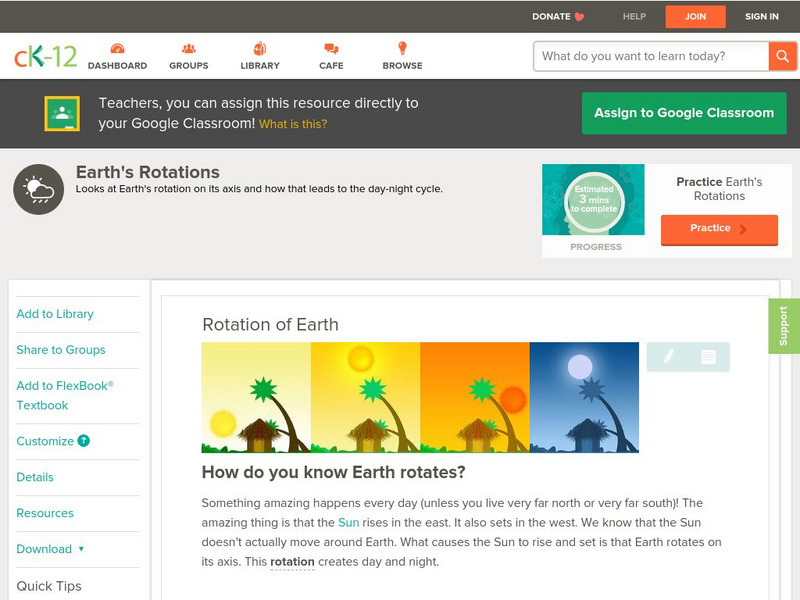
Ck 12: Earth Science: Rotation of Earth
[Free Registration/Login may be required to access all resource tools.] How the Earth rotates around its axis.
CK-12 Foundation
Ck 12: Earth Science: Rotation of Earth
[Free Registration/Login may be required to access all resource tools.] How the Earth rotates around its axis.
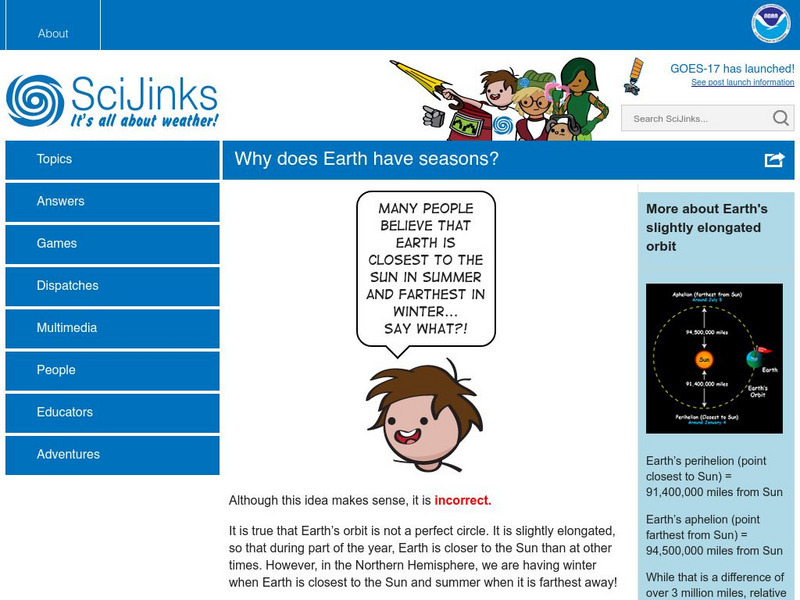
NASA
National Aeronautics and Space Administration: Scijinks: Seasons
An explanation about the rotation of the Earth and why the Earth has seasons.

CK-12 Foundation
Ck 12: Plix: Seasons: Earth's Orbit
[Free Registration/Login Required] An interactive animation demonstrating the Earth's tilted axis and how that causes the seasons. Also included on the site is a short quiz on the topic.

Science Education Resource Center at Carleton College
Serc: Mn Step: Rotation of the Earth
A KWL activity combined with a demonstration model. Young scholars record their ideas and questions about why we have day and night. They then shine a flashlight (the Sun) on a rotating styrofoam ball (the Earth) and record their...
Science Buddies
Science Buddies: Project Ideas: The Reasons for the Seasons
In this astronomy science fair project, investigate how the earth's axial tilt creates seasons. The Science Buddies project ideas are set up consistently beginning with an abstract, objective, and introduction, followed by a section on...

E-learning for Kids
E Learning for Kids: Science: Atlantic Ocean: Day and Night
This module explores day and night. Learn about what we see during the day and night and why we see what we see.
Utah Education Network
Uen: Trb 3:1: Investigation 4: Day and Night
A lesson for third graders in which they learn about the rotation of the Earth on its axis and how this movement creates day and night. They also examine the orbit of the moon about the Earth and the Earth's orbit around the sun.
NASA
Nasa: Imagine the Universe: Speed of Earth's Rotation
Presents an informative answer to the question "What is the speed of the turning of the Earth?"
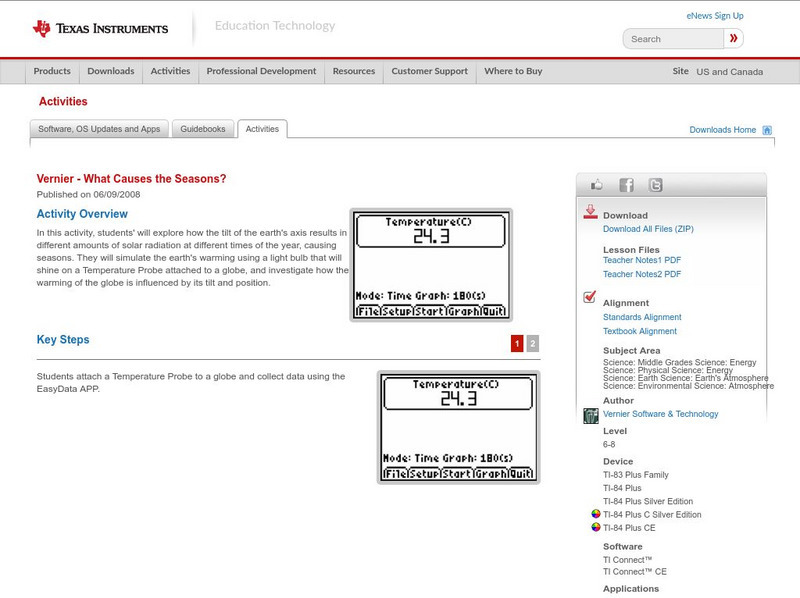
Texas Instruments
Texas Instruments: What Causes the Seasons?
In this activity, students' will explore how the tilt of the earth's axis results in different amounts of solar radiation at different times of the year, causing seasons. They will simulate the earth's warming using a light bulb that...

Other
Astro Methods: Earth's Nutation Visualized
Nutation is a small cyclical motion superimposed upon the steady 26,000-year precession of the Earth's axis of rotation. It is mainly caused by the gravitational effect of the 18.6-year rotation period of the Moon's orbit. The main...
CK-12 Foundation
Ck 12: Fifth Grade Science: Earth Science: Earth's Motion in Space
[Free Registration/Login may be required to access all resource tools.] Discusses the motion of the Earth with its day and night cycle, the seasons, the Earth's orbit around the Sun, and its year-long cycle.
Science Education Resource Center at Carleton College
Serc: Modeling Earth's Seasons by Rotation and Revolution
In this lesson, students will discuss, define, and demonstrate the Earth's rotation and revolution around the sun in a counterclockwise position. They will be able to predict seasons based on the amount of light that hits the Earth.