Hi, what do you want to do?





Wikimedia
Wikipedia: The Black Hole
This site examines the black hole as an object in astrophysics. Delve into this comprehensive resource that covers this concept from its history, to qualitative physics, the reality of black holes, mathematical physics and more.
NASA
Nasa: Imagine the Universe: Black Holes
Learn what black holes are and the myths that surround them.
California Institute of Technology
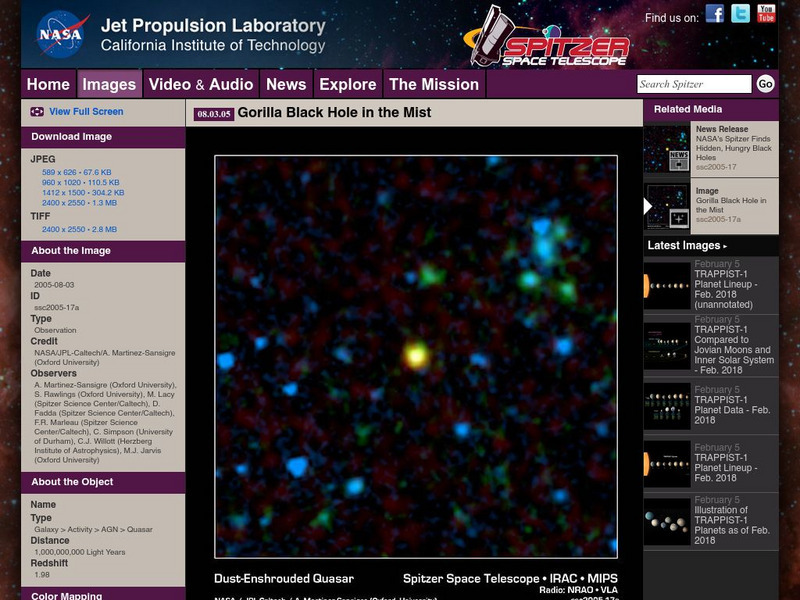
Spitzer Science Center: Gorilla Black Hole in the Mist
The Gorilla Black Hole in the Mist image features a distant galaxy with a quasar and a super-massive black hole. In addition, a detailed textual overview explains various specifics of the picture.
NASA
Nasa: Imagine the Universe: Active Galaxies and Quasars
Describes quasars as being classified within the category of an active galaxy. A description of the emergence of high-energy. Definitions of key words are provided.gamma-ray quasars as an important component of the gamma-ray sky.
NASA
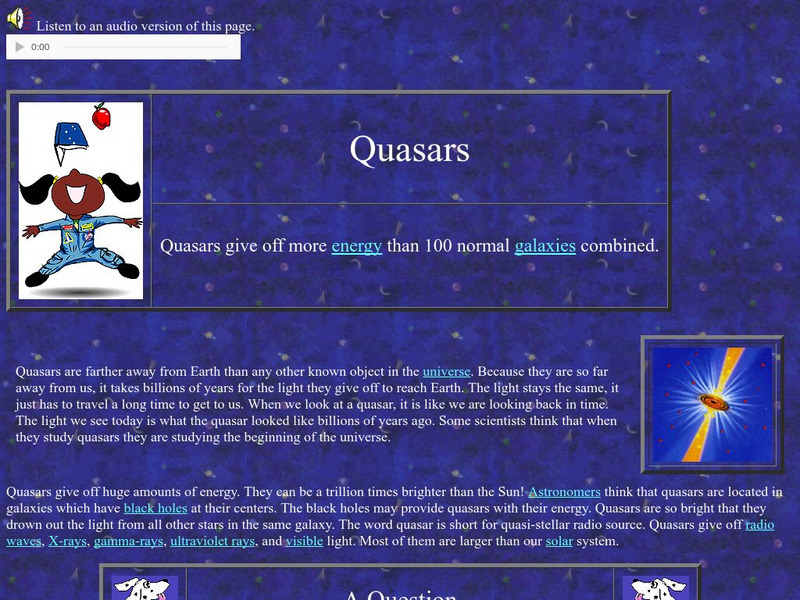
Nasa Star Child: Quasars (Level 1)
Learn why quasars are the brightest things in the universe. Vocabulary words linked to a glossary of terms and a printable version are available.

NASA
Nasa Star Child: Comets (Level 1)
Younger students learn why comets race through the sky as well as related vocabulary words and meanings.
Other
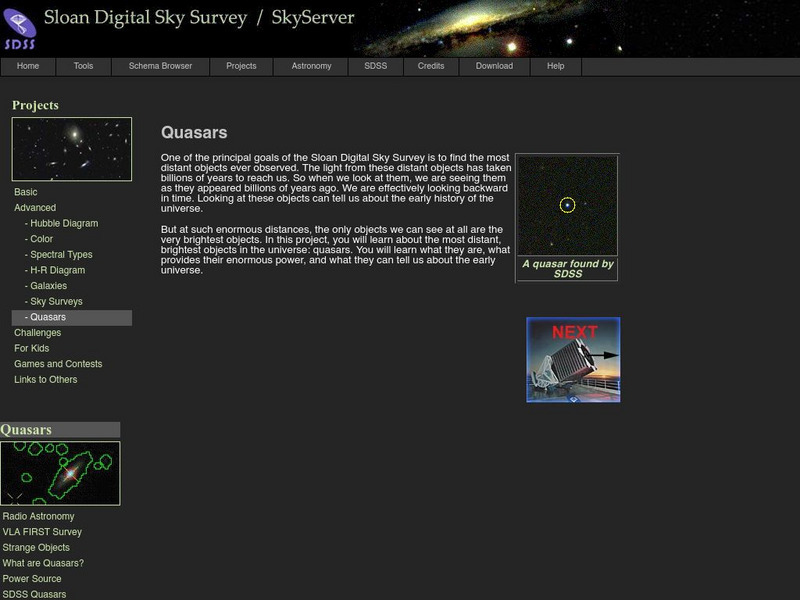
Sky Server: Quasars
This site from the SkyServer offers information as to what quasars are as well as provides links to strange objects, radio astronomy and research. This is a great sit to check out the brief but factual information on the subject.

NASA
Nasa Star Child: Star Child
StarChild from NASA defines and describes the Solar System in a simple and easy-to-understand manner. The website is broken down into two versions for the student, grade school and junior high.
University of Wisconsin
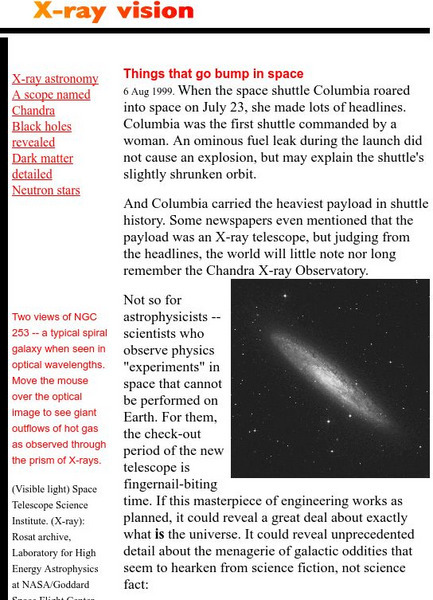
The Why Files: Things That Go Bump in Space
Contains an introduction to x-ray astronomy, describing how x-rays are being used by scientists to learn about the universe. Also contains links to sites describing black holes, dark matter, neutron stars, and how they are investigated...