Hi, what do you want to do?






University of Groningen
American History: Documents: The Marshall Cases:cherokee Nation v. Georgia
This resource presents the text of John Marshall's majority opinion in the Supreme Court case, Cherokee Nation v. Georgia.

Other
The Cherokee Nation
Official site of the Cherokee Nation of Oklahoma. Contains current news, events, online language class, tribal genealogy, and more.
Other
Sweet Briar College: Rebuilding the Cherokee Nation
This 1993 speech by Cherokee Chief Wilma Mankiller, in which she calls for Native Americans to rebuild the Cherokee Nation, also thoroughly describes the history of her tribe in America.
PBS
Pbs the West: Cherokee Nation v. Georgia
The critically acclaimed PBS series, "The West," presents a copy of the order given by Chief Justice John Marshall when the bill to seize the Cherokee lands came to court.
PBS
Pbs Learning Media: Cherokee Nation: Virtual Field Trip
An in-depth look at the lives of the Cherokee Indians, from their first encounters with Europeans to events, such as the Gold Rush and the signing of the Indian Removal Act by Andrew Jackson, that led to their forced relocation to Indian...
PBS
Pbs: Virtual Field Trip: Cherokee Nation
The Cherokee Nation virtual field trip affords an in-depth look at the lives of the Cherokee Indians, from their first encounters with Europeans to events, such as the Gold Rush and the signing of the Indian Removal Act by Andrew...
Other
Cherokee Nation: Inter Tribal Council of the Five Civilized Tribes
The Inter-Tribal Council of the Five Civilized Tribes represents the Cherokee, the Chickasaw, the Choctaw, the Muscogee, and the Seminole Nations in ensuring their rights are respected by the United States government. It also promotes...
University of California
History Project: The Removal of the Cherokee Nation
Middle school lesson plan attempts to answer the question of the government's Indian policy and its relationship to the Cherokee. Students will use sections from 26 primary source documents to aid in the research.

Stephen Byrne
History for Kids: Cherokee Nation
History of the Cherokee Nation presents an overview of the Native Americans who were living in present day Georgia, Tennessee, and the western part of the Carolinas. Teacher resources are included.
University of California
History Project: The Removal of the Cherokee Nation
Lesson on U.S. white-Indian relations and domestic Removal Policy in which students read and analyze primary source material then, based on questions provided, write a narrative evaluating the events leading to the Trail of Tears.
Curated OER
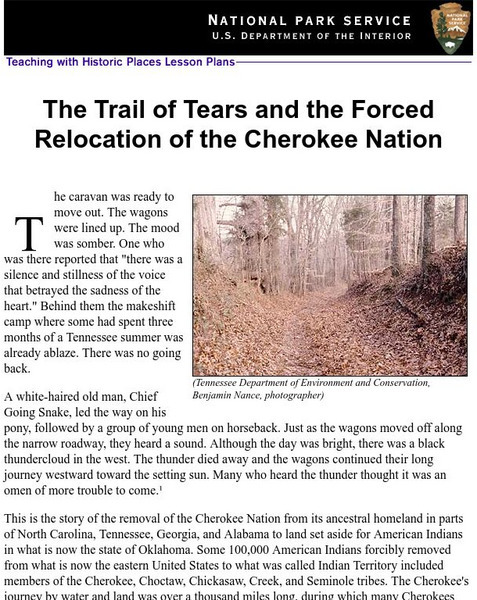
National Park Service: Trail of Tears and Forced Relocation of Cherokee
This Teaching With Historic Places unit, designed for students in grades 5-12 is about the conflict between American settlers and the Cherokee Nation. Students will outline events leading up to the forced relocation of the Cherokee in...
Digital History
Digital History: Georgia and the Cherokees [Pdf]
The Cherokee nation was one of the Five Civilized Tribes in the Southeast. Read about their achievements, the state of Georgia's attempts to annex their lands, and ultimately, President Andrew Jackson's Indian Removal Bill. [pdf]
Other
About North Georgia: Cherokee History in Georgia
About North Georgia provides an account that thoroughly tracks the history of the Cherokee Indians in Georgia and their influence on Georgia's culture.
Other
Teach Us History: Indian Removal
A lesson unit that looks at the efforts of the Cherokee Nation in Georgia between 1817 and 1827 to establish their own system of governance and to keep their lands from being ceded. Even though the Supreme Court ultimately ruled in their...

Georgia Humanities Council and the University of Georgia Press.
New Georgia Encyclopedia: Cherokee Removal
Reveals the story behind the forced removal of the Cherokee Indians from Georgia to Indian Territory in present day Oklahoma.
Digital Public Library of America
Dpla: Cherokee Removal and the Trail of Tears
The sources in this primary set uses documents, images, and music to reveal the story of Cherokee removal, which is part of a larger story known as the Trail of Tears. Includes teaching guide.
Civil War Home
Home of the American Civil War: The Cherokee and the Confederacy
This site contains the document in which the Cherokee pledge their allegiance to the Confederacy.
Oklahoma State University
Oklahoma Historical Society: An Early Account of the Cherokees [Pdf]
A first-hand account describing the Cherokee Native Americans during the period of their displacement (1837) from the southern United States to Oklahoma Indian territory.
Oklahoma State University
Oklahoma Historical Society: History of the Cherokees, 1830 1846 [Pdf]
A good scholarly article which examines the economic situation of the Cherokee both in their territory in Georgia and their new lands in Oklahoma. The article provides a good discussion on their early history after their removal to...
Curated OER
National Park Service: Trail of Tears National Historic Trail
National Park Services provides an overview of the Trail of Tears, a nine state wide stretch of America the Cherokee Indians were pushed across by the Federal government in the 1830s.
Other
Trail of Tears Assoc: The Story Trail of Tears National Historic Trail
Follow the early history of Native American and European contact in America. As more settlers moved west, a law was passed to relocate the Cherokee from Arkansas. The routes they followed and the cruelties they suffered came to be known...

Smithsonian Institution
Smithsonian: National Museum of the American Indian: The Removal Act
At first, the Trail of Tears only described the Cherokee removal of 1838. Later it included the removals of all southeastern Native nations. Take a close look at these primary sources from the Smithsonian which include a reproduction of...
Curated OER
Wikipedia: National Historic Landmarks in Oklahoma: Cherokee National Capitol
Capitol of the Cherokee nation from 1869 to 1907, when Oklahoma became a state.
Curated OER
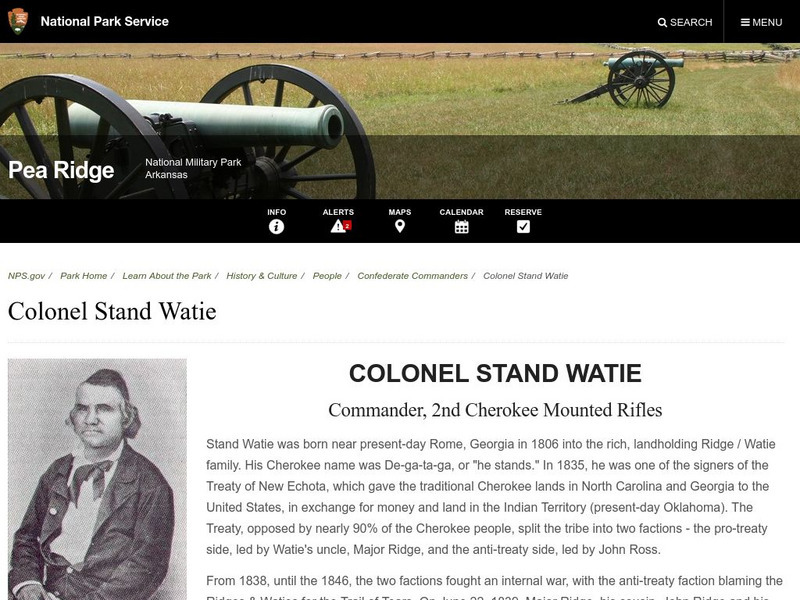
National Park Service: Pea Ridge National Military Park: Colonel Stand Watie
A brief biography of Stand Watie, who was a colonel at the Battle of Pea Ridge, but became the only Native American general in the Civil War. From the National Park Service.