Hi, what do you want to do?





CK-12 Foundation
Ck 12: Concepts, Classification and States of Matter
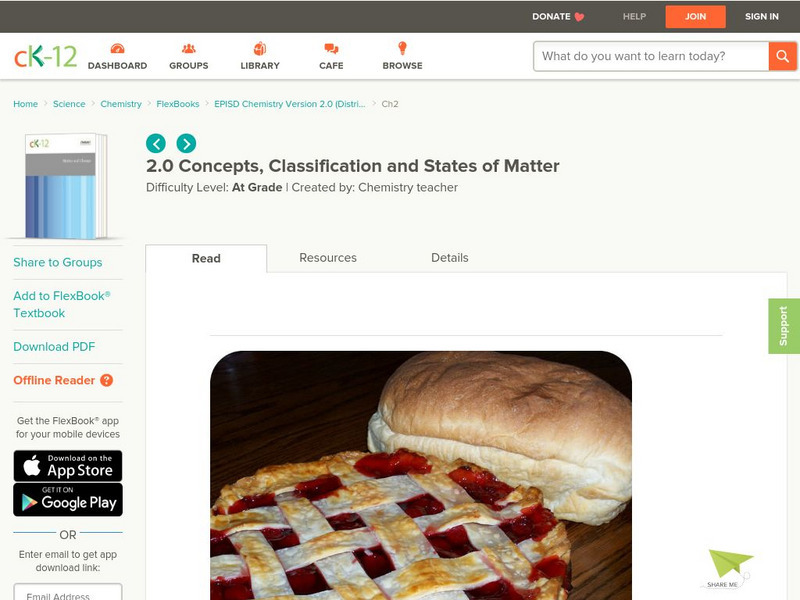
[Free Registration/Login may be required to access all resource tools.] Freshly baked bread and cherry pie are two delicious parts of any meal. What happens to the ingredients that go into the bread and the pie as they are heated in the...

McCracken County Schools
Mc Cracken County Schools: Structure and Properties of Matter
This expansive unit created by McCracken County Schools focuses on the properties of matter. Multiple lessons focus on the concept of scientific modeling of matter particles. Included in this unit are various activities to reach all...

Vision Learning
Vision Learning: Three States of Matter
Concept animation compares molecular movement of solids, liquids, and gases.
Alabama Learning Exchange
Alex: Freezing Things: States of Matter
The class will go back over the Power Point presentation on chemical and physical properties. The teacher will then conduct numerous liquid nitrogen demos. This lesson is used early in the Chemistry course. The students love it. This...
Other
Science4us: States of Matter
In the States of Matter module, students further explore the concept that anything on earth that has mass and takes up space is matter. This exercise introduces students to solids, liquids and gases, the three most common states of...

Wikimedia
Wikipedia: Materia
Explore the concept of matter in this Spanish-language encyclopedia entry. This site features the properties of matter, the Law of Conservation of Matter, and other important features of matter.
Texas Instruments
Texas Instruments: Matter
This Study Card stack enables students to review the concepts of matter, the kinds and classes of mater including atoms, molecules, elements, compounds, pure substance, and mixtures.
University of Texas at Austin
The University of Texas Mc Donald Observatory: Color of Stars
Students observe colors in the flame of a burning candle to explore connections between matter, light, color, and temperature, the basic concepts of matter and energy.
Utah Education Network
Uen: Physical Changes
Second graders explore the concept of law of conservation of mass.

TED Talks
Ted: Ted Ed: String Theory and the Hidden Structures of the Universe
What is everything made of? Thus far, we can break everything in the universe down to a few very small elementary particles. But they fit into strange patterns that are not understood. Clifford Johnson describes these ideas, along with...
CK-12 Foundation
Ck 12: The Mole Concept
[Free Registration/Login may be required to access all resource tools.] In the following online tutorial students will identify three methods for measuring the amount of matter in a sample. They will define the mole and its relationship...
American Chemical Society
Middle School Chemistry: Changing State: Melting
Discover the concept that energy transfer and molecular motion cause the change in state from a solid to a liquid. Also compare state changes of water to the state changes of other substances.
University of Pennsylvania
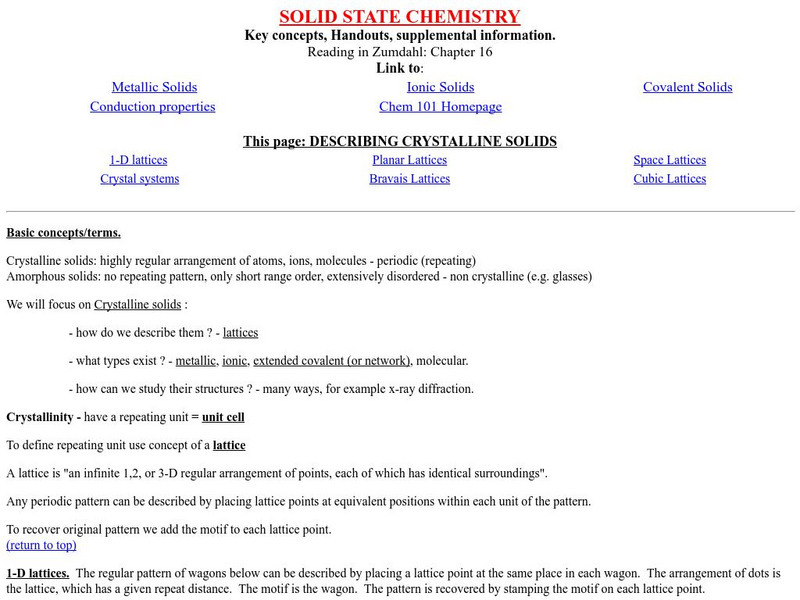
University of Pennsylvania: Solid State Chemistry: Describing Crystalline Solids
This site contains in-depth information on crystalline solids. Includes basic concepts, pictures, learning graphs, and useful tools.
Other
Your Therapy Source: Personal Space Bubble What Is It and Why Does It Matter?
This resource discusses how to directly instruct the concept of personal space.

Open Curriculum
Open Curriculum: The Ray Model of Light
Students will understand the concept of the ray model of light and how light interacts with matter and reflections.

Open Curriculum
Open Curriculum: Conservation of Angular Momentum
Students learn the concept of angular momentum of objects in two dimensions and how rotational motion is determined.

Open Curriculum
Open Curriculum: Work: The Transfer of Mechanical Energy
Read this illustrated article to help you understand the concept of work in regards to the transfer of mechanical energy.
Other
King's Centre for Visualization in Science: Scientific Models
A series of interactive applets use scientific models to teach some basic concepts of matter, including states of matter and physical and chemical changes.
TeachEngineering
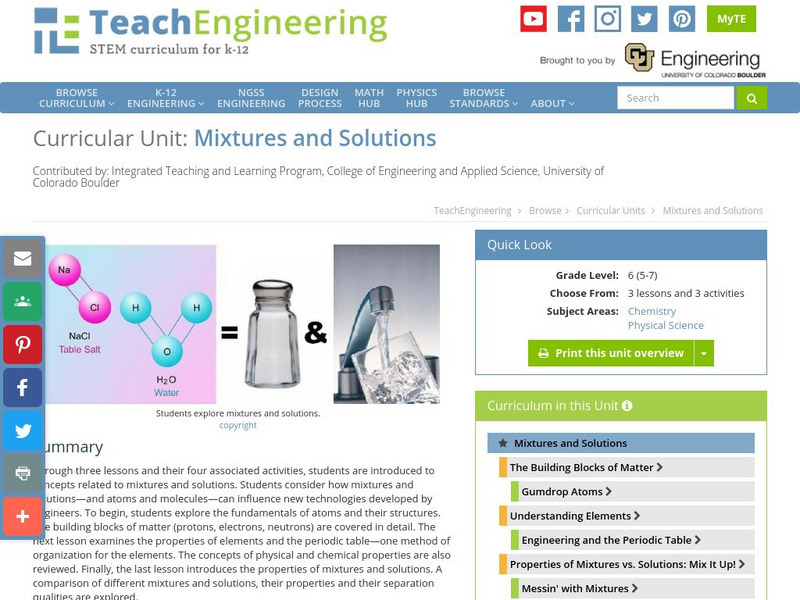
Teach Engineering: Mixtures and Solutions
This unit covers introductory concepts of mixtures and solutions. Students think about how mixtures and solutions, and atoms and molecules can influence new technologies developed by engineers. The first lesson explores the fundamentals...

Open Curriculum
Open Curriculum: Light and Matter: Images by Reflection
An illustrated article helps students understand the concept of reflection of images and the differences in reflection with different optical devices.
University of Texas at Austin
The University of Texas Mc Donald Observatory: Spectroscope
This lesson guides students to build a spectroscope, use it as a tool, and interpret their observations by applying concepts of conservation of energy and properties of matter.
The Association of the British Pharmaceutical Industry
Abpi: Solids, Liquids, and Gases
Students learn about solids, liquids, and gases in this interactive slide show. Animated cartoon characters explain concepts having to do with properties of matter. A self-checking quiz follows the lesson.
TeachEngineering
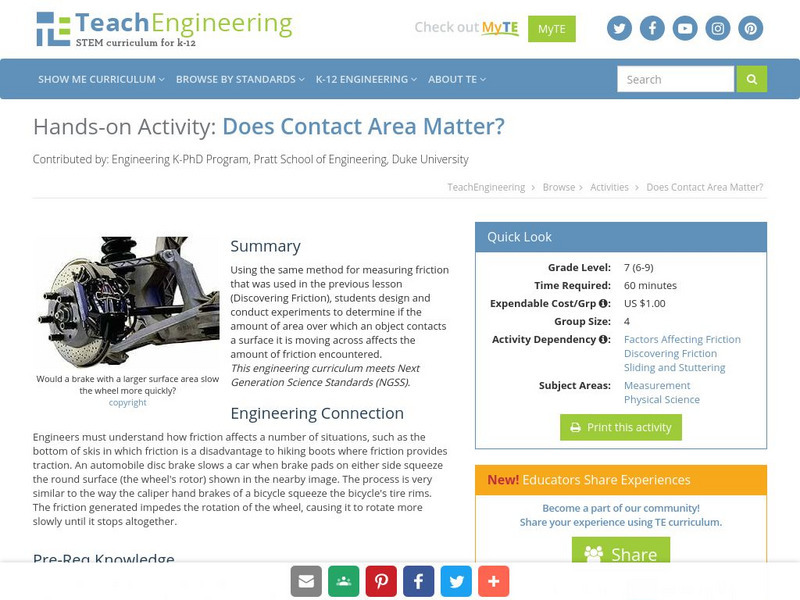
Teach Engineering: Does Contact Area Matter?
Using the same method for measuring friction that was used in the previous lesson (Discovering Friction), students design and conduct an experiment to determine if the amount of area over which an object contacts a surface it is moving...