Hi, what do you want to do?






PBS
Pbs Learning Media: Covalent Bonding
This interactive activity from ChemThink takes a closer look at a covalent bond: how it is formed and how the sharing of two electrons can keep atoms together.
Concord Consortium
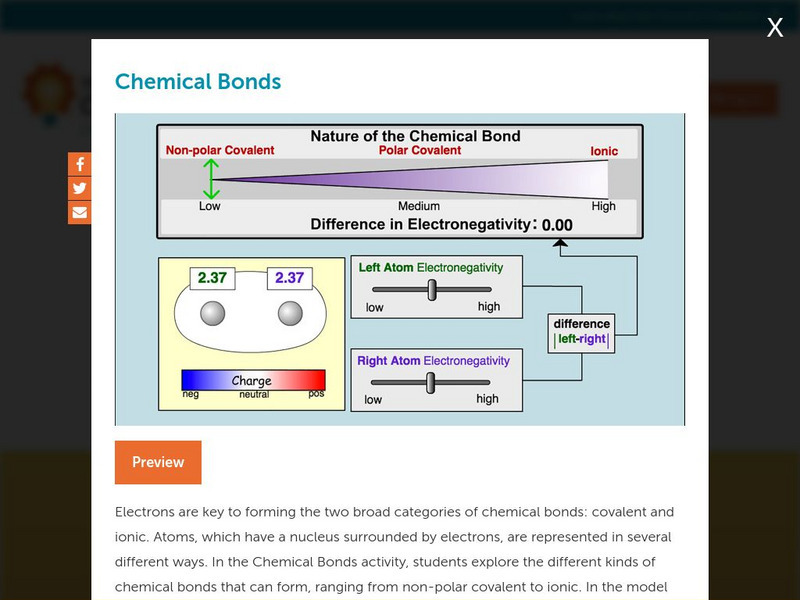
Concord Consortium: Stem Resources: Chemical Bonds
By working through this web-based activity, students differentiate between ionic, non-polar covalent, and polar covalent bonds. Specifically, distinctions are made between bonding types based on orbital shapes and electronegativity...
Texas Instruments
Texas Instruments: Covalent Bonding
This activity helps students review basic covalent nomenclature.
American Chemical Society
Middle School Chemistry: Energy Levels, Electrons, Ionic Bonding
Students discover that ionic bonding occurs when electrons are transferred from one atom to the other and not shared as in covalent bonding.
PBS
Pbs Learning Media: Chemical Bonds
This interactive activity developed for Teachers' Domain demonstrates how attractive forces between atoms create chemical bonds, resulting in the formation of molecules and compounds.
Science Education Resource Center at Carleton College
Serc: Introducing Ionic Bonds: How Does the String Hold Together?
This inquiry activity introduces chemical and ionic bonds and allows students to investigate an unknown situation, make hypotheses, and share data.
University of Arizona
University of Arizona: Biochemistry
Problem sets, tutorials, and activities related to biochemistry.

Science Education Resource Center at Carleton College
Serc: Valence Electrons and Trends in the Periodic Table
This instructor led activity will produce a partially filled periodic table that contains electron-dot models for the first twenty elements in the appropriate boxes. It will be used as a visual tool for young scholars to connect concepts...
PBS
Pbs Learning Media: The Structure of Metal
In this interactive activity from the NOVA Web site, animations explain different aspects of the properties of metal.
Science Education Resource Center at Carleton College
Serc: Loopy Lewis Dot Diagrams
Students will use colored fruit loops to organize valence electrons to develop and master the basics of Lewis Dot diagrams. They will develop processing and critical thinking skills and also master a model of bonding.
Museum of Science
The Atom's Family: Mighty Molecules
In this activity, students construct models of molecules using marshmallows and gum drops.
PBS
Pbs Learning Media: Molecular Shapes
In this interactive activity from ChemThink, students will learn about covalent molecules and how the VSEPR theory predicts the shapes of covalently-bonded molecules.
American Chemical Society
Middle School Chemistry: Lesson Plans: Water Is a Polar Molecule
Students develop their own water molecule model to help them understand the idea that water has a slight positive charge at one end of the molecule and a slight negative charge at the other.