Hi, what do you want to do?





University of Arizona
The Biology Project: Human Biology: Blackett Family Dna Activity 2
In this activity, students learn the concepts and techniques behind DNA profiling of the national DNA databank. Students will then have the opportunity to collect and interpret actual STR data, and to answer one or more questions.

University of Arizona
The Biology Project: Human Biology: Blackett Family Dna Activity
Family studies are a good way to learn about DNA profiling and RFLP analysis because students can follow the inheritance of DNA markers from one generation to the next. Students have the opportunity to do this in this activity.
University of Utah
University of Utah: Dna Mircoarray Virtual Lab
This interactive lab will enhance learning about DNA by virtually translating a gene.

Other
Biotechnology and Biological Sciences Research Council: Discovering Dna
This 51-page booklet is an excellent collection of activities for 11- to 14-year-olds to teach them about DNA. It was designed by Dr Sue Assinder, a molecular geneticist.
TED Talks
Ted: Ted Ed: What Happens When Your Dna Is Damaged?
The DNA in just one of your cells gets damaged tens of thousands of times per day. Because DNA provides the blueprint for the proteins your cells need to function, this damage can cause serious issues-including cancer. Fortunately, your...
TeachEngineering
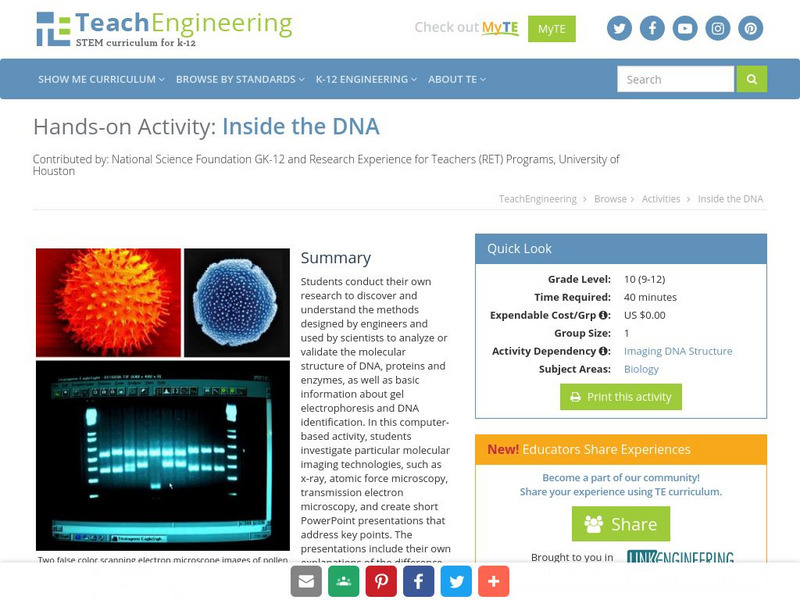
Teach Engineering: Inside the Dna
Students conduct their own research to discover and understand the methods designed by engineers and used by scientists to analyze or validate the molecular structure of DNA, proteins and enzymes, as well as basic information about gel...
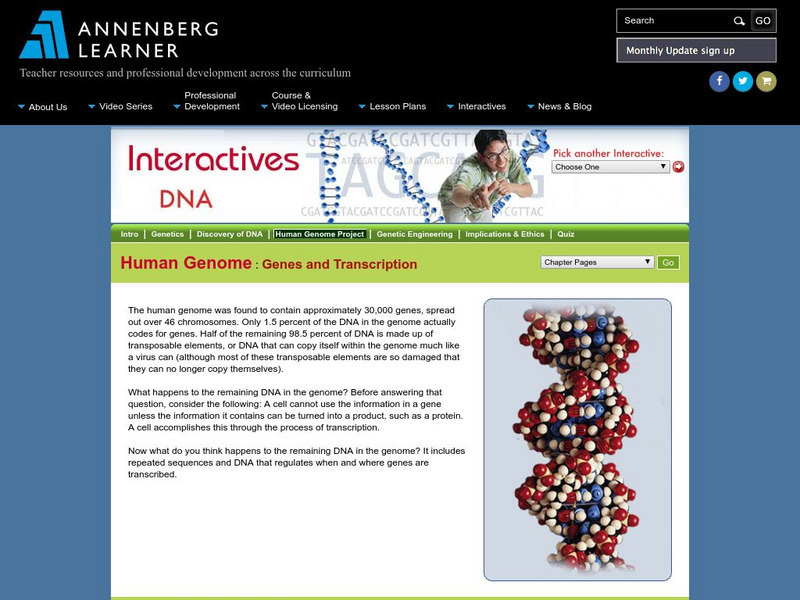
Annenberg Foundation
Annenberg Learner: Interactives Dna: Human Genome: Genes and Transcription
A learning module where students can learn about the structure and function of DNA. Interactive activities will explore DNA transcription.
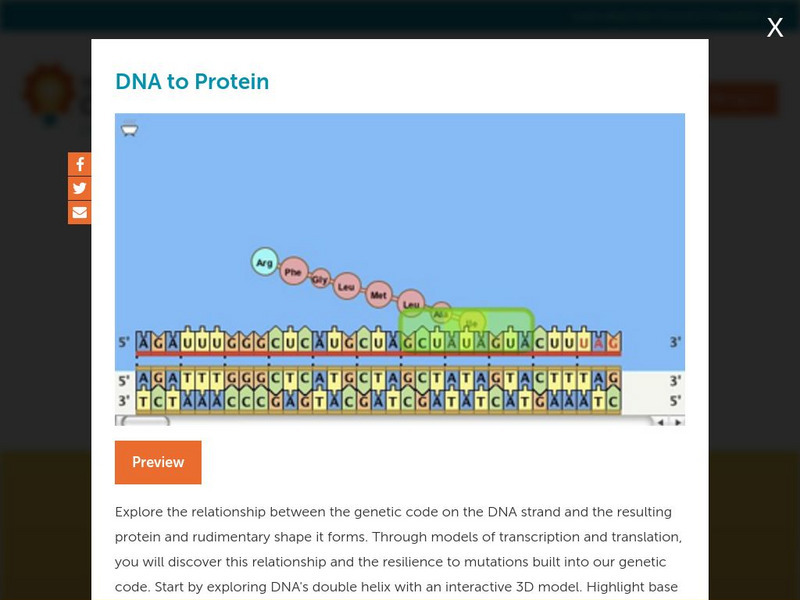
Concord Consortium
Concord Consortium: Stem Resources: Dna to Protein
Investigate how the genetic code on a DNA strands controls what protein is produced with this collection of animations and 3D models. Explore an interactive 3D model of the double helix, watch an animation of transcription, and see the...
Genome British Columbia
Genome British Columbia: Dna Code Bracelet
For this activity, students create a bracelet of beads using DNA code. Each letter represents an amino acid and is three beads. The authors suggest that even younger students would enjoy this activity, although older students will...
Genome British Columbia
Genome British Columbia: Dna Extraction Experiment
This experiment uses simple, easy to obtain ingredients. It involves extracting DNA from fruit. It is recommended for grades 8 and up but is good for demonstration purposes with younger students.
University of Utah
University of Utah: Genetic Science Learning Center: Dna and Verdicts
Part of a site on genetics, this page explores DNA as a forensic science. Explains how and why DNA can be used to convict or acquit a criminal from wrongdoing using forensic DNA analysis. Teacher resources too.
Genome British Columbia
Genome British Columbia: Edible Dna [Pdf]
Students use food (licorice and marshmallows or fruit) to make models of DNA.
PBS
Pbs Learning Media: Dna Structure and Function: Decoding Watson
Discover how the structure of DNA relates to its hereditary function in these videos from the American Masters film Decoding Watson. The first video, "DNA Structure and Function," [2:07] can be used with all middle and high school...
Carnegie Mellon University
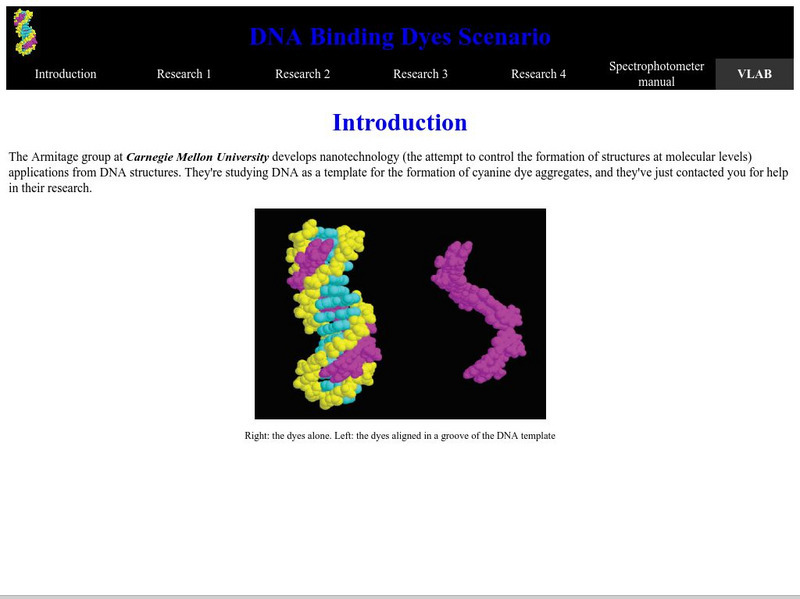
Chem Collective: Dna Binding Dyes Scenario
This activity explores the equilibrium of dyes that self-assemble into DNA templates. Students use knowledge of equilibrium and quantitative spectroscopy to explore different dyes that bind selectively to DNA molecules. In this activity,...
Chemistry Collective
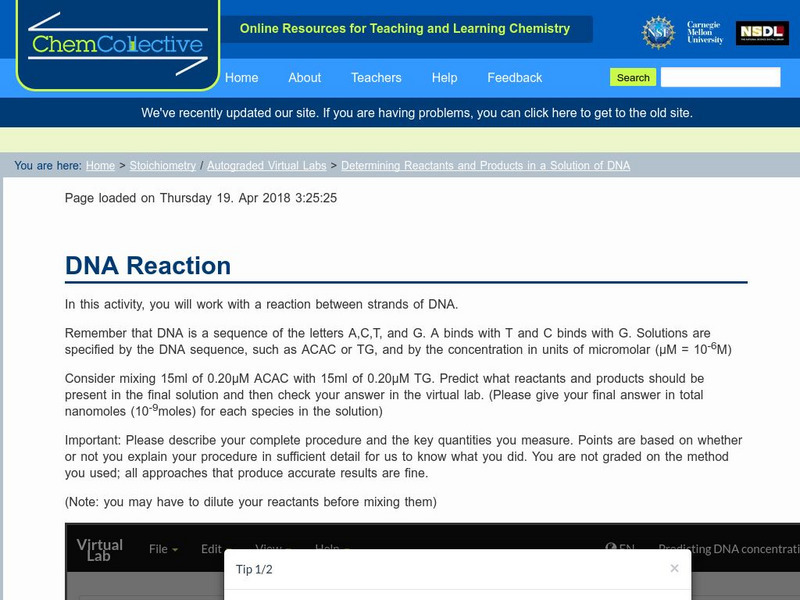
Chem Collective: Determining Reactants and Products in a Solution of Dna
In this limiting reagents problem, students are given specific concentrations of DNA solutions and are asked to predict what products and reactants will remain after a specific volumes are mixed and reaction has occurred.
University of Arizona
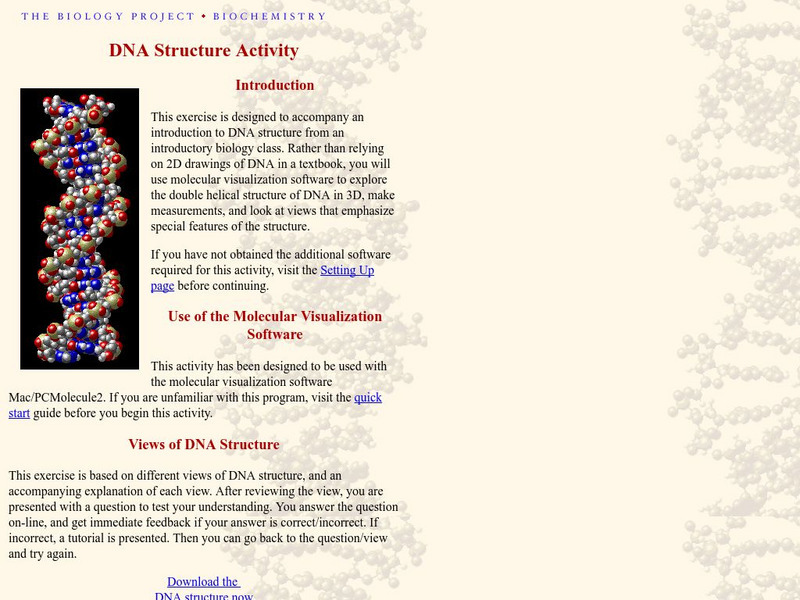
University of Arizona/dna Structure Activity
Activity based on the use of computer enhanced molecular images, might be worth the effort for an AP class to try.
Museum of Science
Museum of Science and Industry: Online Science: Activities: Extract Dna
An experiment where students remove DNA from strawberries using everyday materials.
Other
Beautiful Chemistry: Beautiful Structures: Dna Nanostructures
DNA is the molecule of life, as life's secrets are encoded in DNA. In this interactive activity. we see the famous double helix structure of DNA.
Science Education Resource Center at Carleton College
Serc: Genomic Dna Isolation: From Human Cheek Cells
In this lab activity students isolate genomic DNA from their own cheek cells. They then remove the DNA from those cheek cells through a laboratory process.
Texas Instruments
Texas Instruments: Numb3 Rs: Dna Sequencing Alignment
Based off of the hit television show NUMB3RS, this lesson has student find the level of similarity between two different-length strands of DNA. Connections to Djikstra's algorithm are mentioned, and students learn more to follow careful...
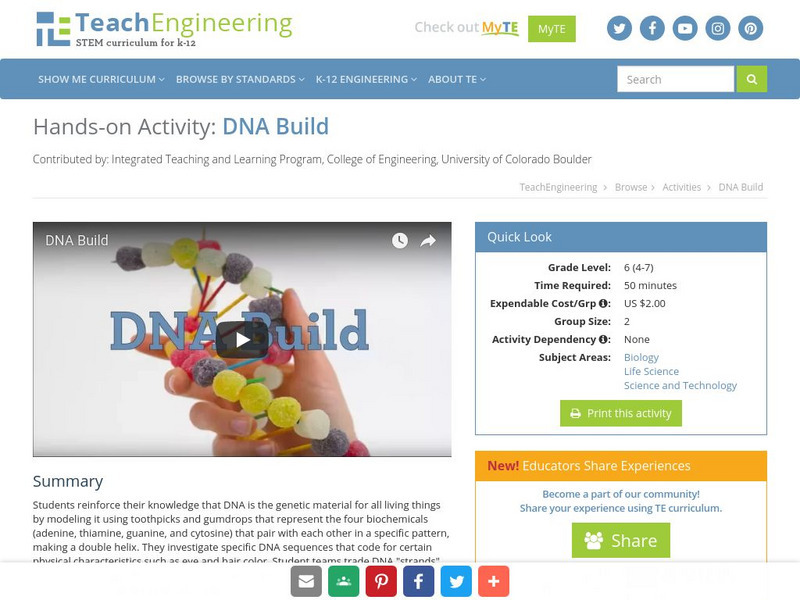
TeachEngineering
Teach Engineering: Dna Build
Students reinforce their knowledge that DNA is the genetic material for all living things by modeling it using toothpicks and gumdrops that represent the four biochemicals (adenine, thiamine, guanine, and cytosine) that pair with each...
TeachEngineering
Teach Engineering: Dna Forensics and Color Pigments
Students perform DNA forensics using food coloring to enhance their understanding of DNA fingerprinting, restriction enzymes, genotyping and DNA gel electrophoresis. They place small drops of different food coloring ("water-based paint")...
National Health Museum
Access Excellence: Dna Sequencing (Dry Lab Activity)
This site is an advanced level hands-on activity to explain the Di-deoxy sequencing of DNA.
National Health Museum
Access Excellence: Genes, Dna, and Mutations
A good Access Excellence site with an introduction to the processes of transcription and translation, leading to a student modeling activity.