Hi, what do you want to do?





CK-12 Foundation
Ck 12: Life Science: Domains of Life
[Free Registration/Login may be required to access all resource tools.] Humans are in the same domain as trees and algae. What could they possibly have in common? It is the location of their DNA inside their cells. Their cells all have a...

BiologyWise
Biology Wise: Three Domains of Life
Describes the characteristics of Archaea, Bacteria, and Eukarya, the three domains of life.
Other
Tree of Life for the Fossil Record
This tree of life is presented in an outline format. The outline is arranged in a hierarchical manner organized from the largest group (domain) to the smallest group (class). This interactive outline includes pictures of fossils and...
Estrella Mountain Community College
Online Biology Book: Biological Diversity: Bacteria and Archaeans
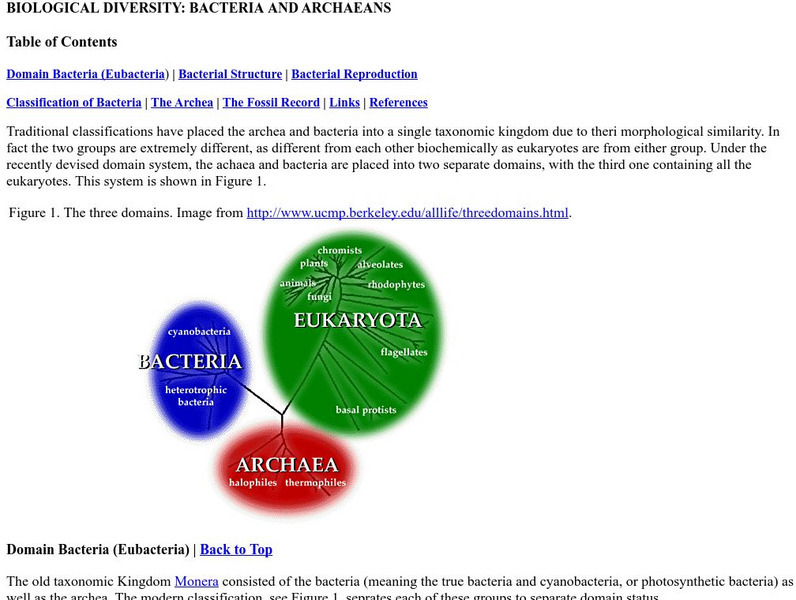
In this online biology textbook, learn about the two prokaryotic domains of life, which include eubacteria and acrhaebacteria.
PBS
Pbs Learning Media: Living and Nonliving
What is it that distinguishes a living organism from a nonliving object? This collection of images presents examples that aren't as clear-cut as one might think, enticing students to question the meaning of life.
PBS
Pbs Learning Media: Jaws and Teeth of Mammals
This image from Biology by Kenneth R. Miller and Joseph Levine illustrates the relationship between structure and function by comparing the jaws and teeth of two animals with very different ways of life: the wolf and the horse.
PBS
Pbs Learning Media: Ingredients for Life: Water
This video segment adapted from NOVA goes on a whimsical journey in search of life forms thriving in extreme conditions on Earth and in outer space. Animations show ice on Jupiter's moon, Europa, and signs that water once existed on...
University of California
Ucmp: The Biosphere: Life on Earth
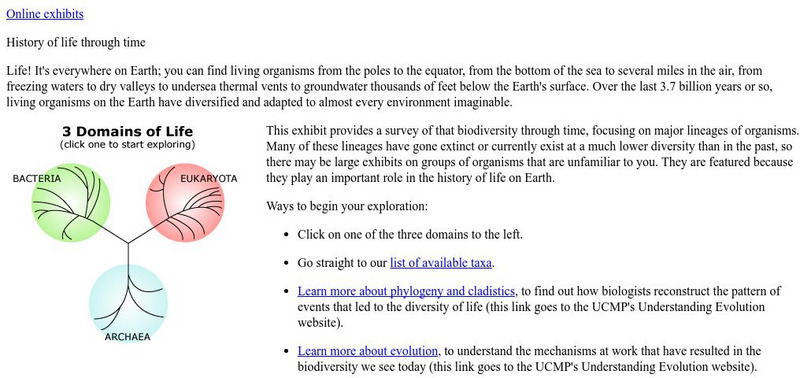
Learn about different forms of life that coexist with us on Earth. This Berkeley article provides links to brief write-ups on the three domains of living organisms: Eukaryota, Bacteria, and Archaea.
PBS
Pbs Learning Media: Migration of the Monarch
This video segment from NOVA: "The Mystery of Animal Pathfinders" explores the migratorial exploits of monarch butterflies. [4:39]
PBS
Pbs Learning Media: The Power of Touch
This video segment explores the role of touch in the development of young animals, including humans. Footage from NOVA: "Mystery of the Senses: Touch." [2:57]
PBS
Pbs Learning Media: The Sense of Taste
This video segment explores the sense of taste in humans -- why we have it, and what happens when we lose it. Footage from NOVA: "Mystery of the Senses: Taste." Includes background reading material and discussion questions. [4:18]
Mocomi & Anibrain Digital Technologies
Mocomi: Major Domains of the Earth Biosphere
Learn about the biosphere, when it originated, how life sustains itself, and what processes occur.
Georgia Department of Education
Ga Virtual Learning: Ap Biology: Diversity
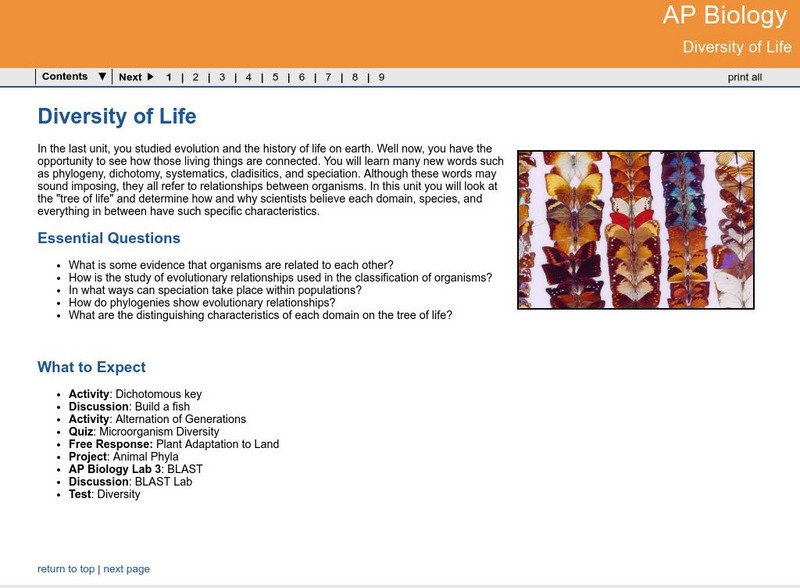
An online course with interactive activities and learning exercises give students the opportunity to look at the tree of life and to determine how and why scientists believe each domain, species, and everything in between have such...
PBS
Pbs Learning Media: Journey Into Dna
Travel deep into the human body to see exactly where your DNA resides. From the NOVA: Cracking the Code of Life Web site.
PBS
Pbs Learning Media: Life's Grand Design
Are nature's complex forms evidence of "intelligent design"? In this Evolution essay, biologist Kenneth Miller explains how the processes of evolution account for complex structures such as the human eye.
PBS
Pbs Learning Media: Einstein: A Timeline of His Life
This illustrated timeline from the NOVA Web site follows Albert Einstein's life, including 1905, his "Miracle Year," during which he developed his Special Theory of Relativity and the equation, E=mc2.
PBS
Pbs Learning Media: Galileo: Timeline of His Life
This illustrated timeline from the NOVA Web site turns back the clock to the late 1500's to relive the dramatic life of one of the world's most renowned scientists.
PBS
Pbs Learning Media: Scent of an Alewife
This video segment from NOVA: "Sea Behind the Dunes" tracks the return of spawning alewife fish from the open ocean back to the freshwater streams and ponds where they were born. [3:34]
CK-12 Foundation
Ck 12: Episd: Linnaean Classification
[Free Registration/Login may be required to access all resource tools.] An introduction to the method of biological classification developed by Carl Linnaean.
PBS
Pbs Learning Media: Disappearance of the Bees What's the Impact?
The disappearance of bees will have tremendous impact upon the way we live according to scientists in this segment from Nature.
PBS
Pbs Learning Media: Function of Fever
Fevers are a sign of infection, but they may also be part of the cure. This drawing illustrates Matthew Kluger's lizard study, which supports the notion that fever can be beneficial.
PBS
Pbs Learning Media: Snapshot of u.s. Energy Use
This video segment adapted from NOVA/FRONTLINE looks at American energy consumption and the resulting production of greenhouse gases. [4:59]
PBS
Pbs Learning Media: Gallery of Cells
While all cells have a great deal in common, there is no end to the variation among them. These images provide a sense of the wondrous diversity found in the world of cells.