Hi, what do you want to do?






Other
New Mexico Genealogical Society: Early Spanish Exploration of the Southwest
This site describes the early Spanish exploration and beginning of colonization in what we know today as New Mexico.
OpenStax
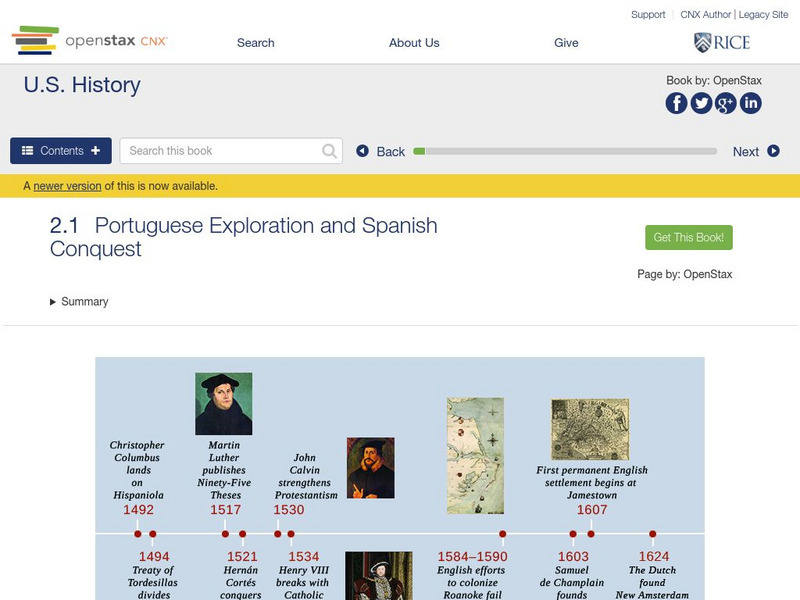
Open Stax: Portuguese Exploration and Spanish Conquest
From a chapter on "Early Globalization: The Atlantic World, 1492-1650," this section describes the importance of Portuguese exploration of the Atlantic and Spanish exploration of the Americas.
Texas State Historical Association
Texas State Historical Association: Early European Exploration and Development
A chronological timeline of early European exploration and development in Texas spanning from the sixteenth to the nineteenth centuries.
Other
Houston Institute for Culture: Early Texas History: Spanish Exploration
Read about Cabeza de Vaca, one of the first Europeans to extensively explore Texas after an accidental landing at Galveston Island.
Library of Congress
Loc: Parallel Histories: Exploration and Early Settlement
Read about the Spanish conquistadors who explored what was to become Spanish America. Included are links to digital collections from the Library of Congress and the National Library of Spain.
Other
Historical Museum of Southern Florida : The Spanish Colonization of Florida
Follow the early colonization of Florida. From explorers to settlers to trades between England and Spain, and finally to the emergence of the American territory of Florida.
Mariners' Museum and Park
Mariners' Museum: The Ages of Exploration: Age of Discovery
This Age of Discovery page presents naval artifacts and explorers of the 15th century to the early 17th century. It looks at European explorers who journeyed to North and South America, the search for the Northwest Passage, and...
Library of Congress
Loc: Parallel Histories: Alvar Nunez Cabeza De Vaca
A brief description of de Vaca's accomplishments with links to information, original illustration and documents, and timeline on Spanish exploration.

University of Groningen
American History: Outlines: The Literature of Exploration
Had history taken a different turn, the United States easily could have been a part of the great Spanish or French overseas empires. Its present inhabitants might speak Spanish and form one nation with Mexico, or speak French and be...
University of South Florida
Exploring Florida: Jean Ribault Claims Florida for France
Find out about the early French settlements in Florida and South Carolina and the Spanish treatment of the settlers there. The site map will take you to many other articles about Florida history.

Library of Congress
Loc: Drake's West Indian Voyage 1588 1589
While studying early American exploration students will view the maps Sir Francis Drake used in his attacks of the Spanish in the New World. This lesson plan makes use of primary source maps to help the students learn how to analyze them.
Walled Lake Consolidated Schools
Loon Lake Elementary School: Vasco Nunez De Balboa
A brief biography of Spanish conquistador, Vasco Nunez de Balboa, featuring his successful voyage for Spain to the western coast of South America in the early sixteenth century.

Library of Congress
Loc: Exploring the Early Americas: Competition for Empire
Part of a larger site, the primary sources here deal with the competition among the European countries in establishing a foothold in the New World.
McGraw Hill
Mc Graw Hill Higher Education: Old World, New Worlds
This article from McGraw-Hill Higher Education discusses European exploration in the late 1400s and 1500s and its impact on English colonization hundreds of years later.
Independence Hall Association
U.s. History: Britain in the New World: Early Ventures Fail
Several Englishmen sailed to the New World to establish settlements for England. Read about Sir Humphrey Gilbert's fate, and the mystery of Roanoke. Follow Sir Francis Drake on the map as he circumnavigated the globe.

Texas State Library and Archives Commission
Texas State Library and Archives Commission: Mission Possible: Spy a Book! (Bilingual Resources)
Explore history, culture, adventures, spies, secret codes, and mysteries through this collection literary activities and resources. Includes poems, clip art, and ideas for crafts.
University of Groningen
American History: Outlines: The First Europeans
The first Europeans to arrive in North America -- at least the first for whom there is solid evidence -- were Norse, traveling west from Greenland, where Erik the Red had founded a settlement around the year 985. In 1001 his son Leif is...
Scholastic
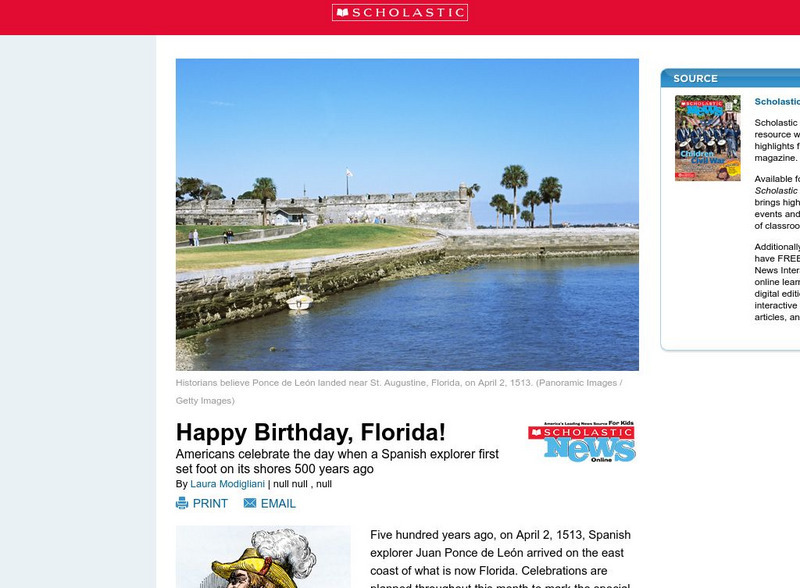
Scholastic News: Week of 4 8 13: Happy Birthday, Florida!
In 2013, Florida turned 500 years old. Read about its discovery and early history.
Independence Hall Association
U.s. History: Britain in the New World
Read about the early English explorers and find out why other countries did much more early exploration than the British. The defeat of the Spanish Armada turned the tide. Discover why the English now could explore and plant colonies.
Library of Congress
Loc: Parallel Histories: Atlantic and Gulf Coasts Settlements
Insights, primary and secondary source material and timeline on early exploration and Spanish settlement of Florida and the Atlantic Coast.
University of Groningen
American History: Essays: Europe's North South Conflicts Reach the Americas
An essay detailing early English and French exploration and settlement in the New World to challenge Spanish control.
Houghton Mifflin Harcourt
Harcourt: Biographies: Robert De La Salle
Read about one of the early French explorer and his ambitions in the New World. (In Spanish)
National Humanities Center
National Humanities Center: Toolbox Library: First Arrivals, American Beginnings: 1492 1690
Numerous visual images of artifacts from English settlements at Jamestown and at Plymouth, and from Spanish settlement in Hispaniola, and three original accounts of each of those early settlements that describe the possibilities and the...
National Humanities Center
National Humanities Center: Toolbox Library: Hardships, American Beginnings: 1492 1690
Three English, a French, and a Spanish primary account of the staggering losses, misery, and deprivation that characterized early European settlement as well as the resilience needed to overcome those challenges.