Hi, what do you want to do?






New York State Education Department
TASC Transition Curriculum: Workshop 11
You'll C-E-R a difference in classroom achievement after using a helpful lesson. Designed for economics, civics, government, and US history classes, participants practice using the CER model to craft arguments about primary and secondary...

EngageNY
TASC Transition Curriculum: Workshop 12
How can opinions slant facts? Workshop participants learn how to examine primary and secondary sources and identify the author's point of view. They also examine how visual art impacts the meaning and rhetoric of sources. Full of...

New York State Education Department
TASC Transition Curriculum: Workshop 5
Are video games sports? Pupils investigate this question as well as various nonfiction selections to learn more about claims and the support that defines them. All of the selections mimic the rigor on state tests and encourage close...

EngageNY
TASC Transition Curriculum: Workshop 15
What do a cheetah, Audi commercial, and air have in common? They're all topics of an engaging inquiry-based, hands-on workshop for educators about background knowledge, reading strategies, the CER model, and argumentative writing. The...

EngageNY
TASC Transition Curriculum: Workshop 6
Is a college education necessary for success in today's world? The class investigates the question, along with others at the end of the sixth workshop in a 15-part series. The lesson has four parts with multiple activities and...
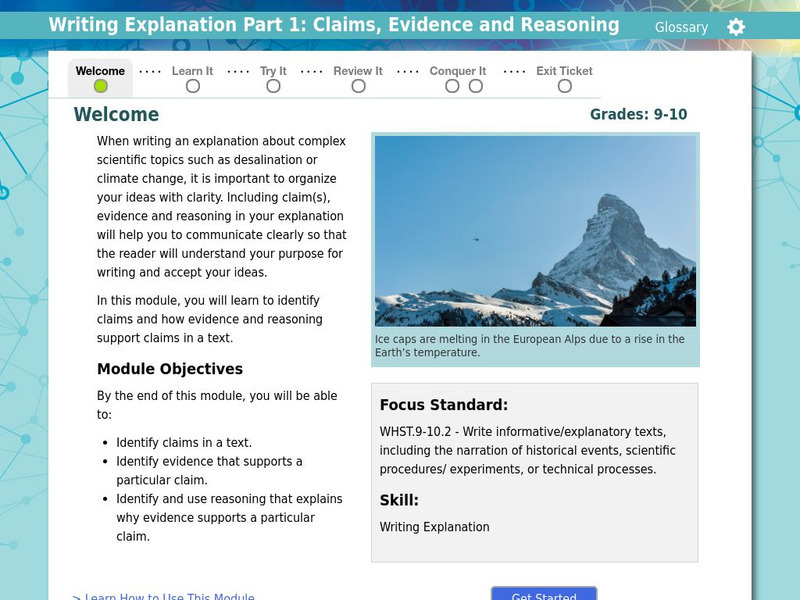
Thinkport Education
Thinkport: Writing Explanation Part 1: Claims, Evidence and Reasoning
In this module, students will explore how claims, evidence and reasoning are used to write an effective explanation. Students will read an article that addresses the question of whether climate change is now confirmed after record high...
Thinkport Education
Thinkport: Writing Explanation Part 1: Claims, Evidence and Reasoning
In this module, students will explore how claims, evidence and reasoning are used to write an effective explanation. Students will read an article that addresses the question, "Should Congress consider comprehensive climate change laws?"
Tom Richey
Slide Share: Claim Evidence and Reasoning
A slideshow with twelve slides about reading or writing an argument, analyzing the claim and looking at how it is supported with observation, evidence, and reasoning.
Sophia Learning
Sophia: Critical Reading as a Learning Strategy
This tutorial focuses on critical reading using a downloadable PowerPoint presentation, "Critical Reading 101," which includes separating fact from opinion, 6 propaganda techniques, and 6 common fallacies in reasoning. Also provided is...

Other
Learning Design Collaborative: Cer: Claim, Evidence, and Reasoning
Students write a scientific claim that is backed up by evidence and supported by scientific reasoning. Base your answer on your reading of a data table.
Texas Education Agency
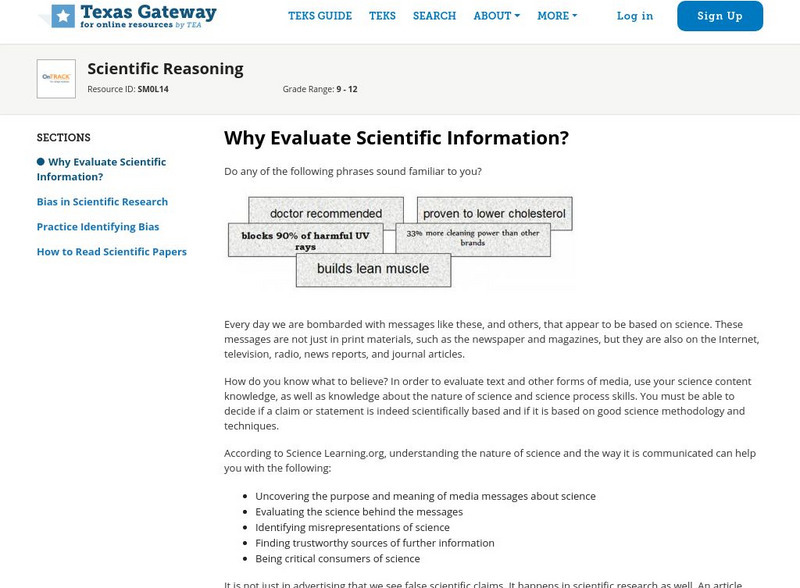
Texas Gateway: Scientific Reasoning
Do you know how to evaluate scientific information? This tutorial reviews how to read and interpret scientific research and information.

Lumen Learning
Lumen: Critical Reading: Logic and Structure
This lesson plan focuses on structure and logic including types and purposes of essays, organizational patterns, argumentative writing, and logic and fallacies.

Khan Academy
Khan Academy: Primordial and Complex Jealousy
Read and analyze the passage "Primordial and Complex Jealousy" and complete the related six-question quiz.

Khan Academy
Khan Academy: Conditional Reasoning and Logical Equivalence
How do we recognize logically equivalent conditional statements? Conditional (or "if-then") statements can be difficult to master, but your confidence and fluency on the LSAT will improve significantly if you can recognize the various...
Texas Education Agency
Texas Gateway: Differentiate Among Empirical, Anecdotal, and Logical Evidence
[Accessible by TX Educators. Free Registration/Login Required] In this lesson, students will learn about three types of evidence that writers often rely on: logical, empirical, and anecdotal. It will also help you distinguish among these...
Texas Education Agency
Texas Gateway: Distinguishing Between Inductive and Deductive Reasoning
This lesson focuses on distinguishing between inductive and deductive reasoning. Sometimes it's difficult to separate these two types of reasoning because we often use them together; drawing conclusions in inductive reasoning is likely...
Palomar Community College District
Palomar College: Reading an Informational Text
Glenn Foss, an instructor at Palomar College, discusses some possible reasons why students have problems reading and recalling textbook material. Provides an outline for seven steps of effectively reading assigned material.
BBC
Bbc: Ks2 Bitesize English: Reading
This site provides activities, games, tests, and worksheets in reading areas: deduction, dictionaries, poetry, and non-fiction.
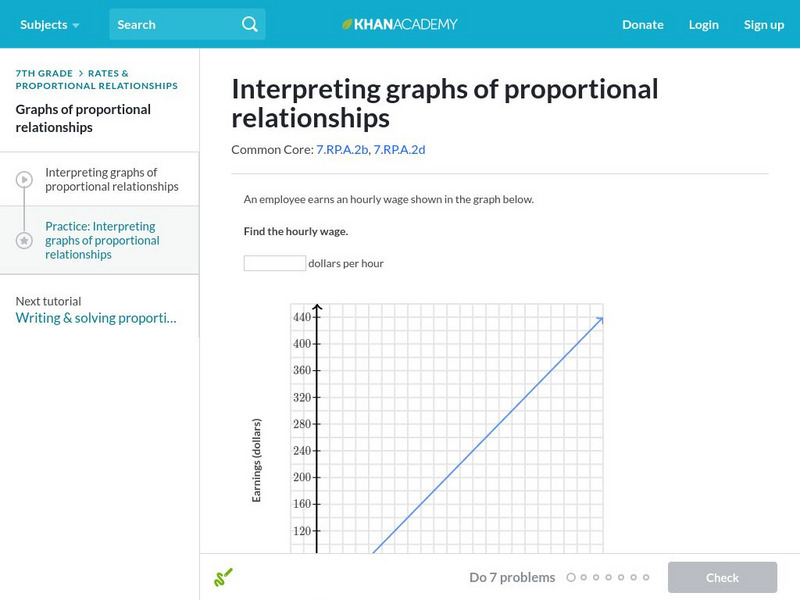
Khan Academy
Khan Academy: Interpreting Graphs of Proportional Relationships
Practice reading and analyzing graphs of proportional relationships. Students receive immediate feedback and have the opportunity to try questions repeatedly, watch a video or receive hints.
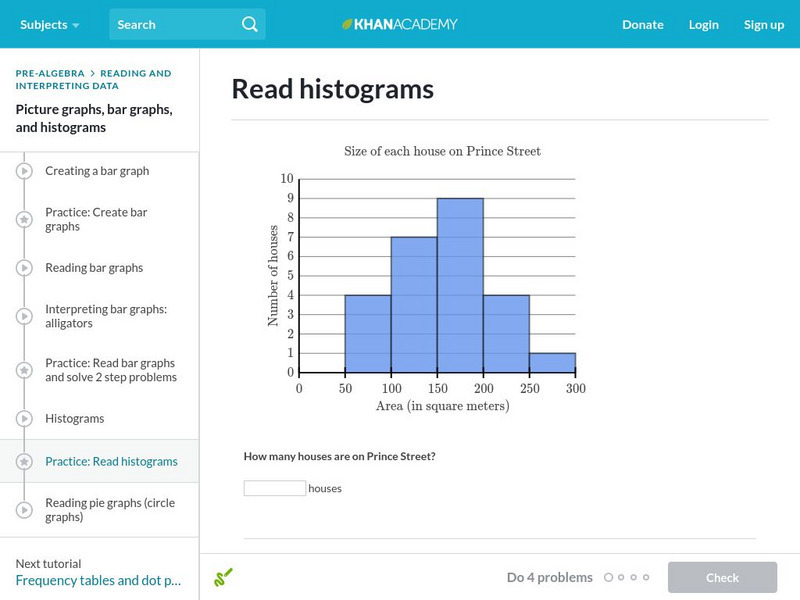
Khan Academy
Khan Academy: Read Histograms
Practice reading and interpreting histograms. Students receive immediate feedback and have the opportunity to try questions repeatedly, watch a video or receive hints.
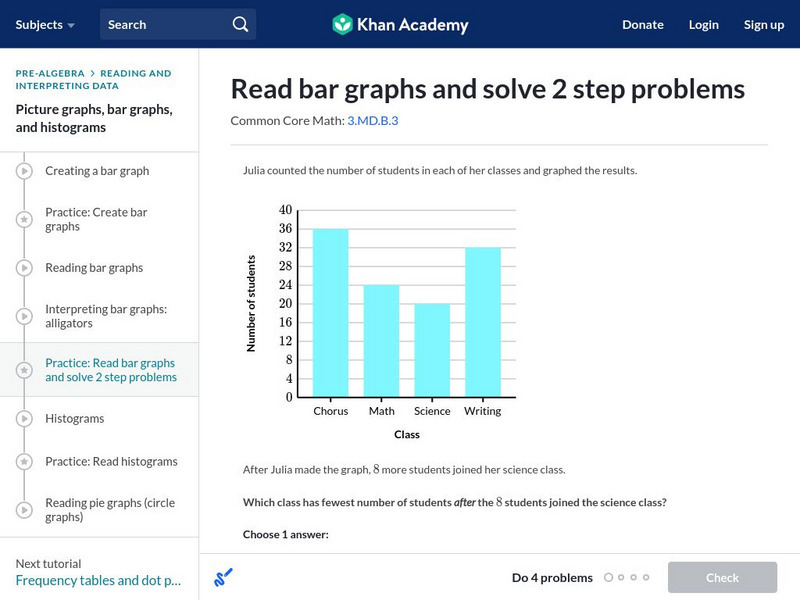
Khan Academy
Khan Academy: Read Bar Graphs and Solve 2 Step Problems
Read and interpret a double bar graphs. Students receive immediate feedback and have the opportunity to try questions repeatedly, watch a video or receive hints. CCSS.Math.Content.3.MD.B.3 Draw a scaled picture graph and a scaled bar...
Sophia Learning
Sophia: Logos, Pathos, and Ethos
Notes introducing logos, pathos, and ethos and explaining how each appeal to an audience in a different way. Notes can be both read and listened to.
Texas Education Agency
Texas Gateway: Analyze an Argument: Practice 1 (English I Reading)
In this lesson, students practice analyzing the evidence that supports or opposes an argument. They are also going to learn to analyze the quality, relevance, and credibility of the evidence so you can decide whether to accept the...
Other
Us News: Money: Reasons Community College Makes Sense Right Now
As the cost of a college education continues to rapidly rise, many more young people are considering the advantages of beginning their higher education experiece at a community college. Read about the most common reasons here.
Other popular searches
- Ell/esl Reading and Reasoning
- Esl/ell Reading and Reasoning
- Ell Reading and Reasoning
- Ell.SL Reading and Reasoning