Hi, what do you want to do?






National Health Museum
Access Excellence: Molecular Biology/primate Phylogeny
This lesson plan involves comparison of amino acids to create a phylogenetic tree of primates. Young scholars will also use other species information to draw conclusions about evolutionary relationships.
The Field Museum
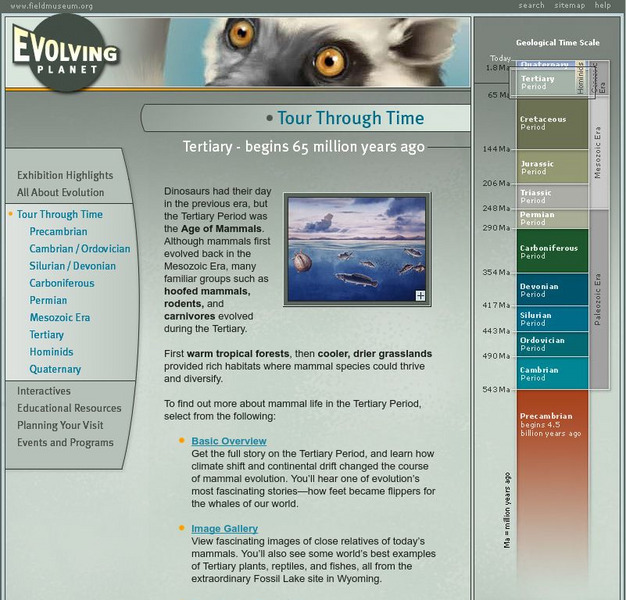
Field Museum: Exhibits: Evolving Planet: Tertiary
Delve into the Tertiary Period portion of the Evolving Planet exhibit, and trace the climate and continental shift during this time. Includes an overview of the period, a collection of images, and a look at the Tertiary Period's...
CK-12 Foundation
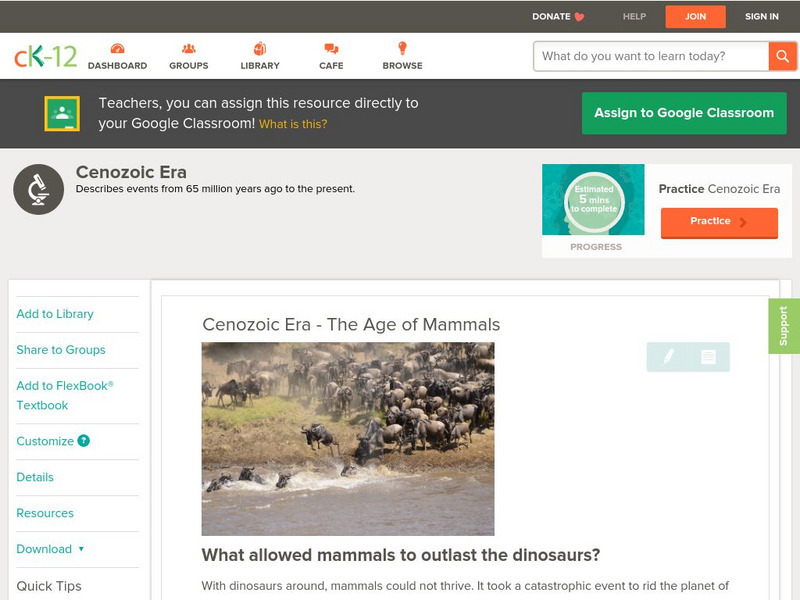
Ck 12: Biology: Cenozoic Era the Age of Mammals
[Free Registration/Login may be required to access all resource tools.] Covers the Cenozoic Era, the age of mammals.
National Health Museum
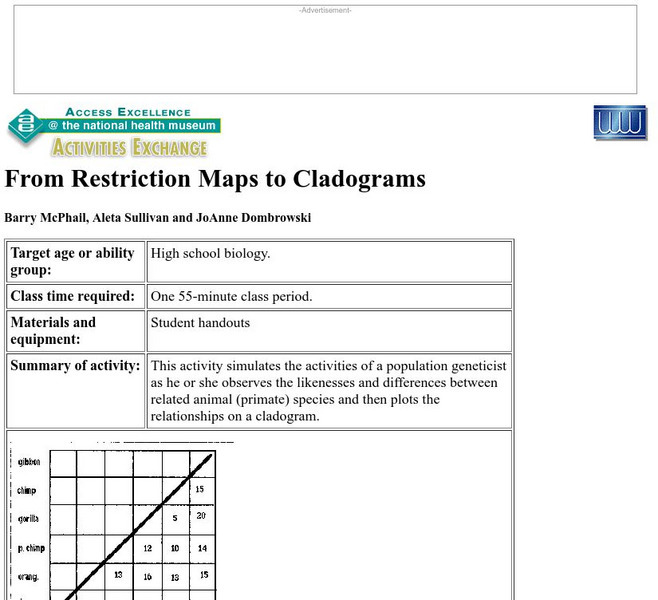
Nhm: Restriction Maps to Cladograms Lesson
This lesson plan requires young scholars to analyze DNA restriction maps to determine the differences in the sequence for several primates and humans. They then use the information to create a cladogram.
Other
Becoming Human: Comparison of Human and Ape Chromosones
Have you ever wondered how closely we are related to other primates? Join this chromosone comparison adventure to compare the banding patterns of human chromosones to those of apes.

PBS
Pbs Teachers: Scientific American: Prime Time Primates: Monkey See, Monkey Do?
Explore the evolutionary advantage of stereoscopic vision and the fully opposable thumb, and describe how each adaptation might affect the use of tools in humans and primates.
Science Education Resource Center at Carleton College
Serc: The Opposable Thumb as a Human Adaptation: Thumb Taping Lab
Students conduct a short experiment to determine the importance of the opposable thumb by taping their thumb to render it useless while they proceed to do an everyday activity. In the end students will have the opportunity to reflect on...
CK-12 Foundation
Ck 12: Life Science: Human Vision
[Free Registration/Login may be required to access all resource tools.] Sight, or vision, is the ability to see light. It depends on the eyes detecting light and forming images. It also depends on the brain making sense of the images, so...
W. W. Norton
W. W. Norton & Company: How Humans Evolved
This provides access to a webbook about How Humans Evolved. The following topics are covered: (1) How Evolution Works, (2) Primate Behavior and Ecology, (3) The History of Human Lineage, and (4) Evolution and Modern Humans. Each chapter...