Hi, what do you want to do?





Smithsonian Institution
National Air and Space Museum: Wright Brothers: Interactive Experiments
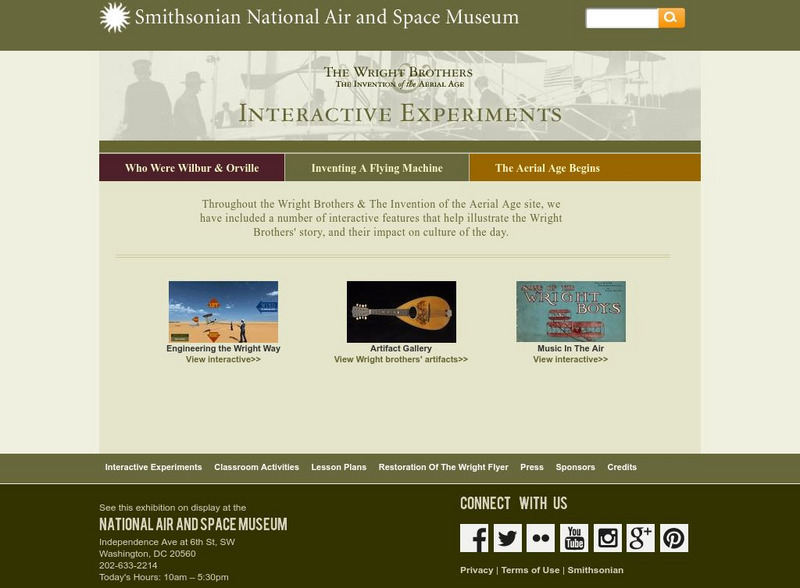
Three interactives in an online exhibition about the Wright Brothers. The first is an engineering activity on the forces of flight, and is accompanied by a lesson plan for Grades 6-8. The second is a gallery of original artifacts related...

Smithsonian Institution
Smithsonian Learning Lab: How Things Fly: Activities for Teaching Flight
Through this series of three lessons, students will gain an understanding of the basics of flight. They will learn about the four forces of flight and practice their observation skills through a number of fun experiments. In addition,...
Smithsonian Institution
Smithsonian Learning Lab: Airplanes and Airports: How to Take Off Without Ever Leaving the Ground
Smithsonian Education presents "Airplanes and Airports: How to Take Off Without Ever Leaving the Ground." Teachers can download this teaching package that discusses airplanes and airports. Included in the discussion are the forces of...
PBS
Pbs Learning Media: Centripetal Force: Pulling Cs and Gs
In this interactive activity from NOVA, discover how centripetal force can affect you when riding in a car or flying at high speeds in a fighter jet.
TeachEngineering
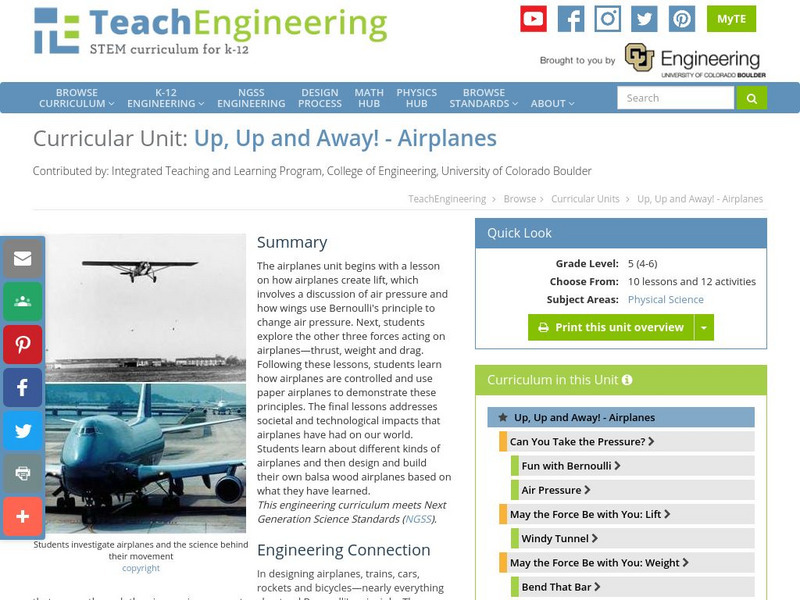
Teach Engineering: Up, Up and Away! Airplanes
The airplanes unit begins with a lesson on how airplanes create lift, which involves a discussion of air pressure and how wings use Bernoulli's Principle to change air pressure. Following the lessons on lift, students explore the other...
TeachEngineering
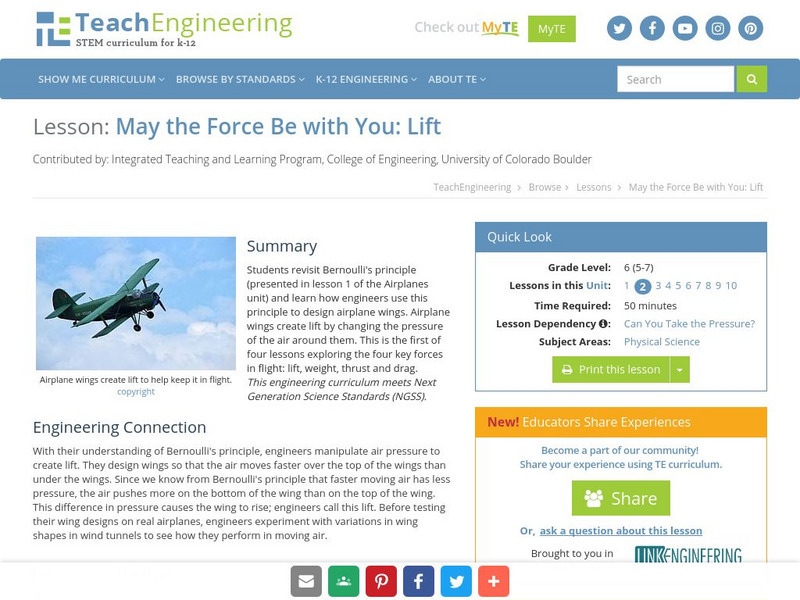
Teach Engineering: May the Force Be With You: Lift
Students revisit Bernoulli's Principle (Lesson 1 of the Airplanes unit) and learn how engineers use this principle to design airplane wings. Airplane wings create lift by changing the pressure of the air around it. This is the first of...
TeachEngineering
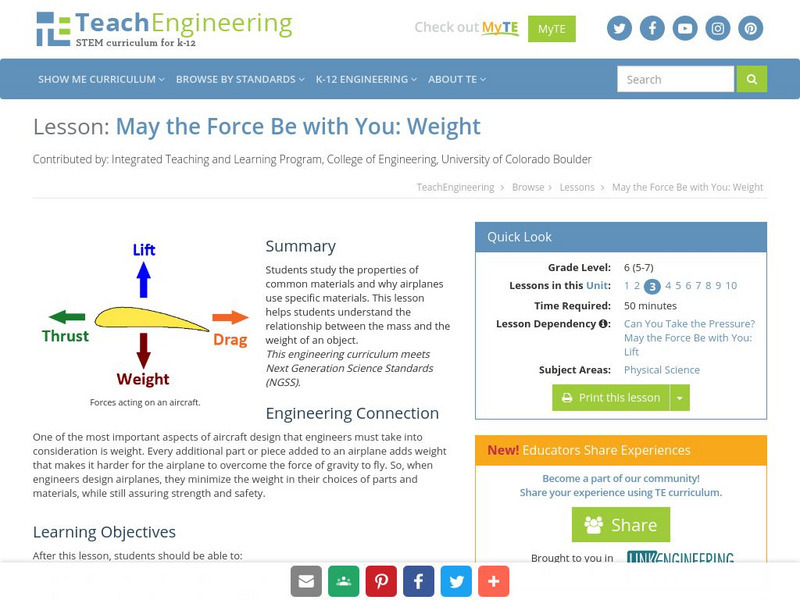
Teach Engineering: May the Force Be With You: Weight
The purpose of this lesson is to help students understand the relationship between the mass and the weight of an object. Students will study the properties of common materials and why airplanes use specific materials.

American Academy of Achievement
Academy of Achievement: General Chuck Yeager, Usaf
Biography with photos and audio on Chuck Yeager, an Air Force pilot credited with being the first man to break the sound barrier. Site includes photos, audio and text.
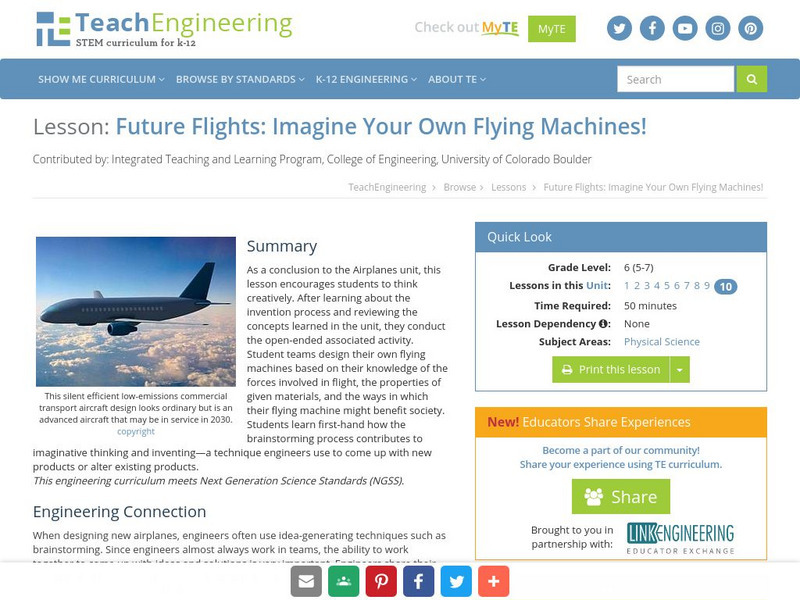
TeachEngineering
Teach Engineering: Future Flights!
This lesson is an exciting conclusion to the airplanes unit that encourages students to think creatively. After a review of the concepts learned, students will design their own flying machine based on their knowledge of the forces...
Children's Museum
The Children's Museum of Indianapolis: Curious Scientific Investigators: Flight Adventures
Students will make paper rockets, parachutes, and foam gliders to experience how objects move through the air. Explore topics such as thrust, weight, gravity, force, and lift through fun activities and stories and cutting-edge work done...
NASA
Glenn Research Center: Newton's Laws of Motion
NASA presents a concise explanation of Newton's three laws of motion. Click on the highlighted vocabulary to find more detailed and illustrated descriptions. Included is a link to a movie that shows how the laws of motion described the...
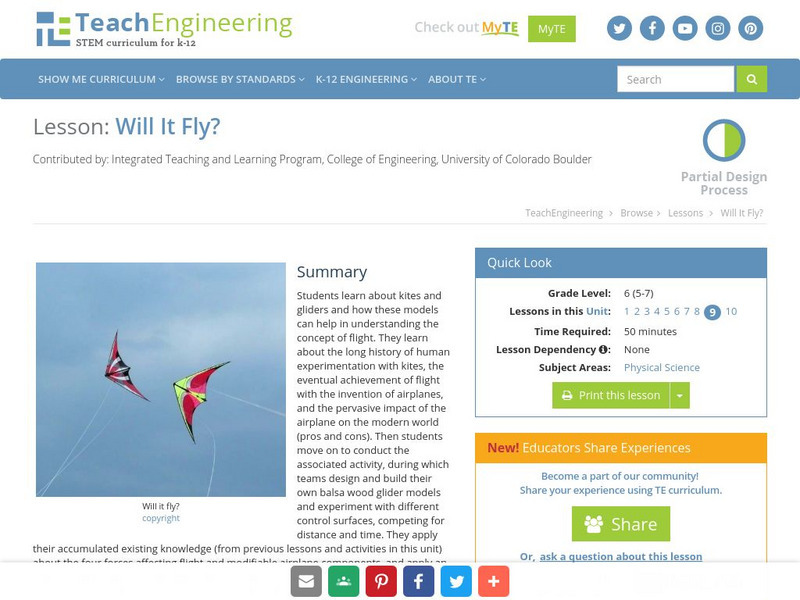
TeachEngineering
Teach Engineering: Will It Fly?
In this lesson, students will learn about kites and gliders and how these models can help in understanding the concept of flight. Students will design and build their own balsa wood models and experiment with different control surfaces....
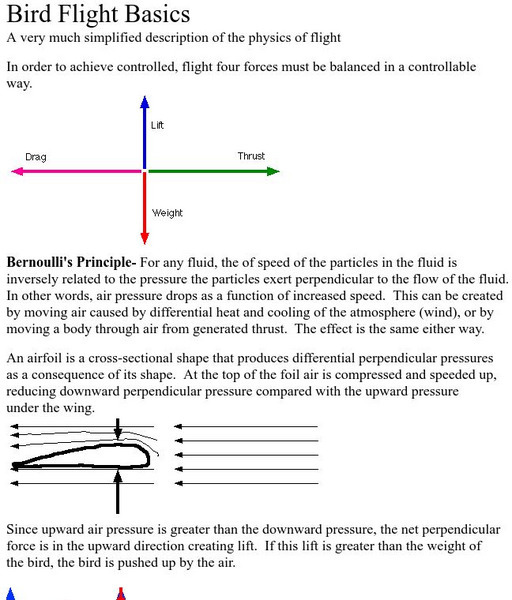
Other
Pacifier Online: Bird Flight Basics
This site provides a simplified explanation of the physics of flight. Site provides information about lift, drag, weight, thrust, Bernoulli's Principle, and much more.
NASA
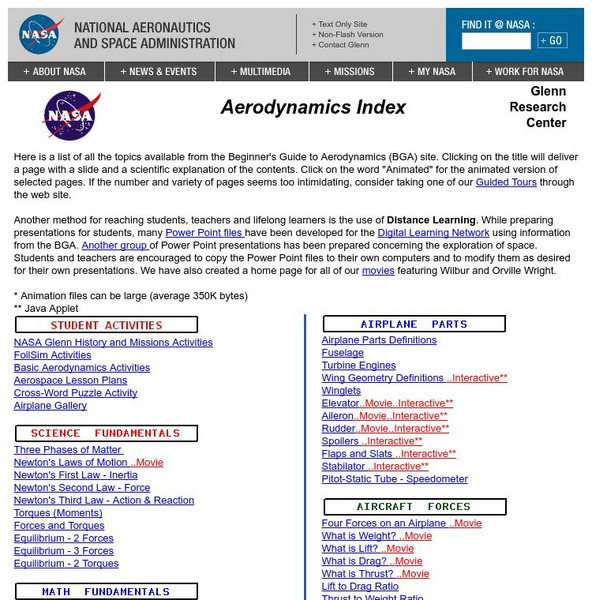
Nasa: Aerodynamics Index
Are you studying or teaching Aerodynamics? This page acts as an index to all the terminology related to this topic. Clicking on any title will open a page with a colored slide and a scientific explanation of the contents. Animated,...
TeachEngineering
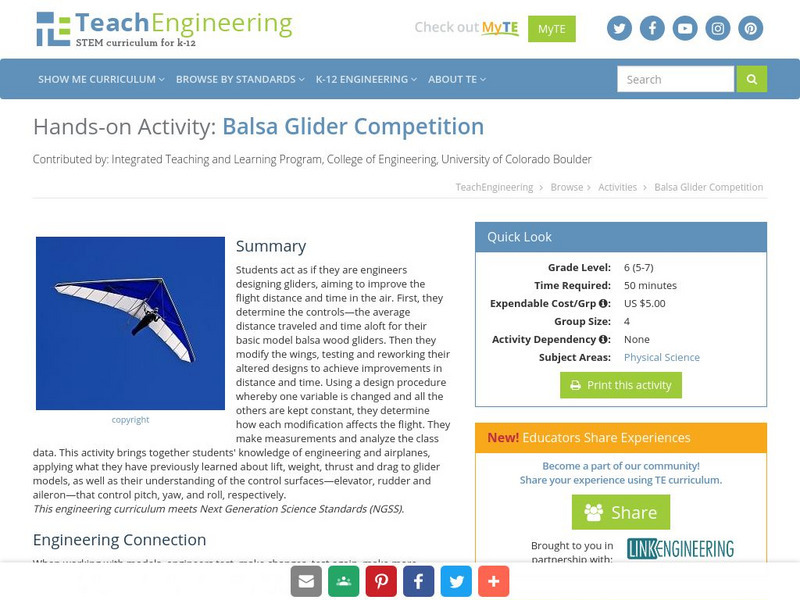
Teach Engineering: Balsa Glider Competition
The purpose of this activity is to bring together the students' knowledge of engineering and airplanes and the creation of a glider model to determine how each modification affects the flight. The students will use a design procedure...
Other
Aviation Internet Group: Aviation Theory
Collection of articles ranging from basic to advanced on aerodynamics theory.
NASA
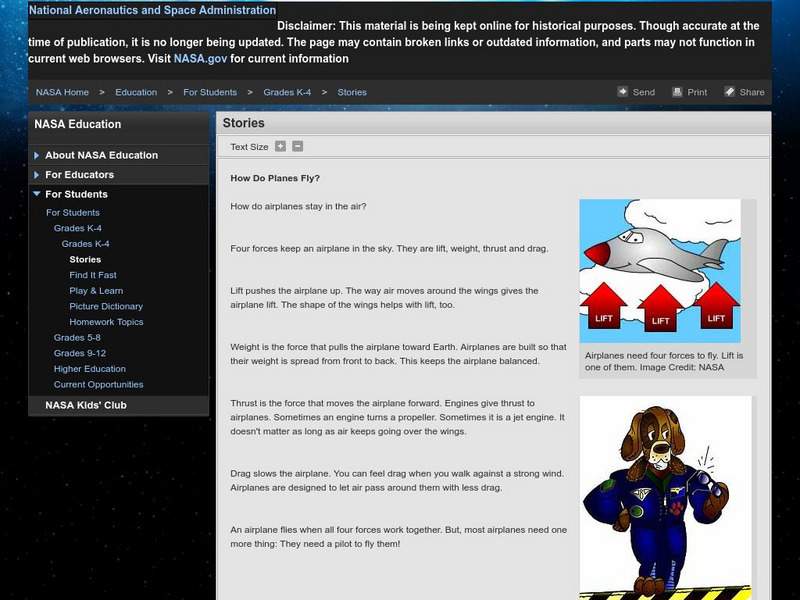
Nasa: How Things Fly
Easy to read guide from NASA on the basics of flight. Great graphics and some simulations are included.
TryEngineering
Try Engineering: Designing Drones
This lesson focuses on helicopters and drones, how they fly, how they are used in different ways that help people and the environment. Teams of students explore helicopter flight; and design, build, and test their own simple rotor out of...
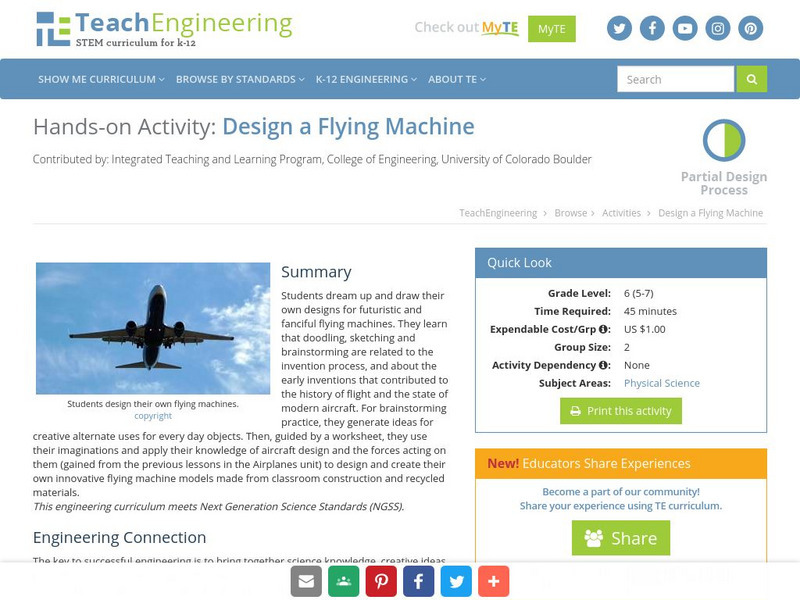
TeachEngineering
Teach Engineering: Design a Flying Machine
The purpose of this activity is for the students to draw a design for their own flying machine. They will apply their knowledge of aircraft design and the forces acting on them. The students will start with a brainstorming activity where...
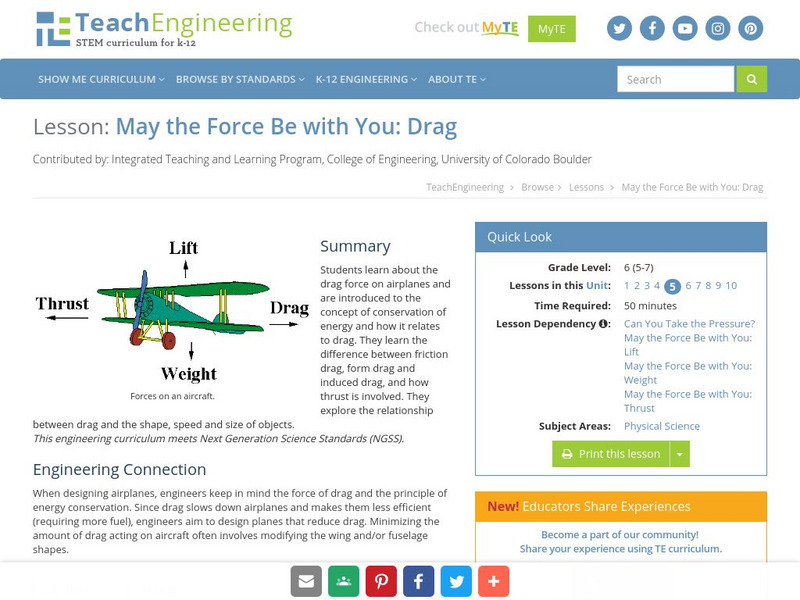
TeachEngineering
Teach Engineering: May the Force Be With You: Drag
This lesson plan explores the drag force on airplanes. The students will be introduced to the concept of conservation of energy and how it relates to drag. Students will explore the relationship between drag and the shape, speed and size...
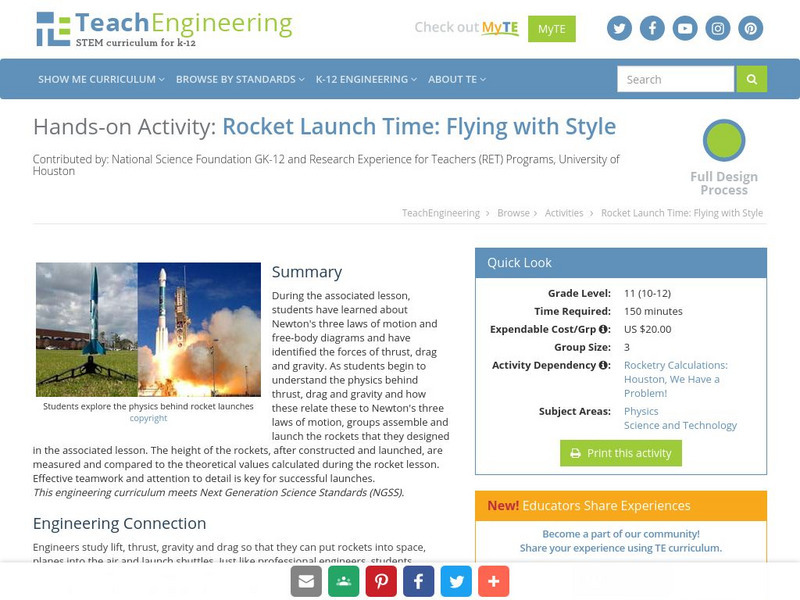
TeachEngineering
Teach Engineering: Flying With Style
As students begin to understand the physics behind thrust, drag, and gravity and how these relate these to Newton's three laws of motion, groups assemble and launch the rockets that they designed in the associated lesson.
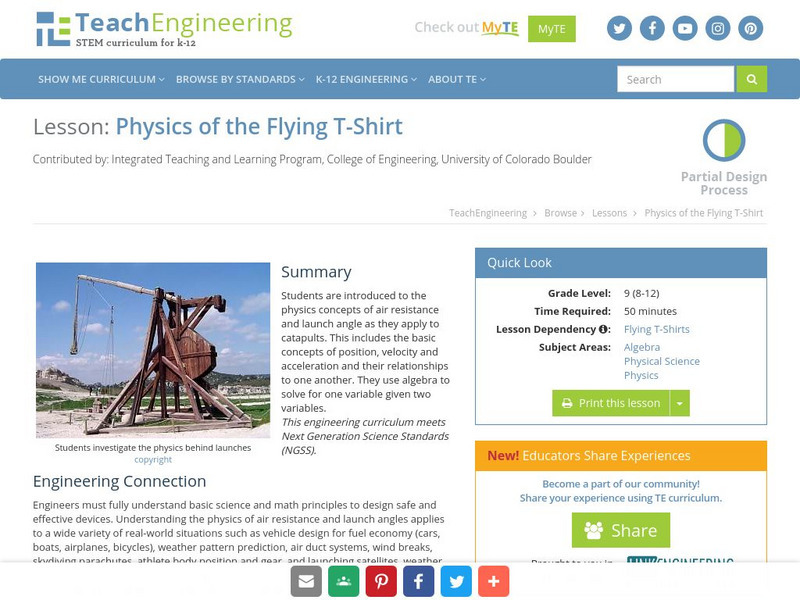
TeachEngineering
Teach Engineering: Physics of the Flying T Shirt
Young scholars are introduced to the physics concepts of air resistance and launch angle as they apply to catapults. This includes the basic concepts of position, velocity and acceleration and their relationships to one another. They use...
Canadian Museum of Nature
Canadian Museum of Nature: How Do Birds Fly?
Have you ever wondered about how birds are able to fly? View three 3D animations to see a bird take off, flap in flight and glide. This is an excellent resource to develop an understanding of the physical forces that make this one of the...
Curated OER
Science Kids: Science Images: Forces of Lift
This diagram shows the forces of lift that affect the wing of an aircraft. Lift, thrust, weight and drag all affect the flight of the aircraft as well as the angle of attack.