Hi, what do you want to do?






Ducksters
Ducksters: Physics for Kids: Light Spectrum
Kids learn about the science of the light spectrum. Wavelengths and frequencies of the electromagnetic waves including visible light, primary colors, and subtractive colors.

Other
Tooter4kids: Light and Color
You'll find a wealth of resources at this site dedicated to color! Easy-to-read discussions can be found on topics ranging from the science of light to complementary colors and the color wheel. All special terms are highlighted and...
NASA
Nasa: Tour of the Electromagnetic Spectrum: Visible Light
Visible light waves are the only electromagnetic waves we can see. We see these waves as the colors of the rainbow. Each color has a different wavelength. Red has the longest wavelength and violet has the shortest wavelength. When all...
Science Struck
Science Struck: Wavelength of Visible Light Spectrum
Explains where visible light fits into the electromagnetic spectrum and the wavelengths for the different colors we see.
Sophia Learning
Sophia: Light Waves: Lesson 4
This lesson will introduce light waves and describe how a particle can travel as a photon or a wave. It is 4 of 4 in the series titled "Light Waves."
Science Buddies
Science Buddies: Absorption of Radiant Energy by Different Colors
In this science fair project, use an infrared thermometer to measure the temperature of differently colored paper exposed to sunlight, and calculate energy emission using the Stefan-Boltzmann equation. Find discussion questions, a list...

NumberNut
Number Nut: Light and Colors
Discover the relationship between light and colors in this brief lesson. Links to related color identification activities, Color Memory Challenge and Identifying Colors Quiz. Immediate feedback given to responses that includes...
Science Struck
Science Struck: Color Spectrum Chart With Frequencies and Wavelengths
Read about the visible light spectrum and learn the frequencies and wavelengths for each of the primary and secondary colors.

Annenberg Foundation
Annenberg Learner: The Science of Light: Light in Color
Site explores colors and how they are formed. Provides three different activities to explore color.
University of Colorado
University of Colorado: Physics 2000: Temperature and Absolute Zero
A thorough, multipage discussion of color and color television sets that explains how an image is formed on the television using red, green, and blue light. Understandable discussion, excellent graphics, and many interactive Java applets.
CK-12 Foundation
Ck 12: Chemistry Simulation: Neon Lights
[Free Registration/Login Required] Neon lights are a type of discharge tube. Observe how electrons create colored light in a hydrogen gas discharge tube. Can you figure out why hydrogen's emission spectrum contains more than one color of...
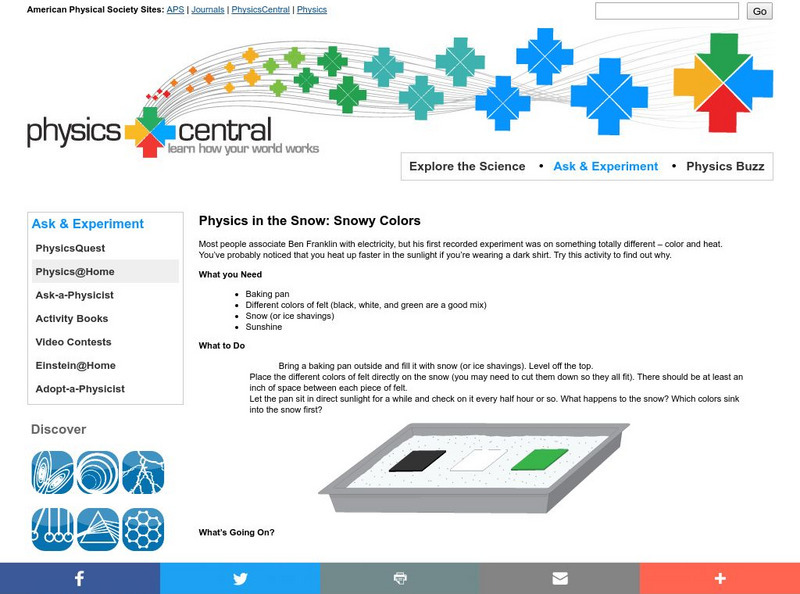
Physics Central
Physics Central: Physics in the Snow: Snowy Colors
A simple experiment through which students observe the connection between color and heat and prove that dark-colored objects and light-colored objects heat at different rates, even when exposed to the same heat or light source.

NumberNut
Number Nut: Basic Topics: Shapes, Symbols, and Colors: Colors
A short explanation of how we see color and what each of the primary and secondary colors symbolize.

NASA
Nasa: The Space Place: Why Is the Sky Blue?
Learn about colors of light by exploring how prisms work. Discover the different colors of the spectrum and how the visible light is what we see.
TeachEngineering
Teach Engineering: Waves: The Three Color Mystery
Students are presented with a challenge question concerning color blindness and asked to use engineering principles to design devices to help people who are color blind. Using the legacy cycle as a model, this unit is comprised of five...
Math Science Nucleus
Math/science Nucleus: Light Magic
This animation discusses light and the properties of light in a storybook format. The animations cover the colors of the rainbow (ROYGBIV) along with prisms, light waves, reflection, and refraction.
CK-12 Foundation
Ck 12 Exploration Series: Simulations: Physics: Light Wave
[Free Registration/Login Required] Are there colors we don't see? This simulation addresses that question by exploring light as an electromagnetic wave. Learn how the electromagnetic wave relates its wavelength and frequency to the...
TeachEngineering
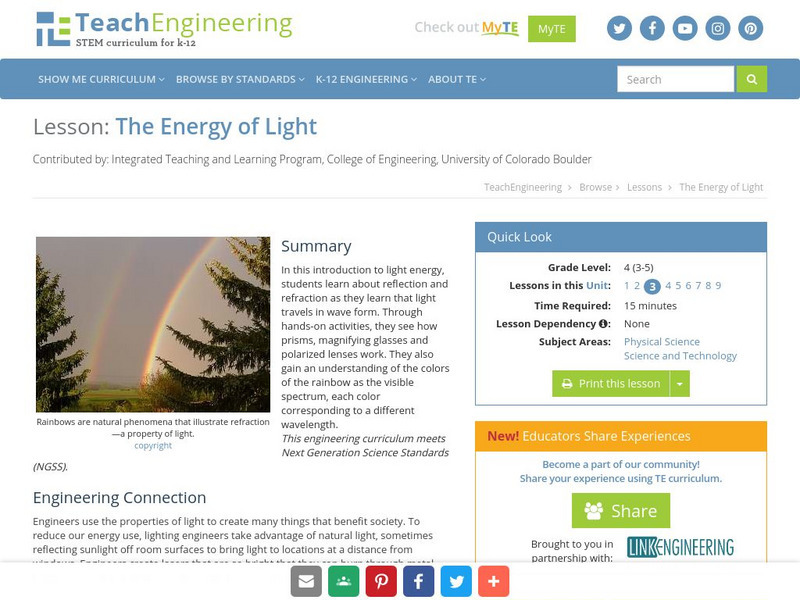
Teach Engineering: The Energy of Light
In this introduction to light energy, students learn about reflection and refraction as they learn that light travels in wave form. Through hands-on activities, they see how prisms, magnifying glasses and polarized lenses work. They also...
BioEd Online
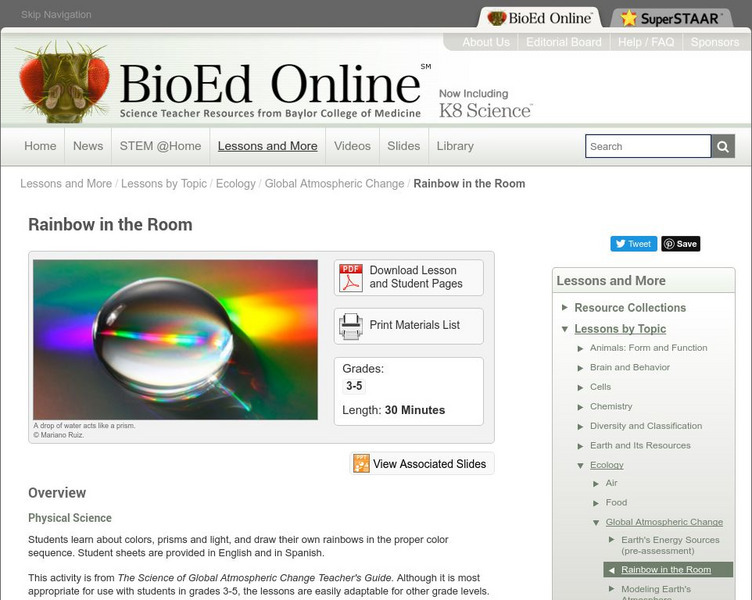
Bio Ed Online: Rainbow in the Room
Students investigate the properties of visible light and the sequence of colors in the spectrum using light shone through water and prisms. The lesson and accompanying slideshow can both be downloaded.
TeachEngineering
Teach Engineering: Rgb to Hex Conversion
Students practice converting between RGB and hexadecimal (hex) formats. They learn about mixing primary colors in order to get the full spectrum of colors and how to average pixel values.
TeachEngineering
Teach Engineering: Waves Go Public!
Students apply everything they have learned over the course of the associated lessons about waves, light properties, the electromagnetic spectrum, and the structure of the eye, by designing devices that can aid color blind people in...
Science4Fun
Science4 Fun: Light
What is light? Illustrated discussion of the speed of light, how we see colors, and how light helps us.
Optical Society
Optical Society of America: Optics for Kids: Release the Rainbow
A simple activity to demonstrate how light separates into colors when it passes through water acting as a prism.
Science Education Resource Center at Carleton College
Serc: Mn Step: Why Is the Sky Blue?
Students will learn about refraction and the scattering of sunlight as it enters the atmosphere, which causes the colors in light to separate, giving us blue skies and colorful sunrises and sunsets.