Hi, what do you want to do?





University of Florida
Florida Museum of Natural History: Animals 1: Fur, Fins, Feathers, and More
This teacher's guide focuses on familiar animals such as mammals, birds, reptiles, amphibians, and fish.

NOAA
Noaa: National Marine Fisheries Headquarters
This home page provides links to fisheries organizations, research and regulations.
San Diego Zoo Global
San Diego Zoo: Fishing Cat
The San Diego Zoo provides extensive information on fishing cats including details about their habitat, size, diet, family life, conservation status, and fun facts.
Other
San Francisco Zoo: Fishing Cat
Detailed information and fascinating facts about the blue-winged teal include diet, habitat, physical features, behavior, and conservation status.
NOAA
Noaa: Puffy the Puffer's Book of Fun Fish Facts
Step inside "Puffy The Puffer's Book Of Fun Fish Facts," and learn all about marine mammals. There are quizzes, games and lots of fun information.

NSTATE
Alaska State Symbols and Emblems
Find out all about the state symbols and emblems of Alaska. Clicking on the words under the heading "Symbol/Emblem" will usually provide a picture and more information. The date the symbol was adopted is also included.
Other
Alabama Emblems, Symbols and Honors
A list of all of the state emblems and symbols for the state of Alabama. Clicking on the underlined link will bring up a picture of the symbol or emblem.
Other
Colorado Division of Wildlife: Colorado Wildlife Species and Profiles
This resource provides a list of species found in Colorado and information about them.

ClassFlow
Class Flow: All About Whales
[Free Registration/Login Required] The objective of this lesson about whales is to learn about the differences between mammals and fish using the Venn diagram. The lesson also covers charting animal sizes and ends with a 10-question...
NOAA
Noaa: Fisheries: Cetaceans: Whales, Dolphins, and Porpoises
Learn more about the marine mammal group of cetaceans. Take a look at their status on the Endangered list and find out what situations put them on that list.

Alabama Learning Exchange
Alex: My Book About Animals
This lesson will allow students an opportunity to create a book about the different characteristics of mammals, birds, fish, reptiles, and insects. This lesson can be used as a wrap-up project for a unit on animals. This is a fun way for...
Smithsonian Institution
Smithsonian National Zoo
Here is the National Zoological Park right at our fingertips. Students will find many things to explore at this colorful and engaging site. Any study of animals will have a successful start here. Chances are students can catch their...
US Fish and Wildlife Service
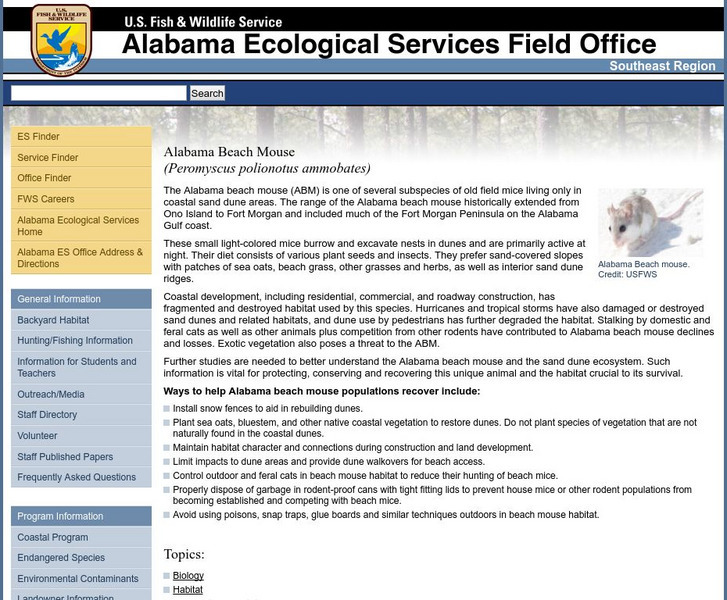
U.s. Fish & Wildlife Service: Alabama Beach Mouse
Read about the endangered Alabama Beach Mouse, and find out what can be done to restore its population numbers.
CK-12 Foundation
Ck 12: Third Grade Science: Life Sci: Animal Characteristics and Classification
[Free Registration/Login may be required to access all resource tools.] Presents an overview of the major animals groups (mammals, birds, reptiles, amphibians, fish, arthropods, vertebrates, invertebrates, those having live births and...
Other
Science4 Us: Animals
In online and offline activities, students broaden their understanding of animals by learning to identify and classify animals into six categories: mammals, birds, fish, amphibians, reptiles, and invertebrates.
Kidport
Kidport: Beaks and Bills
Birds have a wide variety of beaks or bills. Some are designed for opening seeds, while others are designed for catching fish or even tearing flesh to eat a small animal. Discover the dynamic uses of beaks and bills.
Tramline
Tramline, Inc.: Virtual Ocean Field Trip
In this enchanting site, students will learn basic principles about oceans and will be introduced to an assortment of sea life, both plant and animal. Other interesting ocean links can be found on the teacher resource section of this link.
Utah Education Network
Uen: Science Vocabulary Game
Fourth graders will play a review memory game with Utah's Grade 4 Science Standard V vocabulary words during this lesson. Words associated with living things and classifications of living things are included in this lesson.
Smithsonian Institution
National Museum of Natural History: Ocean Planet
Detailed website that was a companion to a 1995 traveling exhibit of the Smithsonian. Links to lesson plans and other educational materials are at the bottom of the page. Enter the exhibition to explore the world of the ocean.
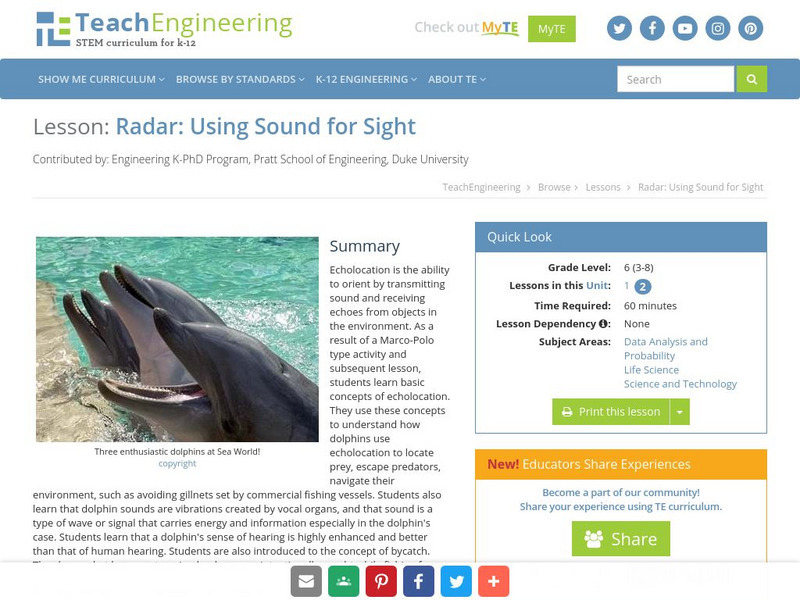
TeachEngineering
Teach Engineering: Sound for Sight
Echolocation is the ability to orient by transmitting sound and receiving echoes from objects in the environment. As a result of a Marco-Polo type activity and subsequent lesson, students learn basic concepts of echolocation. They use...
abcteach
Abcteach: Animals
[Free Registration/Login Required] This link will place at your fingertips all kinds of resources for your science unit pertaining to animals such as birds, bugs, dinosaurs, endangered species, fish, mammals and reptiles.
PBS
Pbs Teachers: Scientific American: The New Zoos: Doctor Fish
Investigate the evolution of the heart and circulatory system in mammals by studying the anatomy of hearts in other animals. Create models of the hearts of fish, amphibians and mammals.
Enchanted Learning
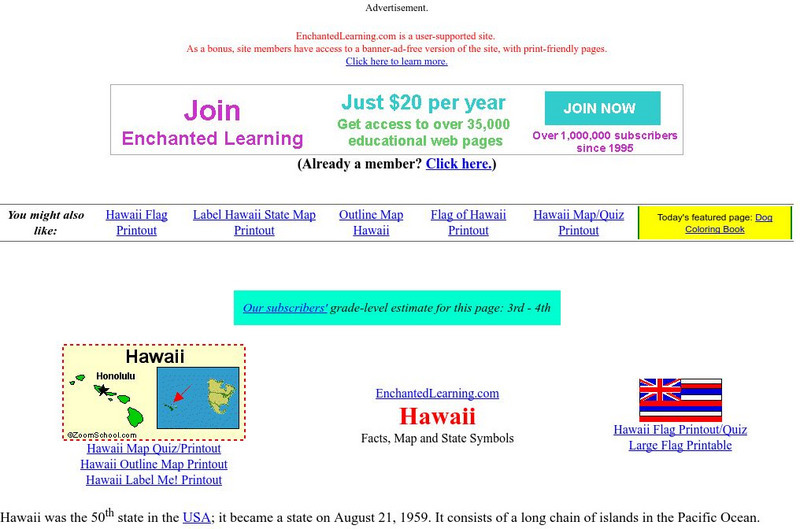
Enchanted Learning: Hawaii Facts, Map, and State Symbols
This is a colorful collection of maps, facts and symbols of Hawaii. Also includes the Hawaiian flag.
Quia
Quia: Animal Facts Scavenger Hunt
At this website you are given ten questions to answer and links to three websites where you can find those answers.