Hi, what do you want to do?






Other
Satellite Images Bridge Understanding Gap Between Climate Change and Individuals
This article discusses how Google Earth has brought the reality of climate change to the average person so that they can see it for themselves. The north and south poles are indicators of what is happening with climate change and an...

Science Buddies
Science Buddies: The Strength of an Electromagnet
Has anyone ever told you that you have a magnetic personality? Have you ever heard that opposites attract? These common phrases are both based on the properties of magnets and magnetic electricity. In this science fair project, learn how...
Treehut
Suzy's World: Magnetism: Why Does a Compass Point North?
This fact sheet from Suzy's World and Suzy Cato explores how magnetism works, including "why a compass points north." Content includes fun facts, an experiment, and the ability to make your own compass.

Science Buddies
Science Buddies: Levitating Magnets: Floating Isn't Just for Magicians
If you ever seen a magician float an object in the air, you might think that levitation is just a magic trick, but the truth is you can use an invisible physical force to levitate a magnet. Try this simple, week-long science project to...
Other
Usps: Polar Lights
You and your students are going on an expedition to learn about the polar regions. Explore the glaciers, subglacial rivers, and volcanoes. Get up close and personal with furry, flippered, and feathered friends. Learn how other people...
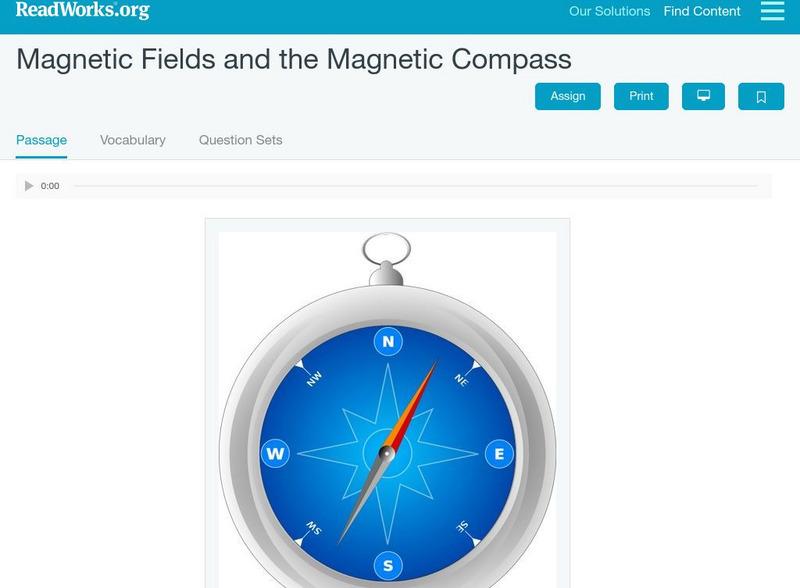
Read Works
Read Works: Electric and Magnetic Forces and the Modern Day Compass
[Free Registration/Login Required] An informational text about how a compass works using electromagnetic force. A question sheet is available to help students build skills in reading comprehension.
Curated OER
Science Kids: Science Images: Aurora Borealis, Northern Lights
The aurora borealis (also known as the northern lights) is a spectacular light display that can be seen at night in regions near the North Pole (auroras can also be seen near the South Pole). Auroras occur because of charged particles...