Hi, what do you want to do?






Science Buddies
Science Buddies: What Makes the Rings of Saturn?
Saturn is a unique planet because of the many beautiful rings surrounding it. How are all of those rings made? Why is each ring unique?
Science Buddies
Science Buddies: Acid Rain and Aquatic Life
Chemicals from the Earth's atmosphere are making their way down to the planet. Not in spaceships, but in rain. The acid rain can infiltrate ground water, lakes, and streams. How does acid rain affect aquatic ecosystems?
Science Buddies
Science Buddies: Growing a Soil Menagerie
Everything on our planet is linked by a giant recycling system called the biogeochemical cycle. How our planet recycles and reuses everything we need to support life is explained by making a miniature biosphere in this lab. You will also...
Science Buddies
Science Buddies: From Gas to Rust: Measuring the Oxygen Content of Air
Earth's atmosphere, the ocean of air that blankets the planet, is mostly nitrogen and oxygen, with small amounts of other gases. How much oxygen is present in air at sea level? Is air high up in the Appalachians or Rockies? Atop Mount...
Science Buddies
Science Buddies: A Puzzling Parallax
Did you know that ancient astronomers could measure the distance to other stars? They could also distinguish between stars and planets. How could they do that without modern technology of telescopes? See if you can discover the link...
Science Buddies
Science Buddies: How Do the Seasons Change in Each Hemisphere?
On a rainy day, do you ever wonder what the weather is like on the other side of the planet? Different regions around the globe can have very different seasonal weather patterns. In this experiment, you can test if these seasonal...
Science Buddies
Science Buddies: Catching Stardust
How do astronomers collect stardust? They design and build satellites that are launched into space to collect particles on specially designed panels. Satellites can be sent to orbit around an object of interest: a planet, moon, or comet....
Science Buddies
Science Buddies: Where Did All the Stars Go?
If you live in a big city or urban area it is hard to see many stars at night. In most urban areas only the most brilliant stars, planets and the moon can be seen. This is because of something called light pollution which is the...

Science Buddies
Science Buddies: The Moon and the Stars
When you are in the city, only a few of the brightest stars are visible. But when you are in the country, you can see many more stars than you can count. Sometimes you can even see the bright belt of our galaxy, the Milky Way. In this...
Science Buddies
Science Buddies: Pop Goes the Geyser!
Our home, Earth, is a living planet. Earthquakes and volcanic eruptions are proof that the geological forces that shaped our planet and created the land masses are ongoing. An amazing example of geologic activity that is less damaging is...
Science Buddies
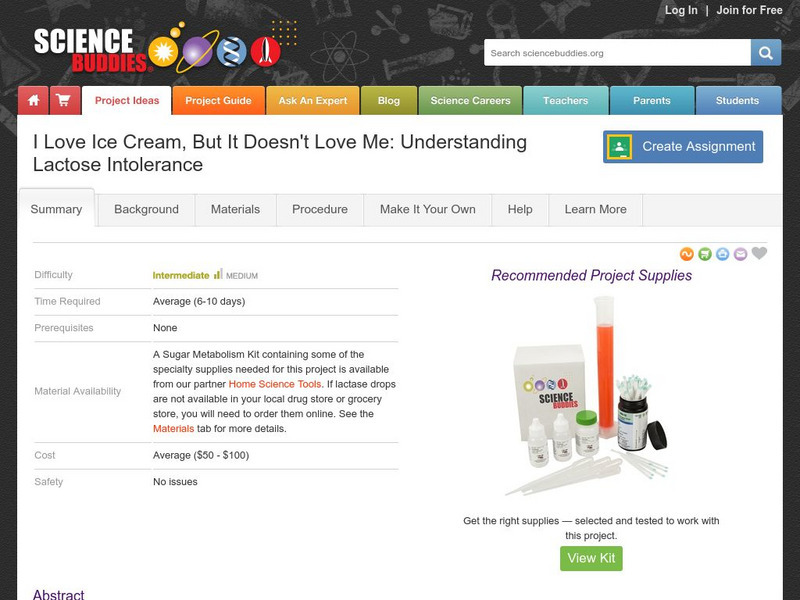
Science Buddies: I Love Ice Cream, but It Doesn't Love Me: Lactose Intolerance
Pizza, milk shakes, and ice cream sundaes all contain dairy products, therefore they cannot be eaten by the majority of people around the world. Dairy products contain the sugar molecule lactose, and the majority of people on the planet...

Alabama Learning Exchange
Alex: To Infinity and Beyond Magazine of Planets
This is a student led activity in which students have to accomplish the task of choosing the most entertaining way to relay written expository information. Art/self expression along with technology are utilized to develop a classroom...
American Geosciences Institute
American Geosciences Institute: Earth Science Week: Places on the Planet: Latitude and Longitude
Students learn how citizen scientists involved in the Geological Society of America's EarthCaching project use GPS technology and latitude and longitude coordinates to find special places on the Earth.

ClassFlow
Class Flow: Using Graphs
[Free Registration/Login Required] This flipchart contains a variety of graphs with internet links which can be beneficial to Science Project planning.
TeachEngineering
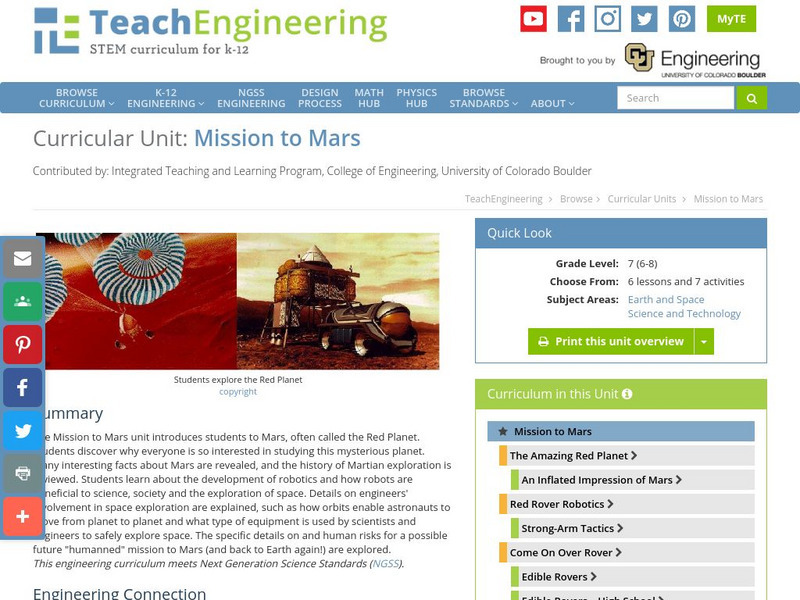
Teach Engineering: Mission to Mars
The Mission to Mars curricular unit introduces students to Mars-the Red Planet. Students discover why scientists are so interested in studying this mysterious planet. Many interesting facts about Mars are revealed, and the history of...
NASA
Nasa Space Place: El Space Place
NASA's space science site for kids - en Espanol. Features a wide range of activities, including games, projects, animations, and more. Also contains useful information on basic physics, chemistry, and other natural sciences, offering...

NASA
Nasa: Mars Exploration Rover Mission
Both historic and up-to-the-minute news regarding the Mars Rover mission. There are activities for children, student projects and other classroom resources. From the "more videos" link you can find a series of animations will take you...

ClassFlow
Class Flow: You Are a Scientist!
[Free Registration/Login Required] You are a Scientist, is an introduction to the scientific method and the steps we take in that process. The final page provides a link to the 2003-2004 winning science fair projects displaying the parts...

Alabama Learning Exchange
Alex: Creating a Life Form
In this particular lesson, the students will create an unknown life form and planet. The creation of the life forms will begin at the chemical level and be explained throughout the levels of organization to the level of organism. The...
abcteach
Abcteach: Earth Day Activities
[Free Registration/Login Required] How can you treat the earth with more respect? Check out this resource featuring links to elementary activities to celebrate Earth Day. You will find word searches, crossword puzzles, reading...