Hi, what do you want to do?





Science Buddies
Science Buddies: Just Keep Cool How Evaporation Affects Heating and Cooling
When we get hot, we sweat. The physiological role of sweat is to cool us down. When the water evaporates, it removes energy from our bodies. This sort of evaporative cooling can also be used to cool homes, using what are referred to as...

E-learning for Kids
E Learning for Kids: Greenland: How Can Heat and Cooling Change Materials?
Nanook wants to learn to cook. In order to cook, she first needs to learn how things can change when they are heated or cooled.
Exploratorium
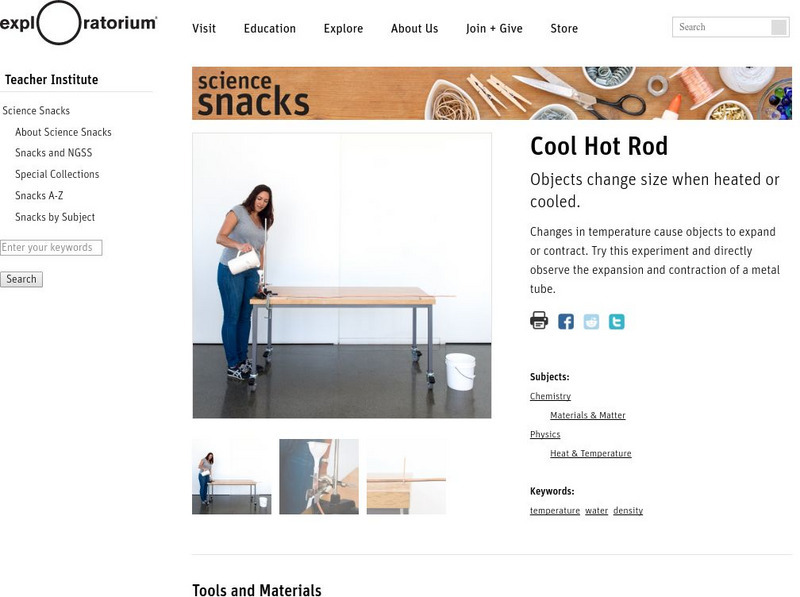
Exploratorium: Science Snacks: Cool Hot Rod
This activity will show students how objects change size when heated and cooled. Students will observe a metal tube have expansion and contraction.
Science Buddies
Science Buddies: Rubber Band Elasticity and Temperature
Many materials expand when heated and contract when cooled. What do you think will happen to the elasticity (stretchiness) of a rubber band when it is heated or cooled to various temperatures?
![Arts Now Learning: Cool / Warm Name Design Rubbings [Pdf] Lesson Plan](https://static.lp.lexp.cloud/images/attachment_defaults/resource/large/FPO-knovation.png "Arts Now Learning: Cool / Warm Name Design Rubbings [Pdf] Lesson Plan")
ArtsNow
Arts Now Learning: Cool / Warm Name Design Rubbings [Pdf]
In this lesson, 3rd graders reflect on who they are by listing their likes and dislikes, beliefs, hobbies, etc. They then create a rubbing of their name and add rubbings of objects they like, along with symbols and sketches. Next, they...
Science Buddies
Science Buddies: What's the Fastest Way to Cool a Soda?
When you are craving an ice cold drink of soda, the last thing you want is to be stuck with a bunch of soda cans at room temperature. This fun science experiment sends you on a discovery to find the fastest way to cool soda with...

E-learning for Kids
E Learning for Kids: Science: Loch Ness: What Happens When Solids and Liquids Are Heated or Cooled?
Students will look at what happens to different types of matter when they have a change of state.
PBS
Pbs Learning Media: The Ruff Ruffman Show: Teacher's Guide: Kitchen Chemistry
Learn about kitchen chemistry alongside Ruff Ruffman. Young scholars can use the videos, games, and activities from The Ruff Ruffman Show to discover how by investigating solids and liquids and exploring heating and cooling, science can...

Khan Academy
Khan Academy: Biology: Specific Heat, Heat of Vaporization, and Density of Water
Why does ice float? In this article answer that question by learning about the topics of Specific heat capacity, evaporative cooling, and heat of vaporization of water.
Science Struck
Science Struck: Conduction, Convection, and Radiation
Explains the concept of heat transfer and describes conduction, convection, and radiation which are the three modes of heat transfer. Includes formulas, examples, and applications.
CK-12 Foundation
Ck 12: Fifth Grade Science: Physical Science: Chemical Properties of Matter
A module that provides the definition of chemical property and examples of the chemical properties of matter using explanations, pictures, and review questions.
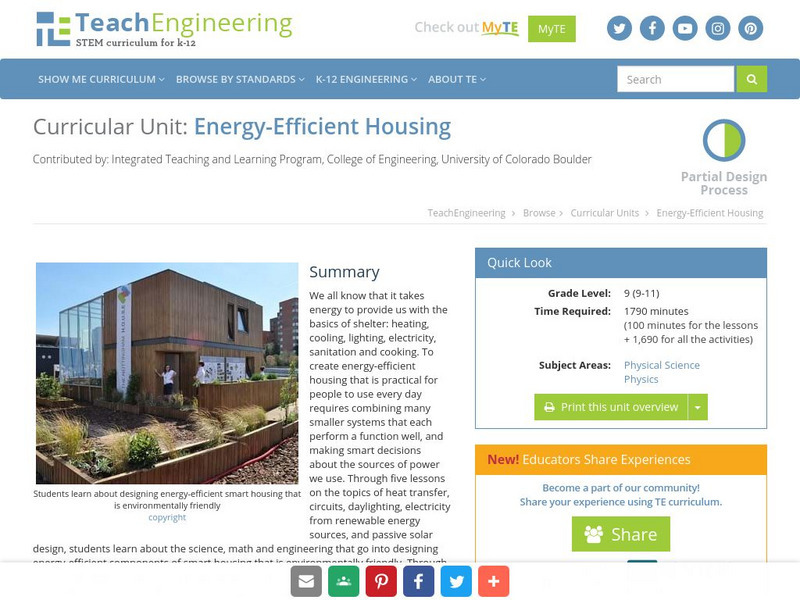
TeachEngineering
Teach Engineering: Energy Efficient Housing
We all know that it takes energy to provide us with the basics of shelter: heating, cooling, lighting, electricity, sanitation and cooking. To create energy-efficient housing that is practical for people to use every day requires...
The Wonder of Science
The Wonder of Science: 5 Ps1 2: Conservation of Matter
On this site, find a variety of materials to help students understand the conservation of matter. Create lessons that allow students to measure and graph quantities that could show even if matter is heated, cooled or combined with other...
BBC
Bb Ci Schools: Revisewise Science: Solids, Liquids, Gases
This site contains an interactive activity in which students can learn about the three states of matter. There is also a factsheet that lists numerous properties of liquids, solids, and gases. The factsheet also uses water as an example...
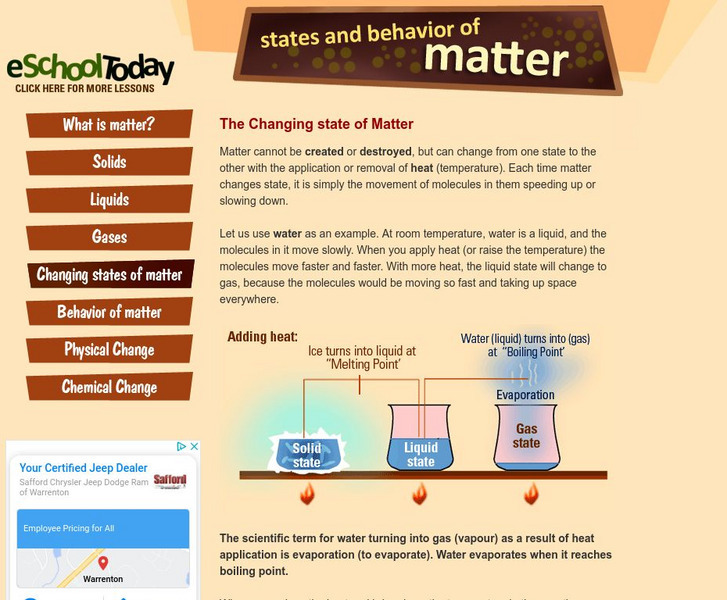
eSchool Today
E School Today: The Changing State of Matter
Learn about the changing states of matter.

National High Magnetic Field Laboratory
Magnet Academy: Jean Charles Athanase Peltier (1785 1845)
Although he didn't start studying physics until he retired from the clock-making business at age 30, French native Jean Peltier made immense contributions to science that still reverberate today. Even with the primitive tools available...