Hi, what do you want to do?






PBS
Pbs News Hour Extra: When Will the Recession End
PBS's NewsHour Extra provides an Economic, Government, and History lesson concerning the four economic indicators impact on a country. Includes two detailed activities. The first exercise covers the history of the U.S. economy from...
Council for Economic Education
Econ Ed Link: The Effects of the Recession
The students learn how a recession affects our economy, and how it might affect them personally.They examine the role the federal government has played in dealing with the current recession. They analyze their thoughts about what role...

Blackdog Media
Classic Reader: "The Recessional" by H. H. Munro
Text of the short story "The Recessional" by H. H. Munro. (Free site registration offers some additional features, e.g., the ability to insert annotations.)
Texas Education Agency
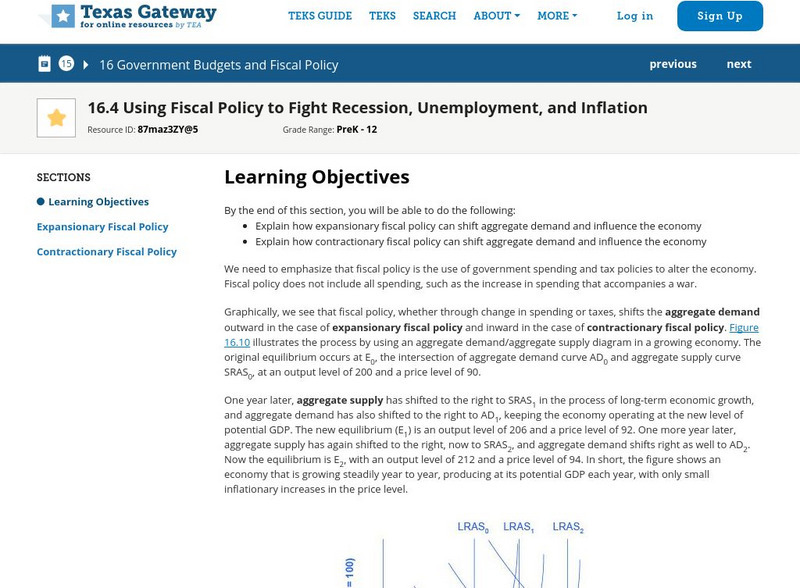
Texas Gateway: Using Fiscal Policy to Fight Recession, Unemployment, & Inflation
A learning module that uses charts and information to explain how expansionary and contractionary fiscal policies shift aggregate demand and influence the economy.
CNN
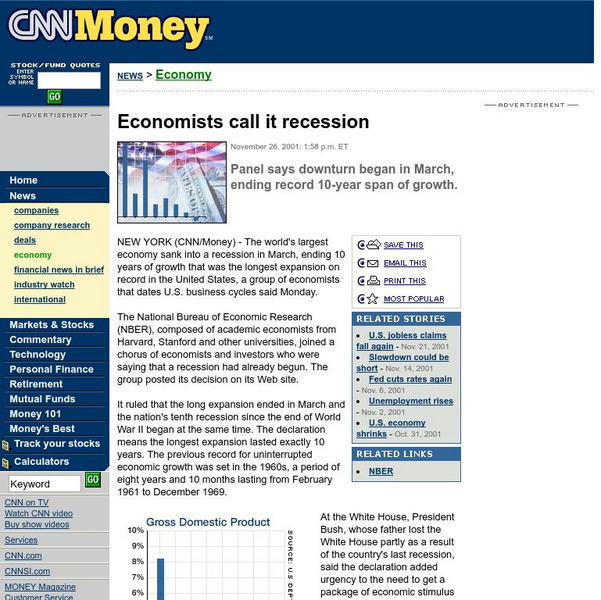
Cnn: Economists Call It Recession
This site is an article that examines the 2001 recession. Looks to economic research and experts to dissect the economic slow down. Includes a brief history of recessions since WWII and links to related stories.
C3 Teachers
C3 Teachers: Inquiries: Great Recession
A learning module on the Great Recession that followed the 2007-2008 mortgage crisis in the United States. It includes several supporting questions accompanied by formative tasks and source materials, followed by a summative performance...

Khan Academy
Khan Academy: The Great Recession
In 2008, America faced the worst economic crisis since the Great Depression. Examine how we got to this point and how the government worked to end it the crisis. Examine the following resource that contains a summary, graphs,...
OpenStax
Open Stax: Challenges of the Twenty First Century: The Domestic Mission
Overview of the domestic issues facing the Bush administration during the first decade of the 21st Century, including education, recession, war, and Hurricane Katrina. Site provides questions for discussion, glossary and links to primary...
Federal Reserve Bank
Federal Reserve Bank of Minneapolis: Achieving Economic Stability: Lessons From the Crash of 1929
This page provides access to the text of the speech "Achieving Economic Stability: Lessons From the Crash of 1929" by Gary H. Stern, President, Federal Reserve Bank of Minneapolis. It compares the Crash of 1929 to the Crash of 1987.
US Department of Labor
Bureau of Labor Statistics: Monthly Labor Review: Job Growth in the 1990s: A Retrospect [Pdf]
An article excerpt that documents how job growth in the 1990s helped to turn around the recession.
New Deal Network
New Deal Network: Great Depression and the Arts
Part of a wonderful website devoted to researching and teaching the Great Depression and the New Deal. These pages are focused specifically on the arts during this time.
New Deal Network
New Deal Network: Roosevelt's Fireside Chats: On the Current Recession
The text of President Roosevelt's fireside chat on April 14, 1938 in which he tries to explain why a recession was occurring despite the New Deal programs.
The White House
The White House: Recovery, Your Money at Work
Explains to everyone what the American Recovery and Reinvestment Act of 2009 is meant to do, track the spending associated with the act, and provide accountability for the act.
Gilder Lehrman Institute of American History
Gilder Lehrman Institute: Facing the New Millenium
[Free Registration/Login Required] A thought-provoking essay discusses the political, social, and technological trends facing the United States at the turn of the 21st century. Of particular focus is the Bush presidency, 9/11, and the...
US Department of Labor
Bureau of Labor Statistics: Monthly Labor Review: Earnings and Employment Trends in the 1990s [Pdf]
An article excerpt that compares earnings in the 1990's to the growth in employment. Requires Adobe Reader. [PDF]

PBS
Frontline: Inside the Meltdown
A fascinating report complete with interviews of those closest to the matter, videos, etc. regarding the 2008-2009 economic crisis is provided by Frontline.
Other
Amos Web: A Pedestrian's Guide to the Economy
Exploring the economy can be a fun adventure with the Pedestrian's Guide to the Economy. Use this site to find your answers to economic topics in a user-friendly format with comic strip guides.

Khan Academy
Khan Academy: The Presidency of George W. Bush
September 11, 2001 occurred in the early days of George W. Bush's administration and set the tone for his presidency. Study his domestic and foreign policy by reading the following summary, answering critical thinking questions, and...
Gilder Lehrman Institute of American History
Gilder Lehrman Institute: History Now: The New Deal
[Free Registration/Login Required] Read about the New Deal, its programs, and the ways it helped a nation in the grips of the Great Depression. The New Deal was not universally popular, so find out what Franklin Roosevelt did to keep the...
Other
Texas Wide Open for Business: State to State Comparison [Pdf]
A graphical comparison of employment data that shows how well Texas fared between 2008-20013 (before and after the recession), against how poorly other states fared.
Federal Reserve Bank
Federal Reserve Bank of Minneapolis: There's No Such Thing as a Good Recession
This article from the Federal Reserve Bank of Minneapolis discusses how a recession effects the economy. It goes into great detail on why a recession can never be a good thing. (Published Sept. 1, 1989)
Federal Reserve Bank
Ask Dr. Econ: How Many Recessions Have Occurred in the u.s. Economy?
Resource takes a look at the period from the 1940s to the end of 2007 and explores in depth the topic of recessions and how many have actually occurred.

Khan Academy
Khan Academy: The Building Blocks of Keynesian Analysis
Keynesian economics focuses on explaining why recessions and depressions occur and offering a policy prescription for minimizing their effects. The Keynesian view of recession is based on two key building blocks: recessions occur when...
Digital Public Library of America
Dpla: The Panic of 1837
This set uses primary sources to explore the financial practices that contributed to the Panic of 1837 and the impact of the crisis on America's politics, economy, and people.