Hi, what do you want to do?





Science Buddies
Science Buddies: Measuring the Speed of 'Light' With a Microwave Oven
In this experiment, you will measure the speed of light using a microwave oven, some egg white, and a ruler. This short project proves to be an extremely interesting choice for a science lab, with pictures for illustration, and thorough...
Science Buddies
Science Buddies: Using a Laser to Measure the Speed of Light in Jello
Think it takes expensive, sophisticated equipment to measure the speed of light? Think again. Outfit yourself with a simple handheld laser pointer, a protractor, and Jell-O, and you're ready to get started.

American Museum of Natural History
American Museum of Natural History: Ole Roemer and the Speed of Light
This resource provides a concise overview of the speed of light and the Ole Roemer, the first man to measure it.
University of Colorado
University of Colorado: Physics 2000: Speed of Light
Using an interesting and intriguing format, this page discusses the question of "How does one measure the speed of light." Explanation focuses on Galileo's and Roemer's efforts to obtain a reasonable value. Also discusses Heinrich...
University of New South Wales (Australia)
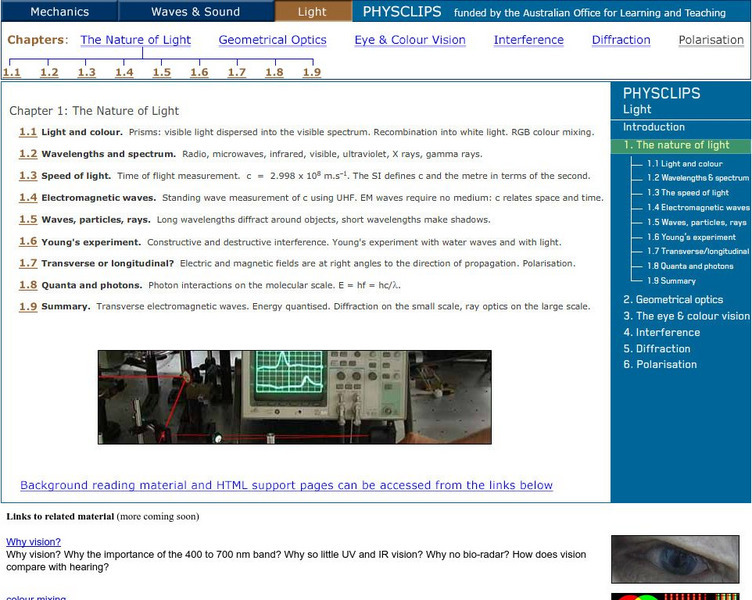
University of New South Wales: School of Physics: Physclips:the Nature of Light
Physiclips thoroughly presents mechanics concepts about light with animations and film clips. Learn about light and color, wavelengths, speed of light, electromagnetic waves, Young's experiment, and photons.

Other
Is the Speed of Light Constant?
Using a question and answer format, this page discusses the question: "Is the Speed of Light Constant?" Discusses some of the history and experiments performed with light and the conclusions drawn from those findings.
Other
Hstry Timeline: It's the Speed of Light, Dude!
An interactive timeline that students can read, watch and listen to in order to understand the scientist who tried and succeeded in measuring the speed of light.
Mocomi & Anibrain Digital Technologies
Mocomi: What Is the Speed of Light?
How fast does light travel? How does its speed change when it travels through different media? Learn how scientists calculate the speed of light and some interesting facts.
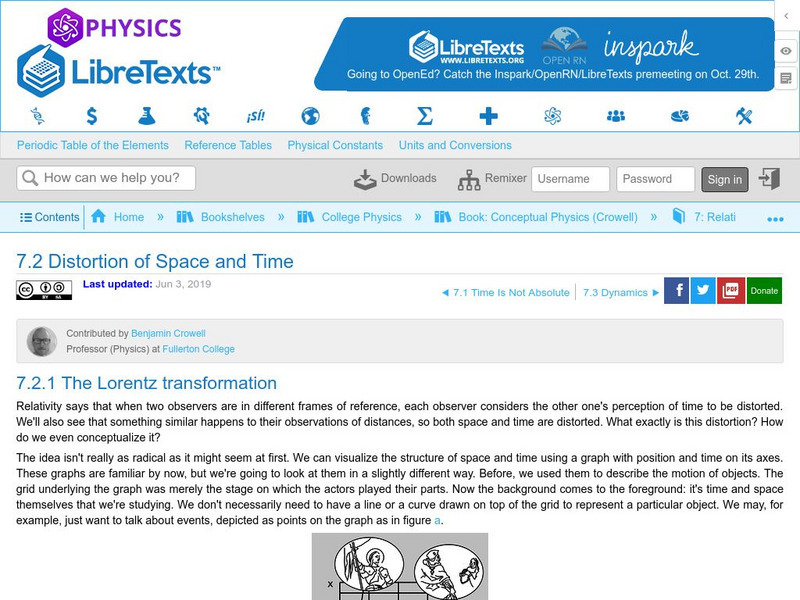
Libre Text
Libre Texts: Physics: Distortion of Space and Time
If the speed of light remains a constant then time and distance change. Oh, it can be confusing! This text will help clear up the confusion. Discussion questions should serve to reinforce comprehension.and exercises
CK-12 Foundation
Ck 12: The Quantum Mechanical Model
[Free Registration/Login may be required to access all resource tools.] In the following online tutorial students will calculate the wavelength, frequency, and energy of light using Planck's constant and the speed of light. They will...
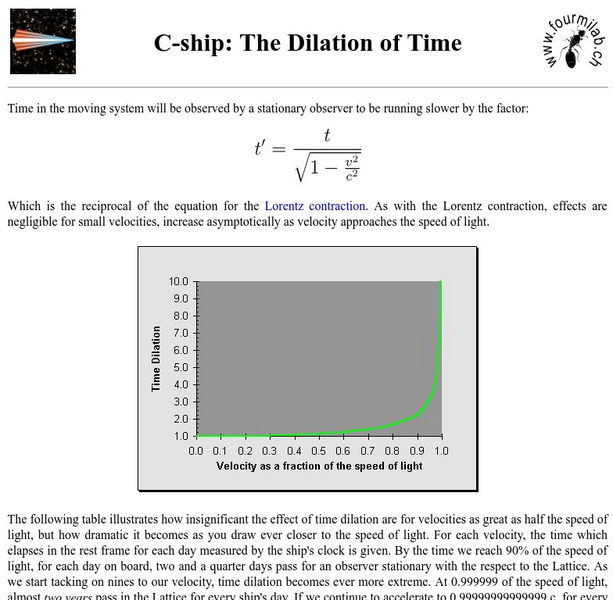
Fourmilab Switzerland
John Walker: C Ship: The Dilation of Time
A good mathematical account of what happens to time as you approach c: the speed of light. Also provides a rather a fascinating video (fly through the Lattice) - don't miss it. Take some time and explore this site.
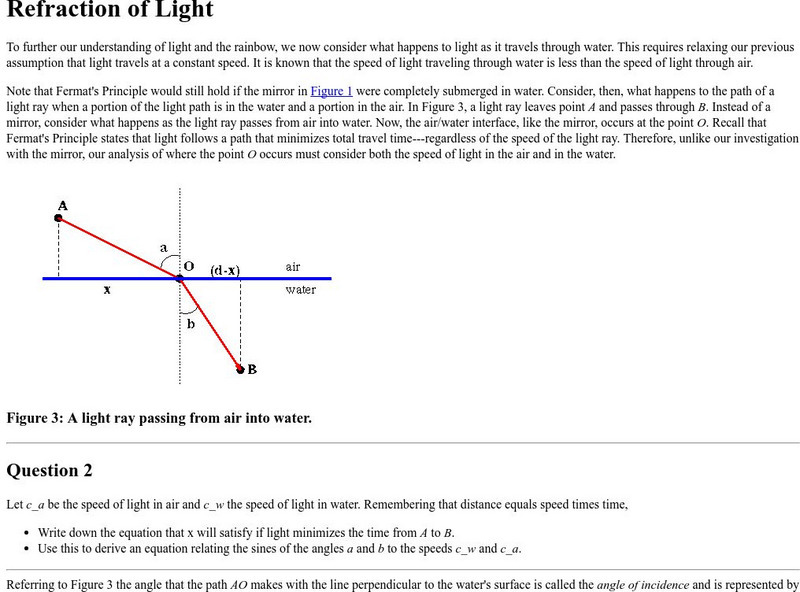
University of Minnesota
University of Minnesota: Refraction of Light
This page is a continuation of a tutorial about light reflection and refraction. It contains a diagram and suggestions on how to derive Snell's Law, which governs the refraction of light in a medium. For background to this derivation,...
Science Struck
Science Struck: How Does Light Travel Through Space and Other Media?
A detailed discussion of the nature of light, how it can travel through a vacuum, and how the speed of light is affected when light travels through a medium.

PBS
Pbs: Nova: Time Travel: Think Like Einstein
Addressed with questions about relative speed and the speed of light, students begin to "think like Einstein" while exploring the science behind the mystery of time travel.
PBS
Pbs Learning Media: Space Math Scale of the Solar System
Practice Space Math! Math is the cornerstone of space travel. Familiarize yourself with all the ways math can help you study the solar system. Practice math problems in areas such as speed of light, the distance of planets to the sun,...
Physics Classroom
The Physics Classroom: Refraction and Ray Model of Light: Direction of Bending
In this interactive physics tutorial about refraction, students investigate the topic of the direction of bending of a light wave.
NC State University
Pira Demonstration Catalog: Speed of Light
A series of short descriptions of possible physics demonstrations for illustrating or measuring the speed of light. Suitable as a supplement to a teacher lesson plan or as an idea-generator for student projects.
Society for Science and the Public
Science News for Students: Breaking the Universal Speed Limit
Describes research into whether neutrinos travel faster than the speed of light.
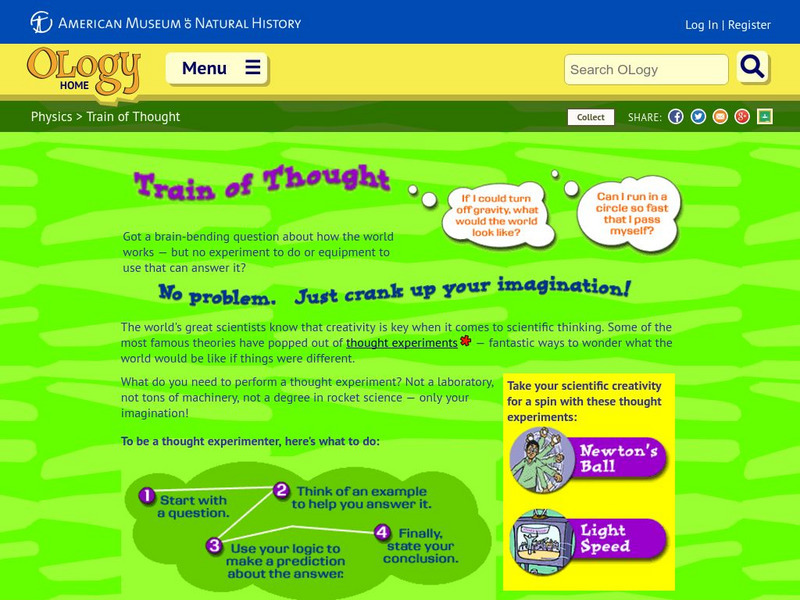
American Museum of Natural History
American Museum of Natural History: O Logy: Train of Thought
Try out your ability to think like Einstein by working through two thought experiments that help explain how satellites stay in orbit and how the speed of light affects the universe.
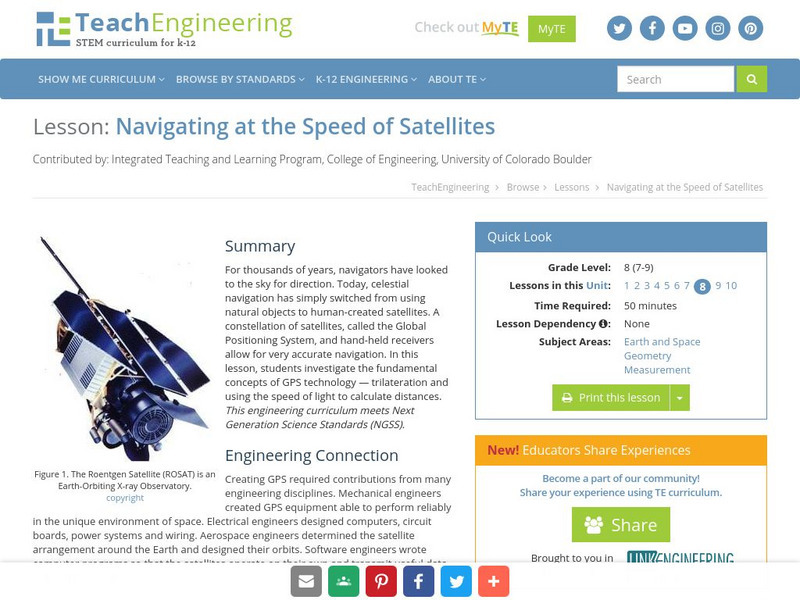
TeachEngineering
Teach Engineering: Navigating at the Speed of Satellites
For thousands of years, navigators have looked to the sky for direction. Today, celestial navigation has simply switched from using natural objects to human-created satellites. A constellation of satellites, called the Global Positioning...
BBC
Bbc: Gcse Bitesize: General Properties of Waves
Light travels as waves. Waves can be described by their amplitude, wavelength and frequency. The speed of a wave can be calculated from its frequency and wavelength.
Stanford University
Stanford University: Conventionality of Simultaneity
This site from Stanford University is on the topic of simultaneity in relativity.
Physics Classroom
The Physics Classroom: Optical Density and Light Speed
A tutorial page explaining how the speed of light is dependent upon the optical density of the material through which it moves. Optical density is related to the index of refraction; sample values are given.

TED Talks
Ted: Ted Ed: The Fundamentals of Space Time: Part 2
In this second installment of a three-part series on space-time, CERN scientists Andrew Pontzen and Tom Whyntie use a space-time diagram to analyze the sometimes confounding motion of light. [4:50]