Hi, what do you want to do?





Khan Academy
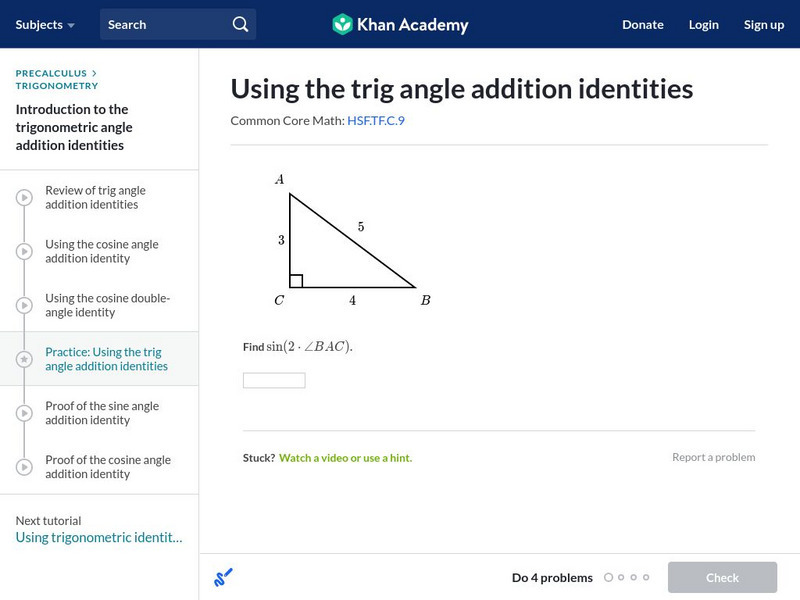
Khan Academy: Using the Trig Angle Addition Identities
Find the trig values of sums of angles whose individual trig values are known. Students receive immediate feedback and have the opportunity to try questions repeatedly, watch a video or receive hints.

Mathigon
Mathigon: Geometry: Triangles and Trigonometry: Pythagoras' Theorem
Pythagoras' Theorem: In any right-angled triangle, the square of the length of the hypotenuse (the side that lies opposite the right angle) is equal to the sum of the squares of the other two sides. (A+B=C)
Mathigon
Mathigon: Geometry: Angles and Polygons: Drawing Triangles
This lesson focuses on the Triangle Inequality, when the sum of the lengths of any two sides of a triangle is greater than the length of the third. When this happens, the three sides cannot form a triangle.
Khan Academy
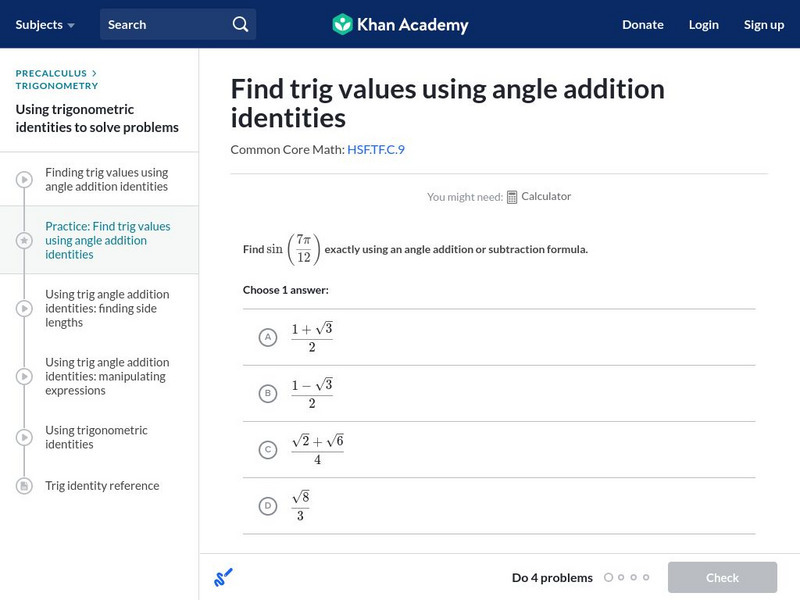
Khan Academy: Find Trig Values Using Angle Addition Identities
Find the trigonometric values of various angles that (while they are not special angles) can be expressed as the sum or difference of special angles. Students receive immediate feedback and have the opportunity to try questions...
Illustrative Mathematics
Illustrative Mathematics: F Tf Sum and Difference Angle Formulas
The goal of this task is to have students derive the addition and subtraction formulas for cosine and tangent, and the subtraction formula for cosine, from the sum formula for sine. Aligns with F-TF.C.9.
Lawrence Hall of Science
The Math Page: Trigonometry: Trigonometric Identities
This resource clearly and thoroughly explains the many types of trigonometric identities. There are example problems solved, problems for the student to attempt, and answers to the student problems.
Math Words
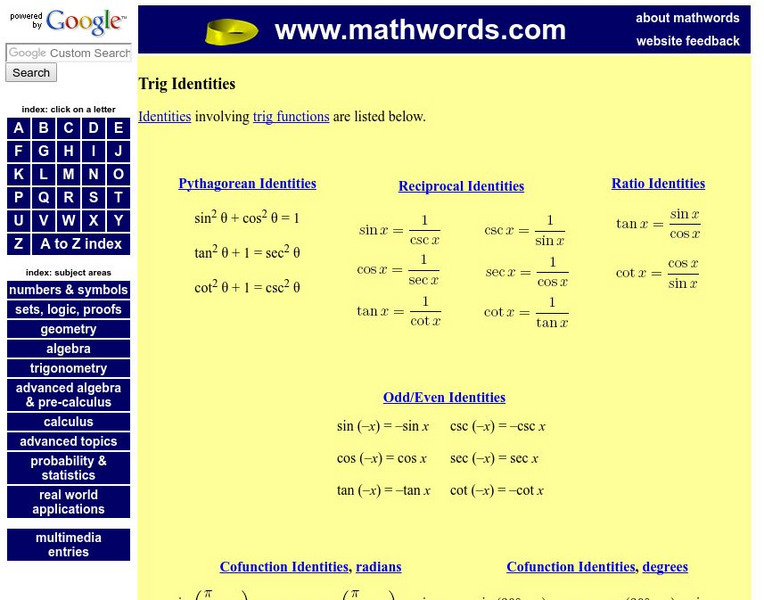
Math words.com: Trig Identities
This MathWords.com site lists the equations for all of the trigonometric identities.

Other
Brown Math: Remembering Trig Identities
Faced with a large number of trigonometric identities, students tend to try to memorize them all. This site the emphasis is on understanding how the functions work and on memorizing only about a half dozen of them - all the others work...