Hi, what do you want to do?





Texas Instruments
Texas Instruments: The World Population: Logistic Model
Students will collect world population data from the Internet, find a logistic model for the data, and use their model to predict future populations.

Geographypods
Geographypods: Theme 1: Population and Settlement
A rich collection of highly engaging learning modules on topics related to population and settlement. Covers six main areas - population growth, population change, population migration, land use, settlement characteristics and patterns,...

Illustrative Mathematics
Illustrative Mathematics: F Le in the Billions and Exponential Modeling
For this task, learners examine world population data from 1804 to 2012 and investigate whether an exponential function is appropriate for modeling the relationship between the world population and the year. Aligns with F-LE.A.1.c.

Other
Rockefeller University: Human Population Dynamics
Mathematically attempts to model human population growth in order to discuss whether the population will skyrocket or level off long before it doubles.

Texas Instruments
Texas Instruments: The World Population: Logistic Model With Ti Interactive!
In this activity, the logistic model for the growth of the world's population will be developed.

Texas Instruments
Texas Instruments: The World Population: Linear and Exponential Models
The population of the world has grown rapidly over the last century. In this activity, several models for the growth of the world's population will be developed. The validity of each in predicting past, current, and future populations...

Illustrative Mathematics
Illustrative Mathematics: F Le in the Billions and Linear Modeling
In this task, students are shown a table of world population data and asked to explore whether linear functions would be appropriate to model relationships within the data. Aligns with F-LE.A.1.b.
University of Saskatchewan (Canada)
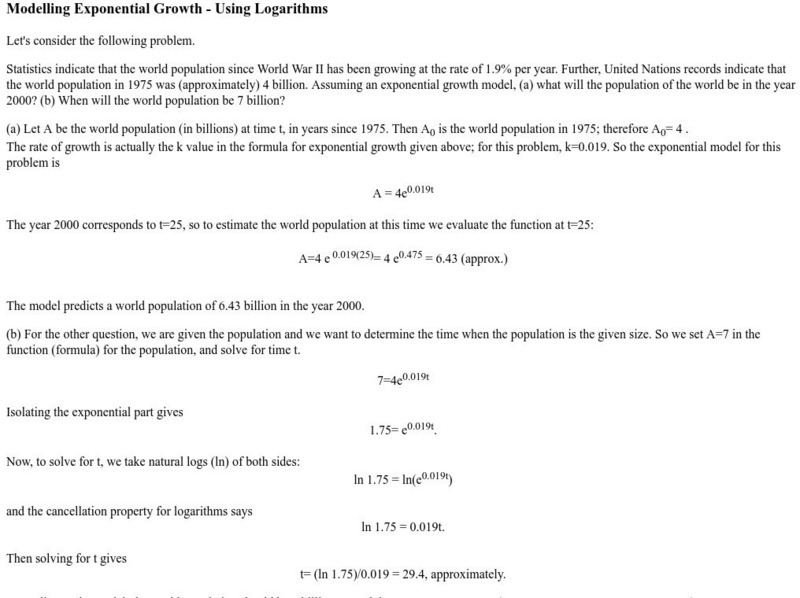
University of Saskatchewan: Modelling Natural Growth
This site shows how to model exponential growth. The site walks the student through an example problem using logarithms to find the exponential growth of the theoretical world population.