Hi, what do you want to do?






University of California
University of California Museum of Paleontology: Distribution in Time and Space
The Understanding Evolution site provides evidence for evolution in biogeography utilizing relative dating, geography, and plate tectonics.
University of California
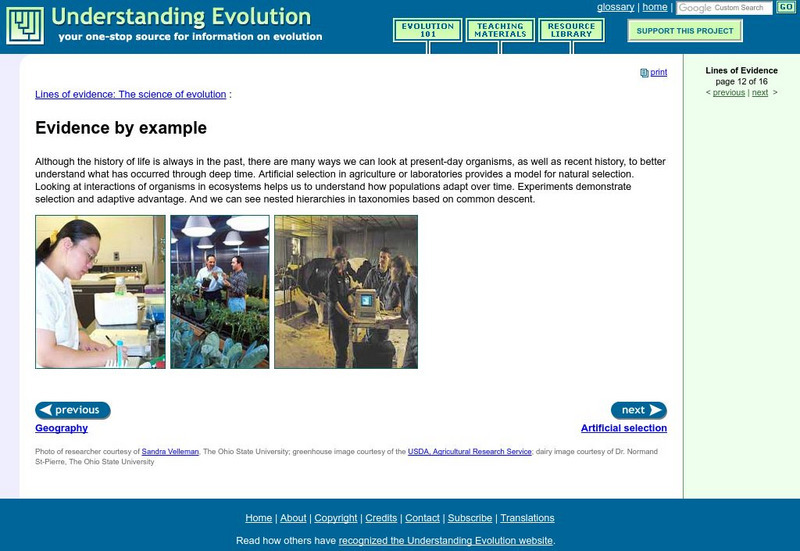
University of California Museum of Paleontology: Evidence by Example
The Understanding Evolution website for teachers provides common examples of evolution, especially by artificial selection.

University of California
University of California Irvine: Evolution of Mammals
A strong, comprehensive look at the evolution of mammals. Includes factors such as changing geologic structure of the earth and the different types found on different continents.
University of California
University of California: The Age of Mammals
This online chapter of a book studying biodiversity and conservation explores the evolution of mammals, from the extinction of the dinosaurs to the evolution of humans.
University of California
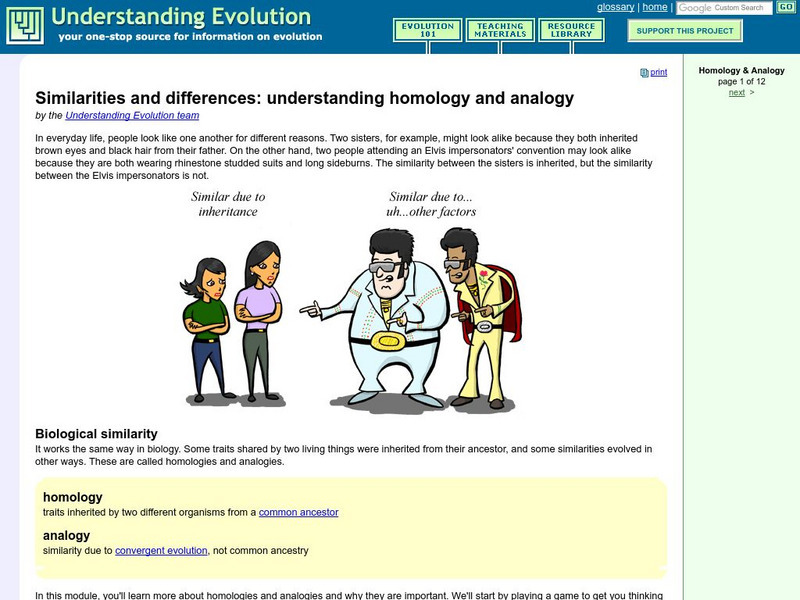
University of California Museum of Paleontology: Similarities and Differences
A module explaining how two different organisms can possess similar traits by sharing a common ancestor(homology) or due to convergent evolution(analogy).
ReadWriteThink
Read Write Think: July 10 the Scopes Trial Began Today in 1925
A great lesson plan using the Scopes Trial as the basis of examining discussion about evolution. Included are student activities as well as links to additional information.
PBS
Pbs Online News Hour Extra: 200 Years Later, Darwin's Theories Still Inspire
Explore this concise article detailing Charles Darwin's Theory of Evolution and follow with discussion questions.

PBS
Pbs: Intimate Strangers: Tree of Life
Find out how Dr. Carl Woese used RNA to develop the tree of life.
Natural History Museum
Natural History Museum: Evolution
As part of a larger online exhibit answering the question, What is evolution, this site examines the specific theory of evolution with immediate attention given to exploring and defining morphs.
Morning Earth
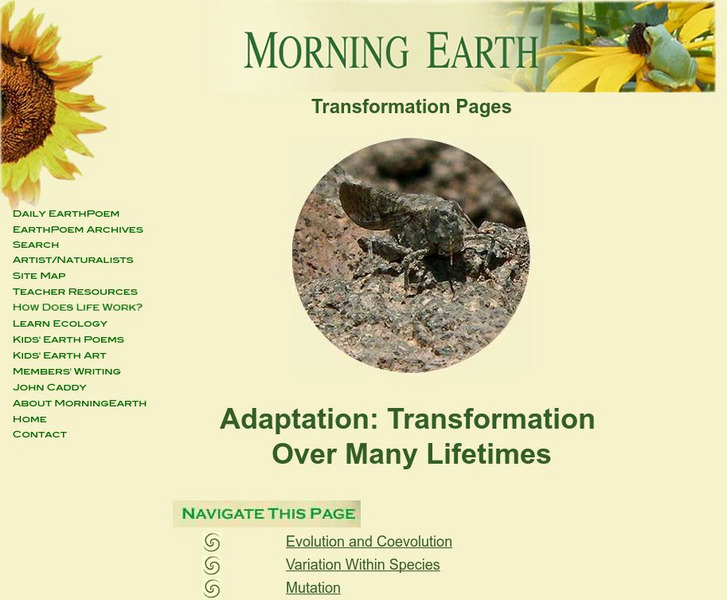
All Lives Interlive: Over Many Lifetimes: Adaptation
The tutorial explores adaptation. Topics examined are evolution, co-evolution, variation within species, and mutation. Definitions, examples, and pictures on the concept are included.
National Health Museum
Nhm: Amino Acid Sequences Show Evolution
This lesson plan focuses on differences in the amino acid sequence of hemoglobin and myoglobin proteins. They use the number of differences to create a phylogenetic tree.
National Health Museum
Access Excellence: Molecular Biology/primate Phylogeny
This lesson plan involves comparison of amino acids to create a phylogenetic tree of primates. Students will also use other species information to draw conclusions about evolutionary relationships.
National Health Museum
Access Excellence: Hardy Weinberg Equilibrium
This site explores what Hardy-Weinberg Equilibrium is, and how teachers can explore this topic in their classrooms. Content includes background information on this topic, as well as numerous learning activities.
PBS
Pbs Teachers: Scientific American: Science Safari: The First People
Emulate the work of archaeologists in South Africa attempting to solve the riddles of human evolution by inferring a person's height from the length of one bone. Identify and communicate present-day rituals through ancient art techniques.

University of California
Understanding Evolution: Microevolution
Get an overview of the process of microevolution.

University of California
Understanding Evolution: Speciation
Explore the evolutionary process of speciation.
Sophia Learning
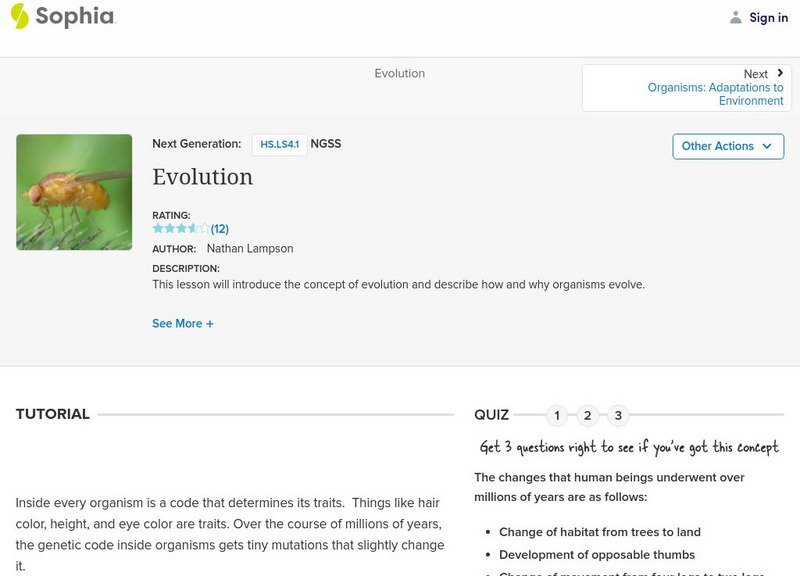
Sophia: Evolution: Lesson 3
This lesson will introduce the concept of evolution and describe how and why organisms evolve.
CK-12 Foundation
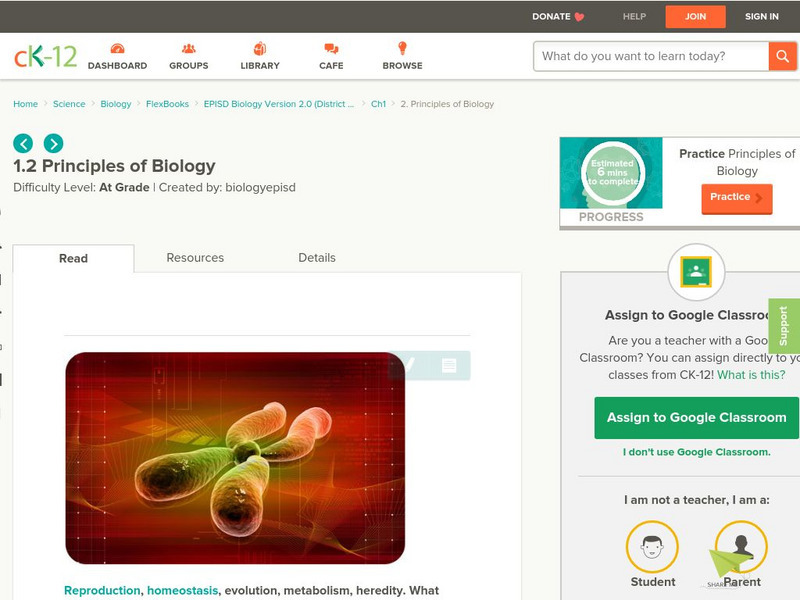
Ck 12: Principles of Biology
[Free Registration/Login may be required to access all resource tools.] Explains the four principles that unify biology - cell theory, gene theory, homeostasis, and evolution.
PBS
Pbs: Nature: Rhinoceros
An interactive timeline describing in both pictures and words the rhinoceroses from 50 million years ago to today. Learn how loss of habitat, poaching, and captivity has changed the rhino population over time.

Scientific American
Scientific American: 50 Years Ago: A Witness at the Scopes Trial
A lengthy article from Scientific American recounting the expert testimony of Fay-Cole Cooper, a professor at the University of Chicago, who supported the idea of evolution in the Scopes Monkey Trial.
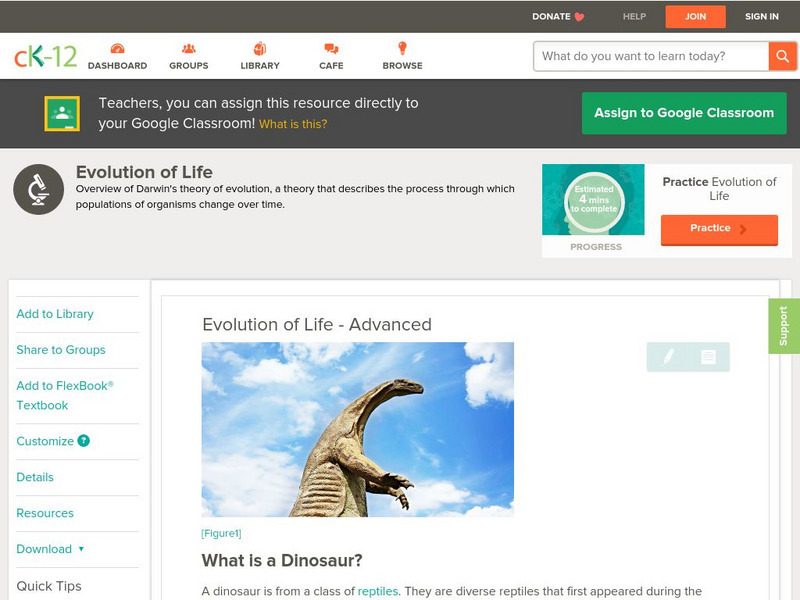
CK-12 Foundation
Ck 12: Biology: Evolution of Life
[Free Registration/Login may be required to access all resource tools.] Covers the evolution of life.
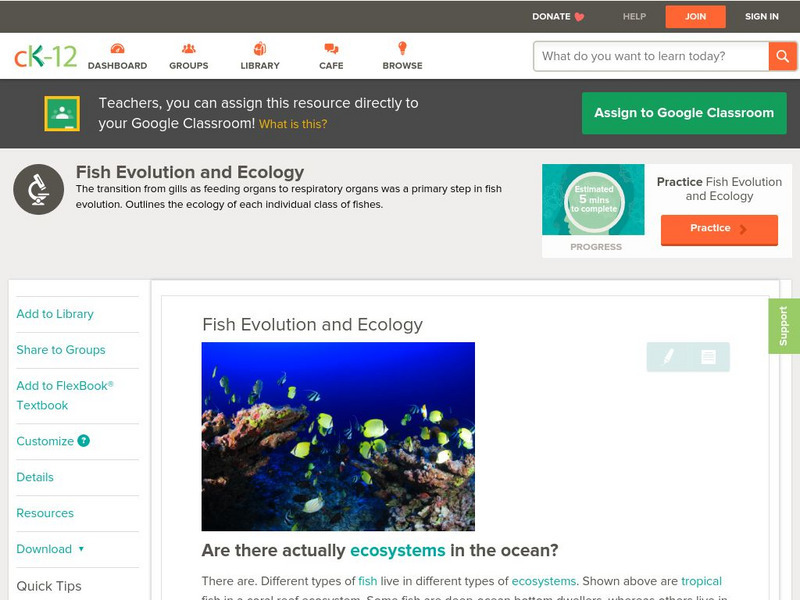
CK-12 Foundation
Ck 12: Biology: Fish Evolution and Ecology
[Free Registration/Login may be required to access all resource tools.] Covers the evolution and ecology of fish.
CK-12 Foundation
Ck 12: Biology: Forces of Evolution
[Free Registration/Login may be required to access all resource tools.] Describes three of the four forces of evolution: mutation, gene flow, and genetic drift.

CPALMS
Florida State University Cpalms: Florida Students: Evolution: Examining the Evidence
Strengthen understanding of how different types of scientific evidence support the theory of evolution, including direct observation, fossils, DNA, biogeography, and comparative anatomy and embryology.