Hi, what do you want to do?





TED Talks
Ted: Ted Ed: How a Single Celled Organism Almost Wiped Out Life on Earth
Anusuya Willis explains how cyanobacteria, simple organisms that don't even have nuclei or any other organelles, wrote a pivotal chapter in the story of life on Earth. [4:14]
TED Talks
Ted: Ted Ed: A Plant's Eye View
What if human consciousness isn't the end-all be-all of Darwinism? What if we are all just pawns in corn's clever strategy game to rule the Earth? Author Michael Pollan asks us to see the world from a plant's-eye view. [17:29]
Tree of Life Project
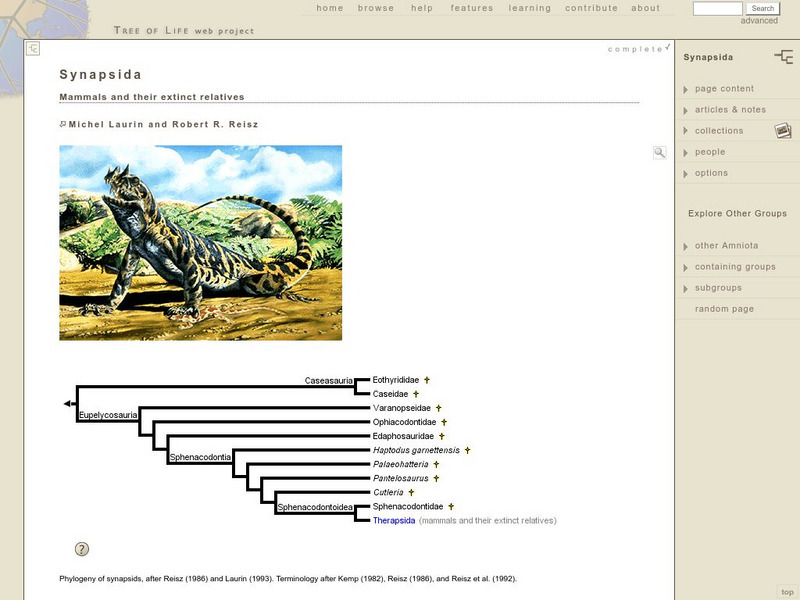
Reptiles: Synapsida
This site contains general information about the extinct link between reptiles and mammals. The Synapsida organisms are the link.
Other
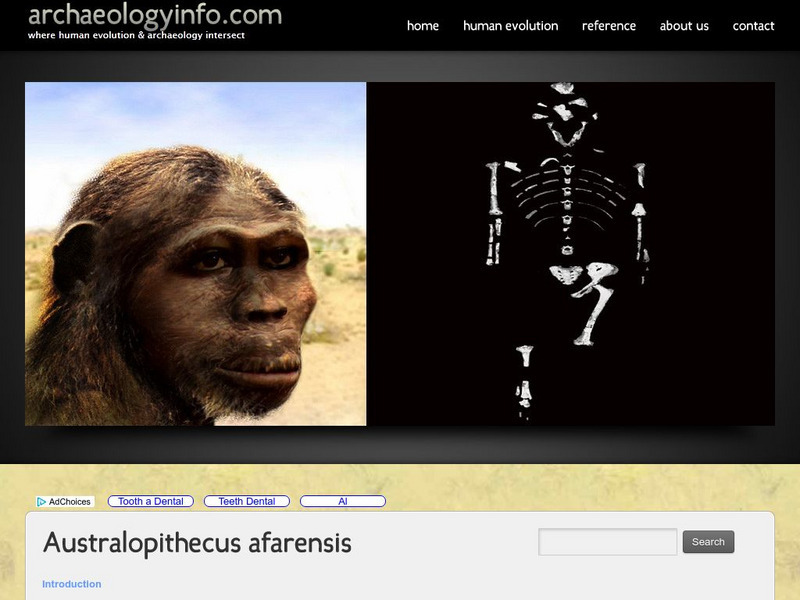
Archaeology Info: Australopithecus Afarensis
This site provides information on the Australopithecus afarensis, a species that is believed to be a human ancestor.

Other
Utct Digi Morph: Digital Morphology the University of Texas
A dynamic archive of information on digital morphology and high-resolution X-ray computed tomography of biological specimens.
Science Daily
Science Daily: Flatworms Are Oldest Living Ancestors
Scientists say that flatworms are the oldest living ancestors of those of us that have right and left sides - that means you!

Tour Costa Rica
Costa Rica: Literature: Prose
The page gives an excellent summary of Costa Rican literature from the 1800s and 1900s. Authors and their works are described.
Eserver
E Server: Summary of Hegel's "Philosophy of Mind"
Topical summary of Hegel's influential but notoriously difficult work from EServer.org. Translates Hegel's vocabulary into ordinary, understandable terms, and divided his major conceptual moves into sections on the individual, society,...
McGraw Hill
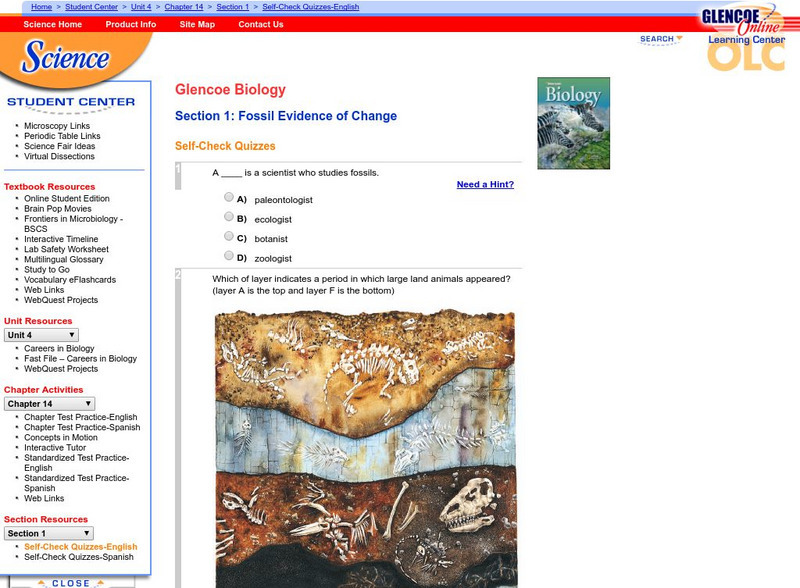
Glencoe Biology: Fossil Evidence of Change: Self Check Quiz
Try these five multiple-choice questions about fossil evidence of change. After submitting answers, students can review the material.
McGraw Hill
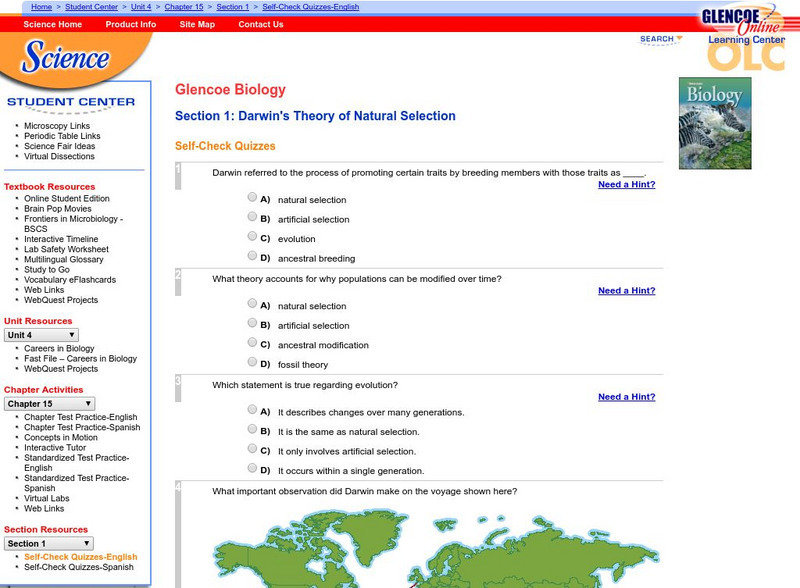
Glencoe Biology: Darwin's of Natural Selection: Self Check Quiz
Try these five multiple-choice quiz questions about Charles Darwin's Theory of Natural Selection.
McGraw Hill
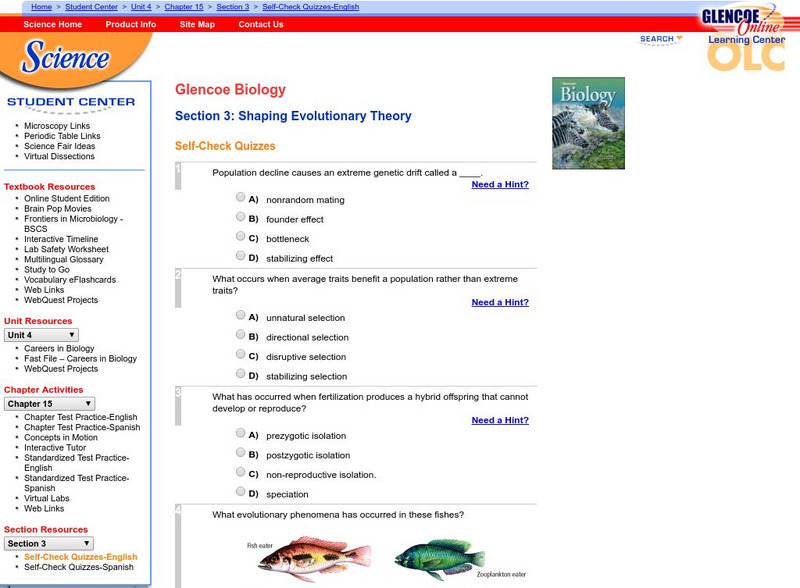
Glencoe Biology: Shaping Evolutionary Theory: Self Check Quiz
This multiple-choice quiz on shaping evolutionary theory allows students to get hints for each question and check their answers after submitting.
National Health Museum
Access Excellence: Wolf Pack in a Bottle: Dna Simulation
This lesson plan can be used to illustrate the principle of electrophoresis without the equipment. Paper chromatography can be used to separate dye just like electrophoresis will separate DNA. The lab also covers DNA analysis for an...
Other
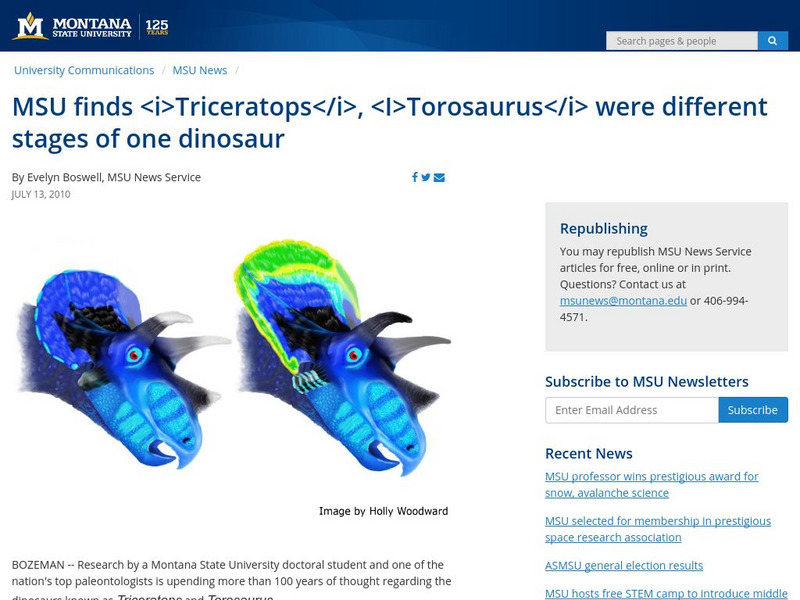
Msu News: Msu Finds Triceratops, Torosaurus Were Different Stages of Dinosaur
Two paleontologists from Montana State University, John Scannella and Jack Horner, discuss their newly released theory that Triceratops and Torosaurus were actually the same dinosaur but at different stages of their life cycle. [Date of...
Sophia Learning
Sophia: 7 Characteristics of Life: Lesson 2
This lesson will introduce the 7 characteristics of all living things. It is 2 of 4 in the series titled "7 Characteristics of Life."
Other
Cincinnati Museum Center
This site describes the Museum of Natural History and Science in detail and provides links to other programs and exhibits offered.
Khan Academy
Khan Academy: Natural Selection in Populations
How natural selection works at the level of genes, alleles, genotypes, & phenotypes.
Khan Academy
Khan Academy: Species & Speciation
Find out what defines a species, and learn how new species can arise from existing species.
Khan Academy
Khan Academy: Phylogenetic Trees
Learn what a phylogenetic tree is, Learn how to read phylogenetic trees and determine which species are most related.
Khan Academy
Khan Academy: Building a Phylogenetic Tree
Understand the logic behind phylogenetic trees. Learn how to build a tree using data about features that are present or absent in a group of organisms.
CPALMS
Florida State University Cpalms: Florida Students: Classification Using Dna
Identify the differences in genetic and non-genetic classification methods. Why is genetic evidence powerful for understanding evolutionary relationships among organisms? Find out!
Famous Scientists
Famous Scientists: Charles Darwin
A short biography of Charles Darwin, and how he discovered evolutionary theory and natural selection.
Famous Scientists
Famous Scientists: Charles Lyell
Learn about the works of Charles Lyell, a geologist who studied Earth's history.
Famous Scientists
Famous Scientists: E. O. Wilson
Find out about the environmental advocate known as both the father of sociobiology and the father of biodiversity, Edward O. Wilson.