Hi, what do you want to do?






Fuse School
Molar Volumes of Gases
In the United States, motor vehicles cause around 75 percent of the carbon monoxide pollution, but how do we measure this pollution? The 21st video in a series of 30 discusses what we mean by molar volumes of gases. It...

DoodleScience
Non-Renewable Energy Resources
What is a fossil fuel and why is it important? The video explains fossil fuels as an energy source and how they may be harmful to the environment. Nuclear energy is an alternative with its own implications.

Crash Course
The Hydrologic and Carbon Cycles: Always Recycle!
Introduce biogeochemical cycles and goes into detail about the hydrologic and carbon cycles. A scientific video engages learners and teaches them at the same time.

TED-Ed
How to Create Cleaner Coal
It's easy to take for granted the the importance of electricity in modern society, and even easier to overlook the environmental cost that is paid for all that energy. Watch as this video explores the detrimental impact...

TED-Ed
Cambridge Ideas - How Many Lightbulbs?
Humans have become addicted to fossil fuels. From pumping oil into our cars, to burning natural gas to heat our water, or using coal to create electricity that lights our homes, we are constantly relying on these nonrenewable resources....

Curated OER
The Carbon Cycle
Hear how carbon functions on our earth and the purpose it serves. The carbon cycle is illustrated with narration for your junior high or high school biologists. Global temperature increase is also included, though the clip cuts off...

Curated OER
Natural Gas
Did you know that natural gas is the cleanest burning fossil fuel? The cost of processing natural gas is significantly less than processing even nuclear and wind energy. In this fast-moving, upbeat video, viewers learn about the benefits...

Curated OER
Crude Oil
Watch the distillation process as a female narrator explains what is happening. Ideally you would demonstrate this process or have advanced classes work in lab groups to perform it themselves. If time is short or materials not available,...

Curated OER
Sources of Energy
Explore the various sources of energy with your junior scientists. Rather than a video, this is a series of slides that the narrator simply reads aloud. Unless your learners have the energy to keep themselves alert, this may not be the...

Curated OER
Fossil-Fuelled Electricity - How it Works
Thermal power is electricity generated by the burning of fossil fuels. Through a series of video clips and computer animations, youngsters learn about how coal is used to produce useful electricity. The website provides quizzes that are...

PBS
Pbs Learning Media: Capturing Carbon
In this video segment adapted from NOVA scienceNOW, a scientist, inspired by his daughter's science fair project, develops a synthetic tree to remove excess carbon dioxide from the air. [5:23]

PBS
Pbs: Frontline Heat
Our world is changing dramaticlly. View these nine videos with links to related content that deal with the evidence of global warming, dependence on fossil fuels and the potential we have to stop the damage.
The Atlantic Monthly Group
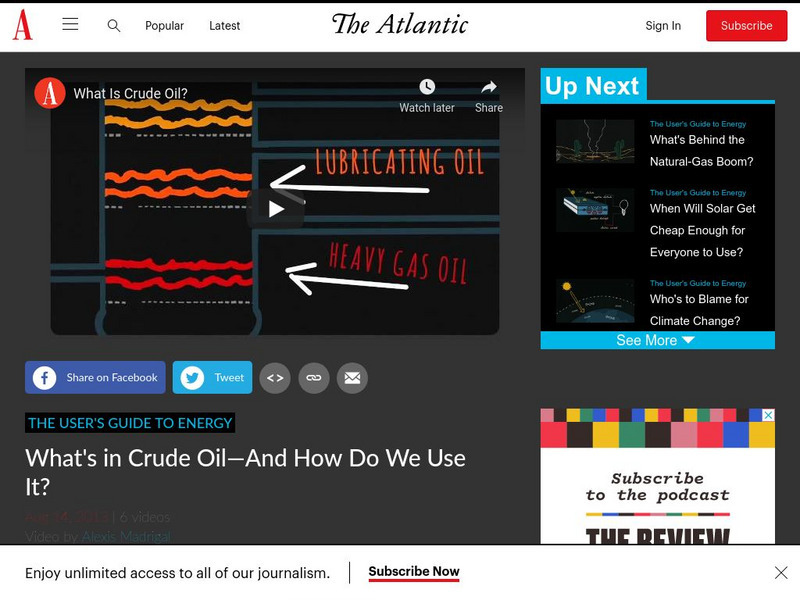
The Atlantic: What's in Crude Oil and How Do We Use It?
Understand the refining process that turns crude oil into gasoline, diesel fuel, aviation fuel, and other useful products with this video. [1:55]
NPR: National Public Radio
Npr Videos: Skunk Bear: The Carbon Footprint of a Sandwich
What is the carbon footprint of a sandwich? Follow the path of a BLT from field to plate in this video and you will see a simple sandwich isn't so simple!
PBS
Pbs Learning Media: Global Warming: The Hydrogen Car
Is the hydrogen car the answer to global warming? This video segment adapted from NOVA/FRONTLINE looks at the pros and cons of this developing technology. Uses popups. [1:26]
PBS
Pbs Learning Media: Energy Sources
This video segment illustrates a variety of energy sources used to generate electricity, some of which are in use and some of which are under exploration. [6:09]

Khan Academy
Khan Academy: The History of Everything Ted
David Christian gives a TED talk covering the Universe's 13.8 billion year history in 18 minutes.

Khan Academy
Khan Academy: Crash Course World History: Globalization Ii Good or Bad?
John Green asks whether globalization is a net positive for humanity. While the new global economy has created a lot of wealth and lifted a lot of people out of poverty, it also has some effects that aren't so hot. [13:54]

Khan Academy
Khan Academy: How Do Earth and Life Interact?
A look at the 'comfort zone' humans live in, and the interplay of life and the biosphere. [9:58]

Khan Academy
Khan Academy: How Was the Modern World Created?
This video looks at three forces of change that gather momentum and help create the modern world, transforming the biosphere. [11:22]
PBS
Pbs Learning Media: American Experience: Building the Alaska Oil Pipeline
Short AMERICAN EXPERIENCE video tells the story of how environmentalists, Alaska Native peoples, and engineers concerned about the effects of permafrost challenged plans for the Alaska oil pipeline. [5:19]

PBS
Nova Labs: A Never Ending Supply
Renewable energy sources might just be the answer to a sustainable future. What makes an energy source renewable, and how can we use these sources to power our societies well into the future? [2:44]
Bozeman Science
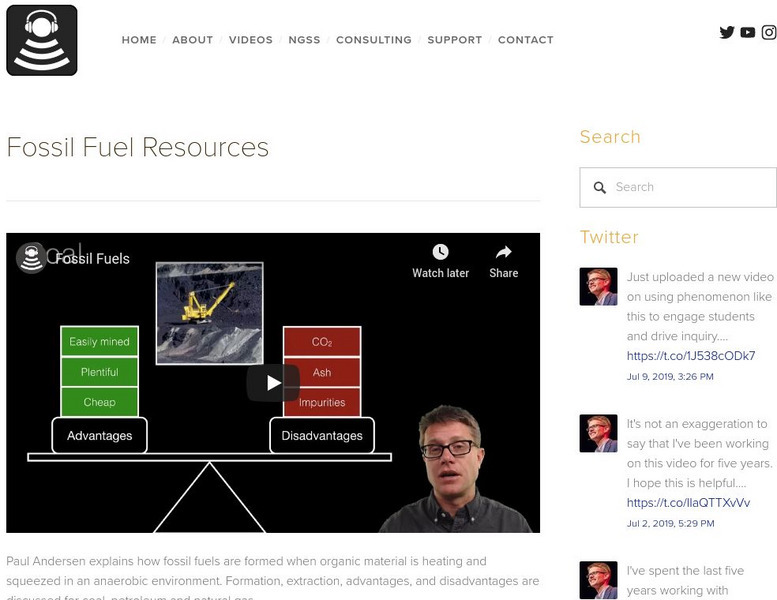
Bozeman Science: Fossil Fuel Resources
Paul Andersen explains how fossil fuels are formed when organic material is heating and squeezed in an anaerobic environment. Formation, extraction, advantages, and disadvantages are discussed for coal, petroleum and natural gas. [7:57]

Kurzgesagt
You Tube: Kurzesagt in a Nutshell: Fracking Explained Opportunity or Danger
Fracking is a controversial topic. On the one side the gas drilling companies, on the other citizen opposed to this drilling method. Politicians are also divided on the matter.We try to take a neutral look on fracking. It is relevant for...