Hi, what do you want to do?





Read Works
Read Works: The Descendants
[Free Registration/Login Required] This passage discusses the roles of paleoanthropologists and how they determine whether the remains of a prehistoric species is a direct ancestor or not. This passage is a stand-alone curricular piece...
CK-12 Foundation
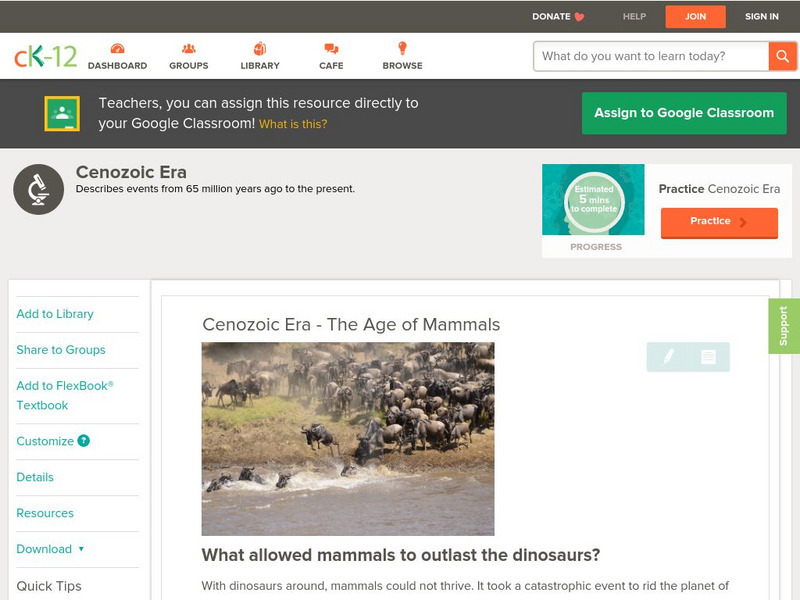
Ck 12: Biology: Cenozoic Era the Age of Mammals
[Free Registration/Login may be required to access all resource tools.] Covers the Cenozoic Era, the age of mammals.
CK-12 Foundation
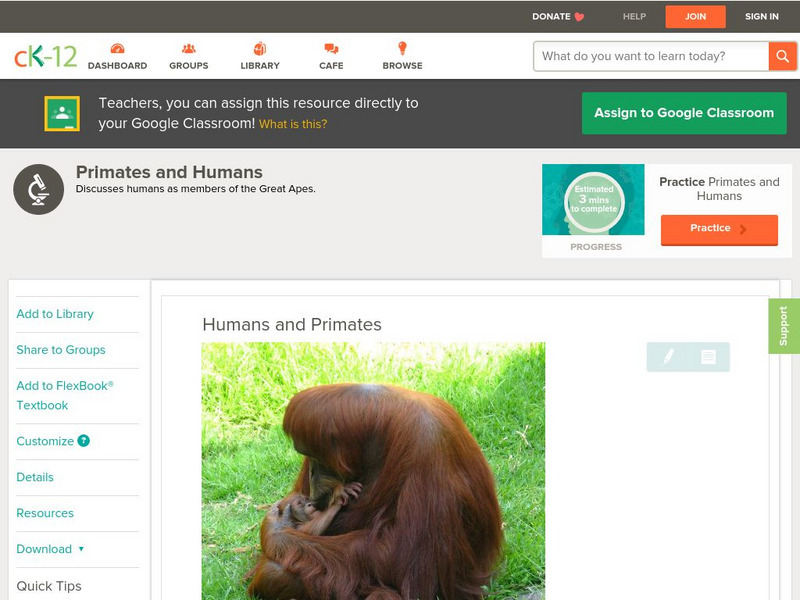
Ck 12: Life Science: Humans and Primates
[Free Registration/Login may be required to access all resource tools.] The great apes are the members of the biological family Hominidae, which includes four living genera: chimpanzees, gorillas, humans, and orangutans. Learn more about...
Lin and Don Donn
Lin and Don Donn: Who's Who of Early Man
The little cave man guy with a club welcomes you to the site. Did early man look like him? Mr. Donn has put together a Cheat Sheet of Who's Who of Early Man beginning with the famous Lucy and ending with men that looked a lot like us!

BiologyWise
Biology Wise: Theories Behind the Extinction of Neanderthals
Discusses the discovery of Homo neanderthalensis and describes the different theories that have been put forward to explain why Neanderthals became extinct.
A&E Television
History.com: How Early Humans Survived the Ice Age
The most recent ice age peaked between 24,000 and 21,000 years ago, when vast ice sheets covered North America and northern Europe, and mountain ranges like Africa's Mt. Kilimanjaro and South America's Andes were encased in glaciers. At...
BBC
Bbc: The Story of Afrca: Early History
A brief article detailing theories of Africa's early rich history.
PBS
Pbs Nova: Who's Who in Human Evolution
Easy-to-understand chart of human evolution that traces hominins back more than six million years. Follow along using this clickable illustration right up to us, Homo sapiens. Clicking on each name will provide a brief descriptive...