Hi, what do you want to do?






Fuse School
Testing for the Negative Ions
Polyatomic ions... where do I begin? One of the most difficult concepts for budding scientists to learn and recognize comes to life in an enlightening resource. Show pupils some demonstrations, via the sixth video in a series of 10, to...

Fuse School
Testing for the Positive Ions (Part 2)
How can you tell the difference between chemical compounds, when so many of them are white and powdery? The fifth installment in a series of ten videos exposes learners to flame tests and formation of insoluble compounds as methods...

Fuse School
Testing for the Presence of Water
Want to know a secret? Young chemists may dismiss the idea of needing to test for the presence of water after a chemical reaction, but when you tell them they can create invisible ink in the process, that might get their attention!...

Fuse School
Testing for Hydrogen, Oxygen, Carbon Dioxide, Ammonia, and Chlorine
How can a chemist tell what gas a chemical reaction produced? Part two of a ten-part series prompts pupils to discover a number of simple tests that can reveal the identity of a gas. The video reinforces the concepts of solubility,...

Fuse School
Titrations
Cartoon drawings demonstrate the proper way to complete a titration lab. The video includes information about the tools needed, the set up required, and the reason for multiple trials.

Fuse School
Acid + Metal
What happened to the woman who was stopped for having sodium chloride and a nine-volt in her car? She was arrested for a salt and battery! Here's a video that explains how combining an acid with a metal produces a salt and water and...

Fuse School
Indicators
Use a scientific video that begins with types of pH indicators, including pH meters, universal indicators, and litmus paper to explain titration indicators.

Berkeley University of California
Strong Acid and Indicator+Base (NB)
What happens when you mix a strong base into a strong acid and the resulting pH change? Explore this reaction with a demonstrative chemistry video. This is the ninth video in a series of 13.

Curated OER
Disappearing Ink with a Carbon Dioxide Blast!
Create disappearing ink and send your own secret messages. Have your learners explore the properties of acids and bases in order to figure out how to cause a chemical reaction. After they understand the process, they can perform some...

Steve Spangler Science
Milk of Magnesia - Cool Science Experiment
Learn from Steve how to perform a beautiful demonstration of how an antacid works. He puts a pH indicator solution into a beaker with a magnetic stirrer. He pours an acid in to show the red and a base to show the blue. Then he puts...

Steve Spangler Science
Goldenrod Paper Message - Sick Science! #059
Have your class write secret messages using Goldenrod paper and a basic liquid such as ammonia. This is a great way to illustrate the chemical reactions between acids and bases. This could lead to an exploration of chemical reactions and...

Steve Spangler Science
Disappearing Ink - Cool Science Experiment
Create disappearing ink and send your own secret messages. Have your learners explore the properties of acids and bases in order to figure out how to cause a chemical reaction. After they understand the process, they can perform some...

Steve Spangler Science
Berry pH Paper - Sick Science! #048
Steve Spangler shows how to make your own litmus paper. Using blackberries, construction paper, and water, learners can make their own litmus paper in the classroom. Then, they can take different liquids, such as oil and soapy water, and...
Khan Academy
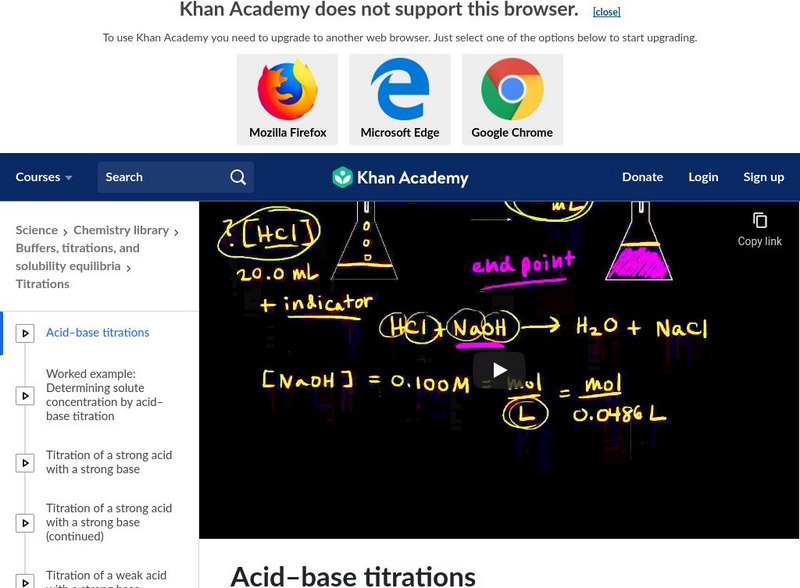
Khan Academy: Titration Introduction
Introduction to acid-base titrations using example of titrating 20.0 mL of HCl of unknown concentration with 0.100 M NaOH. Covers indicators, endpoint, equivalence point, and calculating the unknown concentration. [8:50]

Khan Academy
Khan Academy: Titration Introduction
This video is an introduction to acid-base titrations using example of titrating 20.0 mL of HCl of unknown concentration with 0.100 M NaOH. Covers indicators, endpoint, equivalence point, and calculating the unknown concentration.