Hi, what do you want to do?






Massachusetts Institute of Technology
Mit: Blossoms: How Mosquitos Fly in the Rain
By viewing high-speed videos of raindrops hitting mosquitos, learn how insects are able to fly in the rain by calculating the impact forces of raindrops on flying mosquitoes.
Massachusetts Institute of Technology
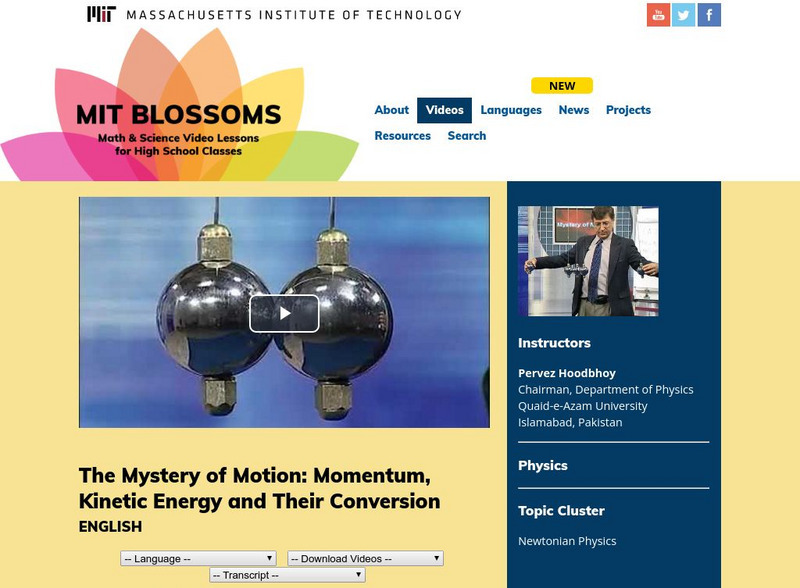
Mit: Blossoms: The Mystery of Motion: Momentum, Kinetic Energy & Conversion
In this video lesson, the concept of momentum applied to hard-body collisions is explained using a number of simple demonstrations, all of which can be repeated in the classroom. Understanding Newton's Laws is fundamental to all of...

Khan Academy
Khan Academy: Momentum : Introduction to Momentum
A video showing that momentum is the product of mass and velocity. Video contains a simple example problem to show how to calculate. [9:17]

PBS
Wnet: Thirteen: Circus Physics: Linear Momentum
Platform trapeze requires athleticism, good timing, and a strong understanding of the principle of conservation of linear momentum. The momentum of a system is the sum of the momenta of all the objects in it. Like energy, the momentum of...
University of Nebraska
University of Nebraska Lincoln: Football Physics
Every Husker home game, Dr. Tim Gay attempts something as crazy as running against the NU defense: bringing physics to everyday life. In one-minute segments shown on the screens around the stadium, he talks about basic physics concepts...

Sophia Learning
Sophia: Solving for Momentum in Inelastic Collisions
This lesson demonstrates how to find the momentum of objects after they have undergone an inelastic collision.

Sophia Learning
Sophia: Using Conservation of Momentum
This lesson demonstrates how the momentum of a system is conserved.

Bozeman Science
Bozeman Science: Momentum
In the following video Paul Andersen will first define momentum as the product of an object's mass and velocity. 3.56]

Bozeman Science
Bozeman Science: Impulse
In the following video Paul Andersen defines impulse as the product of the force applied and the time over which the force is applied. The impulse of an object is equivalent to the change in momentum of the object. [9:11]
Bozeman Science
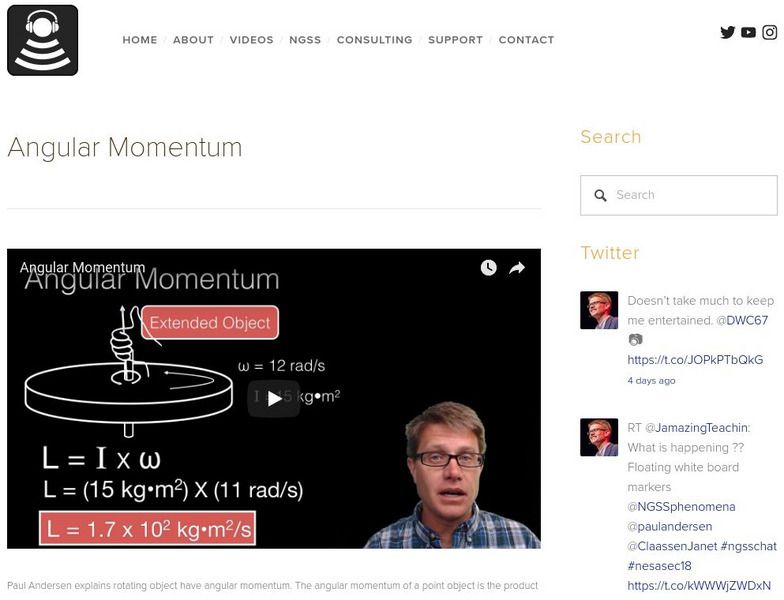
Bozeman Science: Angular Momentum
Video [7:28] in which Paul Andersen explains in a clear and understandable way, that rotating objects have angular momentum.

Bozeman Science
Bozeman Science: Force Time Graph
In the following video Paul Andersen explains hot the force-time graph can be used to determine the impulse of an object. Since the impulse and the change in momentum are equivalent the graph can also be used to determine the change in...
Bozeman Science
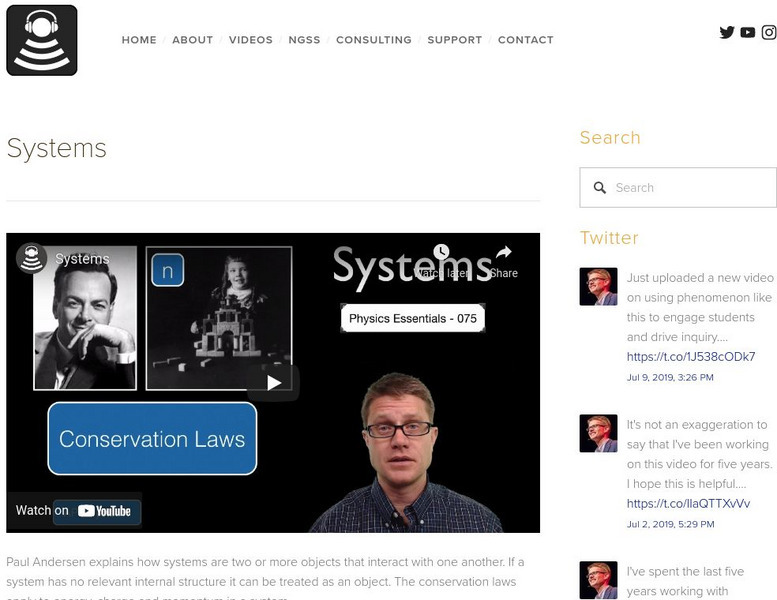
Bozeman Science: Systems
The following video narrated by Paul Andersen explains how systems are two or more objects that interact with one another. If a system has no relevant internal structure it can be treated as an object. The conservation laws apply to...
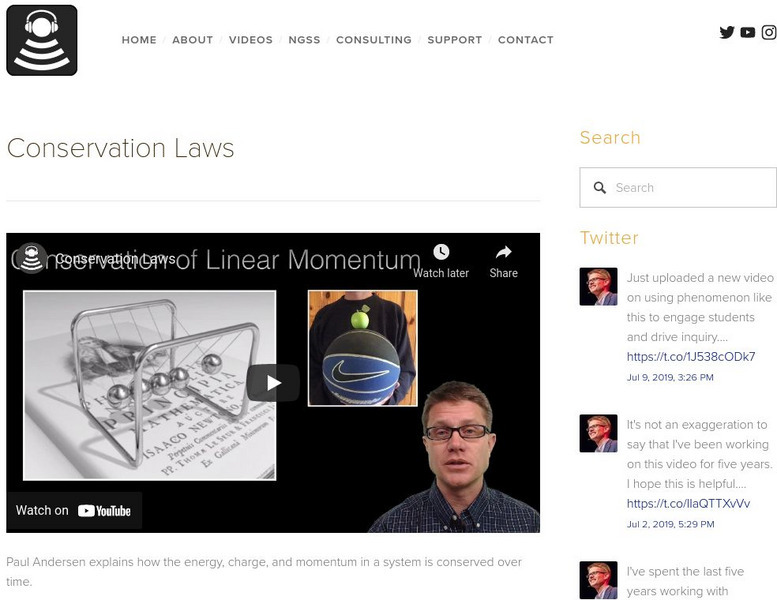
Bozeman Science
Bozeman Science: Conservation Laws
The following video narrated by Paul Andersen explains how the energy, charge, and momentum in a system is conserved over time. [4:53]
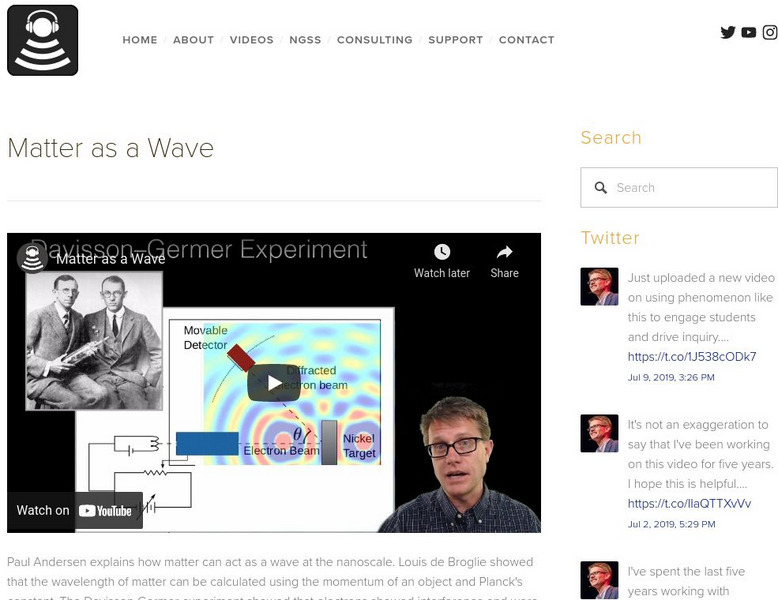
Bozeman Science
Bozeman Science: Matter as a Wave
In the following video Paul Andersen explains how matter can act as a wave at the nanoscale. Louis de Broglie showed that the wavelength of matter can be calculated using the momentum of an object and Planck's constant. The...
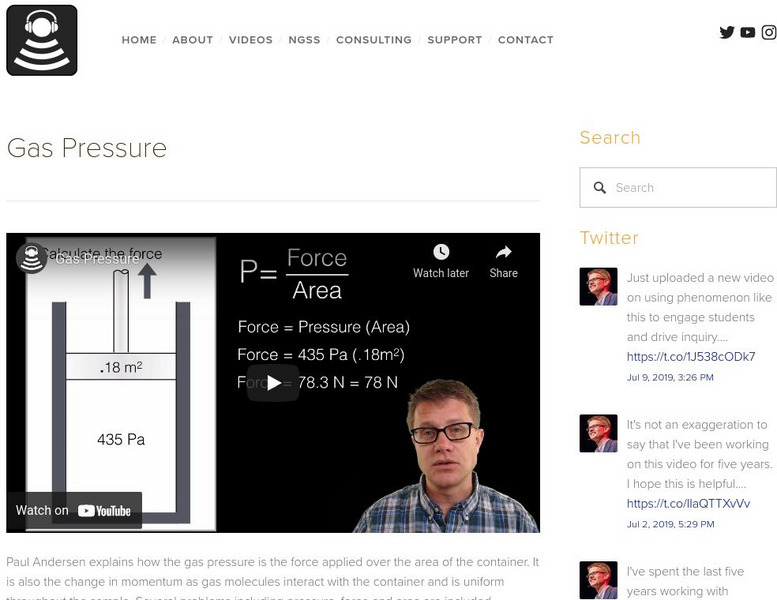
Bozeman Science
Bozeman Science: Gas Pressure
In the following video Paul Andersen explains how the gas pressure is the force applied over the area of the container. It is also the change in momentum as gas molecules interact with the container and is uniform throughout the sample....
National Science Foundation
National Science Foundation: Science of Speed: Momentum and Time
Increasing the time of a collision from a tenth of a second to two tenths of a second can make a huge difference in the number of G's a driver experiences. The car, the track, seat belts, and seat construction spread out the force of...

Other
Physics Girl: Stacked Ball Drop
Momentum transfer is demonstrated by dropping a perfectly balanced stack of balls. How is the result like a supernova? [3:33]
Crash Course
Crash Course Physics #44: Quantum Mechanics Part 2
e=mc2. It's a big deal, right? But why? And what about this grumpy cat in a box and probability? In this video episode of Crash Course Physics, Shini attempts to explain a little more on the topic of Quantum Mechanics. [9:07]

Khan Academy
Khan Academy: Chemistry: Proof: U=(3/2)pv or U=(3/2)n Rt
A video lecture that relates pressure, volume, and temperature to internal energy. The lecture shows how to derive an equation for the ideal gas to relate internal energy and pressure and volume. The video shows that if the temperautre...

Khan Academy
Khan Academy: Momentum: Introduction to Momentum
Explains what momentum is, and works through a simple problem involving momentum. [9:18]

Sophia Learning
Sophia: Decreasing Momentum
A video module showing that to determine a decrease in momentum you should look at impulse. Videos explores the equation for impulse and its application. Also given in lesson is an example of how to decrease momentum. [4:59]
Sophia Learning
Sophia: Introduction to Impulse
A screencast which provides an explanation of impulse force as it relates to Newton's laws of motion. [4:12]
Sophia Learning
Sophia: Mass, Velocity, and Momentum
A narrated presentation which illustrates how momentum is affected by mass and velocity. [3:16]

The Kid Should See This
Tksst: Physics Girl: The Stacked Ball Drop (And Supernovas)
What happens when you drop a stack of bouncy balls together? Watch this classic momentum transfer demonstration, and discover how it relates to a supernova. [3:33]