Hi, what do you want to do?






Bozeman Science
Bozeman Science: Matter as a Particle
In the following video Paul Andersen explains how matter, like light, can be treated as both a particle and a wave. Louis de Broglie proposed that matter could act as a wave and described the wavelength of matter as a function of...
Bozeman Science
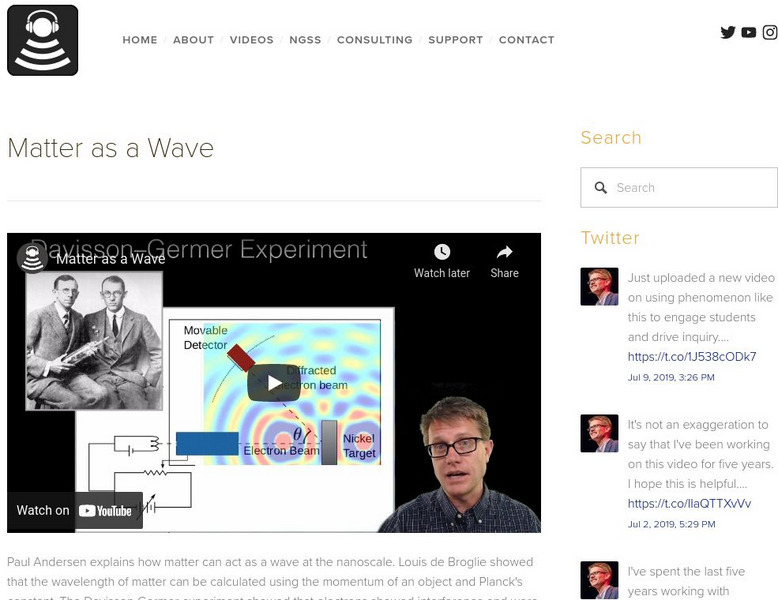
Bozeman Science: Matter as a Wave
In the following video Paul Andersen explains how matter can act as a wave at the nanoscale. Louis de Broglie showed that the wavelength of matter can be calculated using the momentum of an object and Planck's constant. The...
Crash Course
Crash Course Astronomy #24: Light
In order to understand how we study the universe, we need to talk a little bit about light. Light is a form of energy. Its wavelength tells us its energy and color. Spectroscopy allows us to analyze those colors and determine an object's...

PBS
Pbs Learning Media: Inverse Square Law
This animation from KET's distance learning physics course demonstrates the mathematical formula for a scientific law as it applies to light.
Bozeman Science
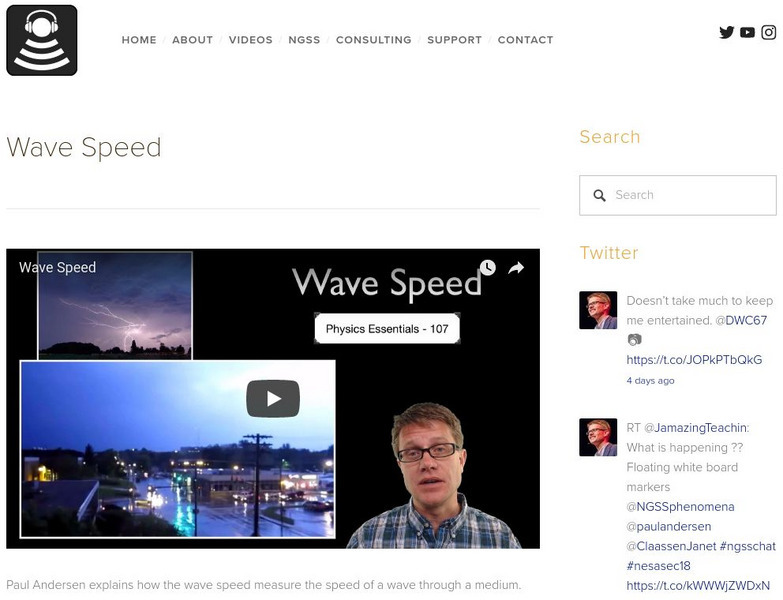
Bozeman Science: Wave Speed
In the following video Paul Andersen explains how the wave speed measure the speed of a wave through a medium. The medium determines the speed of the wave. The velocity of the wave is equal to the product of the wavelength and the...
Bozeman Science
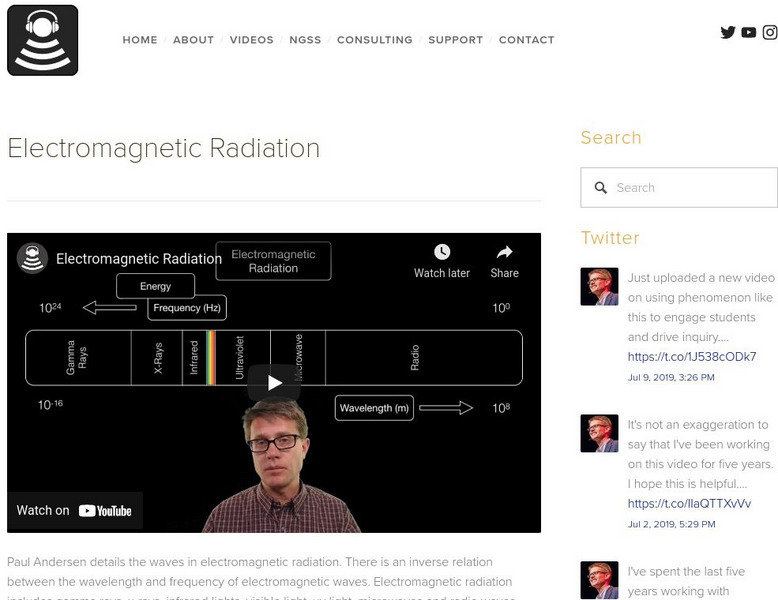
Bozeman Science: Electromagnetic Radiation
In the following video Paul Andersen details the waves in electromagnetic radiation. There is an inverse relation between the wavelength and frequency of electromagnetic waves. Electromagnetic radiation includes gamma rays, x-rays,...
Crash Course
Crash Course Physics #17: Traveling Waves
Waves are cool. The more we learn about waves, the more we learn about a lot of things in physics. Everything from earthquakes to music! Ropes can tell us a lot about how traveling waves work so, in this video episode of Crash Course...

Khan Academy
Khan Academy: Amplitude, Period, Frequency and Wavelength of Periodic Waves
A video looking at the properties of periodic waves, including amplitude, period, frequency, and wavelength. [14:26]
NPR: National Public Radio
Npr Videos: Skunk Bear: Finding the Speed of Light With Peeps
There's a new use for those stale Easter marshmallows you have lying around - calculating a constant that governs the universe. [5:06]

Khan Academy
Khan Academy: Standing Waves in Closed Tubes
Find out why you can make music by blowing into empty bottles. [9:57]
Sophia Learning
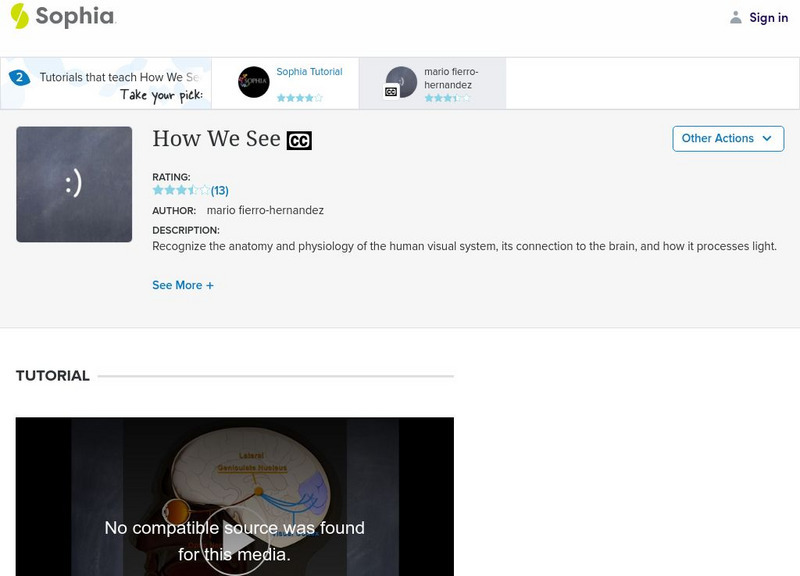
Sophia: How We See: Lesson 2
This lesson will introduce you to the anatomy and physiology of the human visual system, its connection to the brain and how this system processes light. It is 2 of 3 in the series titled "How We See."