Hi, what do you want to do?






Steve Spangler Science
Play and Freeze - Having Fun Making Ice Cream
Steve Spangler has created a toy that relies on science to make ice cream! He uses a ball with two cylinders inserted. One contains rock salt and water, while the other contains the ice cream ingredients. Once sealed, a family kicks the...

Curated OER
Dry Ice Fun for a Spooky Halloween
Create a cauldron of bubbling fun with this Halloween-themed demonstration idea. Using dry ice, Steve Spangler creates a crystal ball. If you compare the sublimation of dry ice to the melting of water ice, it is a wonderful way to...

Steve Spangler Science
Cornstarch Monster - Sick Science! #055
Make a strangely-moving "monster" out of cornstarch and water. The mixture produces a colloid with properties of both a liquid and a solid. Place the material over a stereo speaker, turn up the music, and watch it dance! This is a fun...

Steve Spangler Science
Amazing 9 Layer Density Tower - Sick Science! #012
This is a strong visual display of density. It requires a mountain of materials and is quite messy, so you most likely will not want to have lab groups perform this activity. You could demonstrate it for your class when exploring the...

Curated OER
Energy and the Four States of Matter Solid Liquid Gas and Plasma
There are four states of matter: solid, liquid, gas, and plasma. As this clip describes, the key to changing the states of matter is the addition or subtraction of energy. Learn about molecules, heat, plasma, and the science behind...

Curated OER
What is a Cylinder?
Follow along as the instructor explains what makes a solid shape a cylinder. Yes, learning the meaning of these terms: cylinder, base, curved side, curved face, congruent bases, solid, three dimensional, area, circumference, parallel,...

Curated OER
What is a Pyramid?
One base, triangular sides, and defined polygons are all parts of what make up a pyramid. Check out this video and see the instructor draw pictures of a variety of pyramids. She identifies the specific parts and gives them names based on...
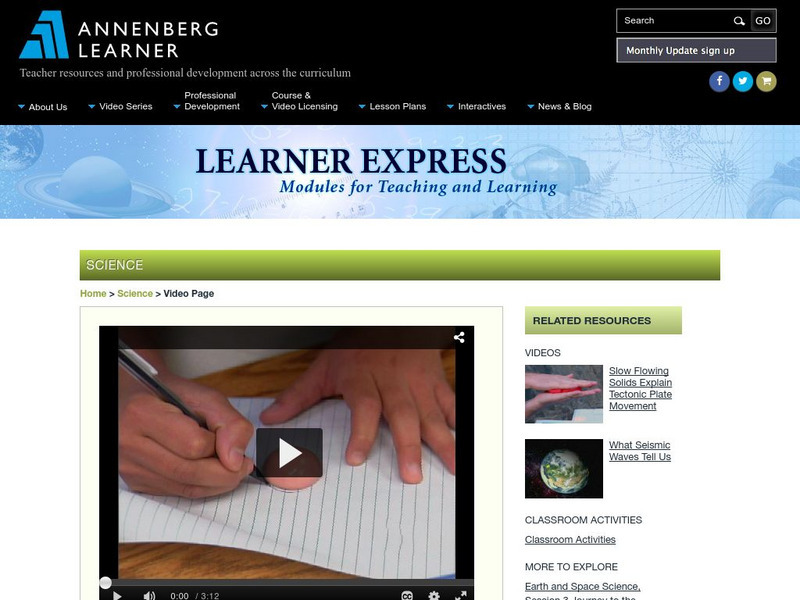
Annenberg Foundation
Annenberg Learner: Classroom Exploration of Flowing Solids
In this video, observe how students investigate the properties and behaviors of a fluid solid. [3:12]

PBS
Pbs Learning Media: Sound and Solids: Listening Stick
This video segment, adapted from ZOOM, explores how sound waves travel differently through air than through solids like a yardstick, a baseball bat, and a golf club. [1:46]

Sophia Learning
Sophia: Monomials, Binomials, Area, and Volume
This video explains how to find the volume of a solid using the foil method to multiply polynomials.
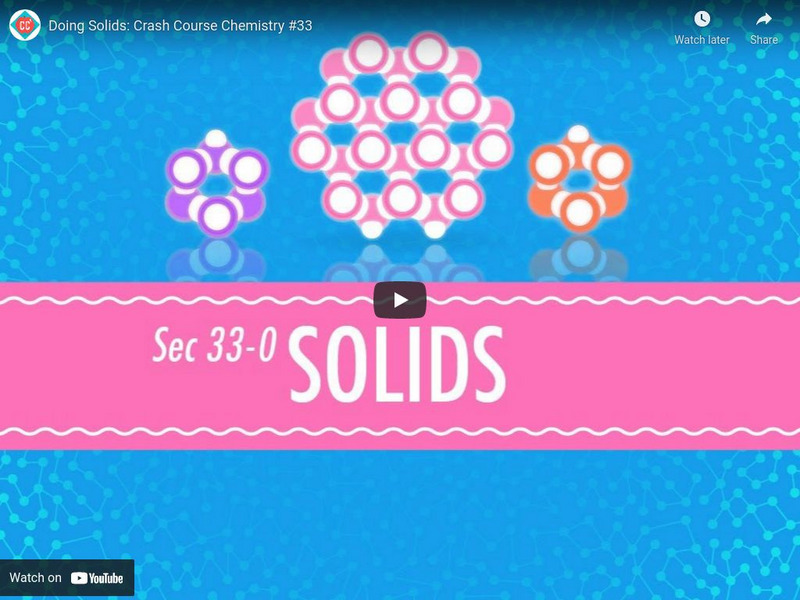
Crash Course
Crash Course Chemistry #33: Doing Solids
Learn about amorphous and crystalline solids, types of crystalline solids, types of crystalline atomic solids, properties of each type of solid, and that the properties depend on the bond types. [9:18]

CK-12 Foundation
Ck 12: Elem Math: Overview of Basic 3 D Figures
[Free Registration/Login may be required to access all resource tools.] Students watch a video overview on the properties of three dimensional figures.
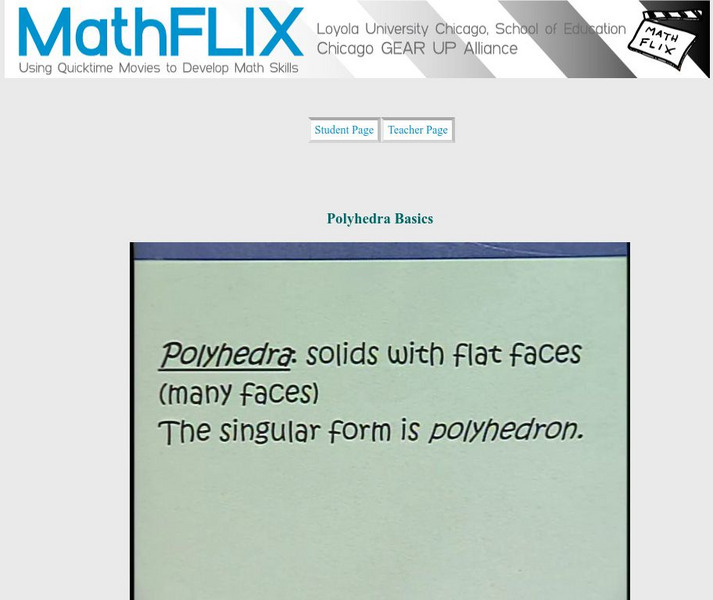
Loyola University Chicago
Math Flix: Polyhedra Basics Using Nets
This QuickTime movie provides an opportunity to learn about the basics of Polyhedra using Nets. As you watch and listen to the teacher and student interact it helps clarify the thinking behind applying this concept.

Loyola University Chicago
Math Flix: Polyhedra Nets 2
This QuickTime movie provides an opportunity to identify more Polyhedra using Nets. As you watch and listen to the teacher and student interact it helps clarify the thinking behind applying this concept.

Loyola University Chicago
Math Flix: Polyhedra Formula for Vertices
This QuickTime movie provides an opportunity to discover the formula for finding the number of vertices on a polyhedron. As you watch and listen to the teacher and student interact it helps clarify the thinking behind applying this concept.
Loyola University Chicago
Math Flix: Polyhedra Formula for Edges
This QuickTime movie provides an opportunity to discover the formula for finding the number of edges on a polyhedron. As you watch and listen to the teacher and student interact it helps clarify the thinking behind applying this concept.
Sophia Learning
Sophia: Solid: Lesson 2
This lesson will explore a solid from a molecular viewpoint and describe its general properties. It is 2 of 2 in the series titled "Solid."
Sophia Learning
Sophia: Solid: Lesson 1
This lesson will explore a solid from a molecular viewpoint and describe its general properties. It is 1 of 2 in the series titled "Solid."

Bozeman Science
Bozeman Science: Ap Chemistry: Solids and Liquids
Paul Andersen compares and contrasts the properties of solids and liquids. Solids have a more organized structure which can either be amorphous or crystalline. In liquids the intermolecular forces are lower and so the molecules can show...
Bozeman Science
Bozeman Science: Ap Chemistry: Covalent Network Solids
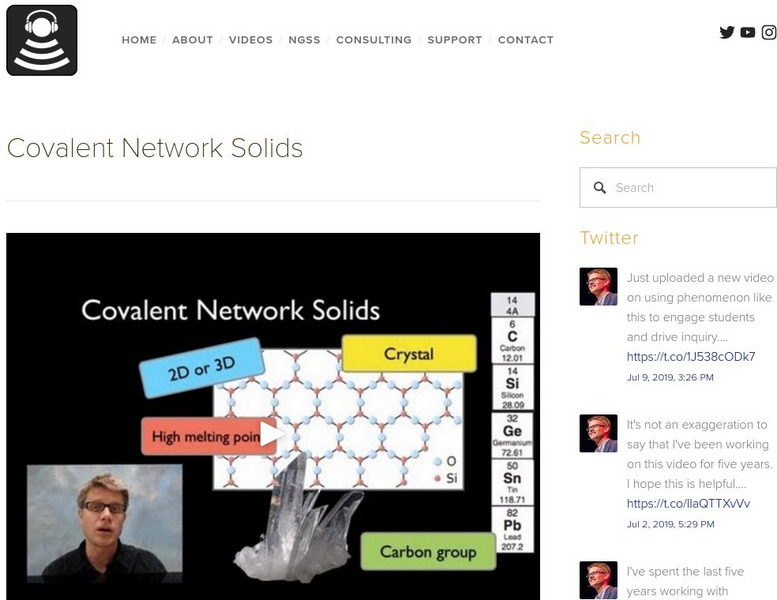
Paul Andersen explains how covalent network solids form elementally (like graphite) or by combining multiple nonmetals (like quartz). Covalent network solids contain elements from the carbon group because they have four valence electrons...