Hi, what do you want to do?






Curated OER
Oozing Pumpkin - Sick Science! #060
Make a Halloween pumpkin foam at the mouth! Using hydrogen peroxide, toothpaste, and yeast, you can recreate this chemical reaction in your classroom. It can lead to a discussion of the way ingredients mix together to make a new...

Steve Spangler Science
Magic Crystal Tree - Sick Science! #065
Chemical reactions can be beautiful. Show your learners how to make a crystal tree using cardboard, food coloring, Mrs. Stuart's Bluing, ammonia, and salt. Use this activity to demonstrate crystal growth within Earth. The results are...

Steve Spangler Science
Light Sticks - Cool Halloween Science
The light sticks that trick-or-treaters carry at Halloween glow by the process of chemiluminescence, a chemical reaction in which electrons jump to a higher energy level. In this video, the variable of temperature is introduced to find...

Steve Spangler Science
Goldenrod Paper Message - Sick Science! #059
Have your class write secret messages using Goldenrod paper and a basic liquid such as ammonia. This is a great way to illustrate the chemical reactions between acids and bases. This could lead to an exploration of chemical reactions and...

Steve Spangler Science
Genie in a Bottle - Cool Science Experiment
An exothermic reaction is demonstrated by showing what happens when hydrogen peroxide reacts with manganese dioxide. It creates the effect used by film makers to have a genie coming out of a bottle in a burst of cloudy gas. Spangler is...

Steve Spangler Science
Film Canister Explosion - Sick Science! #032
A film canister, Alka Seltzer, and a little water can be an explosive combination. Have your learners try out this chemical reaction in the classroom, and then discuss the results.

Steve Spangler Science
Patriotic Monster Foam - Cool Science Experiment
In honor of the 4th of July, Steve Spangler shows how to make an explosive concoction in red, white, and blue. Using hydrogen peroxide, dishwashing liquid, and yeast, he creates a colorful chemical reaction. Consider this combination...

Steve Spangler Science
Chemical Magic - Think Ink - Cool Science Experiment
This is a classic chemical reaction to use in your science class. Starch and iodine mix to cause a color change. Discuss with aspiring chemists the chemical and physical changes that occur as you demonstrate.

Curated OER
Borax Crystal Star - Sick Science! #066
Make your own crystals. Learners can use borax, water, food coloring, and a string to make a colorful crystal. This is a great way to explore chemical reactions, crystal formation, or evaporation.

JFR Science
Percent Yield: Determining the Success of a Chemical Reaction
Are you looking for a resource that will yield great results? Scholars view a video in the JFR Science playlist that shows the method for computing percent yield. It highlights the equation and explains how to find each component.

Educreations
Hydrolysis
Young chemists examine the effects of salt on the pH levels of solutions with the help of this instructional video. Taking a close look at reactions between three different salts and water, students learn to predict the...

Educreations
Entropy & Free Energy
An understanding of chemical reactions really boils down to two concepts: entropy and enthalpy. Follow along with this instructional video as it explains how these two principles are used to calculate Gibbs free-energy which...

Curated OER
Monster Foam
In honor of the 4th of July, Steve Spangler shows how to make an explosive concoction in red, white, and blue. Using hydrogen peroxide, dishwashing liquid, and yeast, he creates a colorful chemical reaction. Consider this combination...

Curated OER
Chemical Magic - Think Ink!
This is a classic chemical reaction to use in your science class. Starch and iodine mix to cause a color change. Discuss with aspiring chemists the chemical and physical changes that occur as you demonstrate.

Massachusetts Institute of Technology
Mit: Open Course Ware: Chemistry Behind the Magic: Death of a Gummy Bear
A great video demonstration along with teaching notes that shows the release of energy and resulting byproducts when a gummy bear is oxidized when heated with potassium chlorate.
Massachusetts Institute of Technology
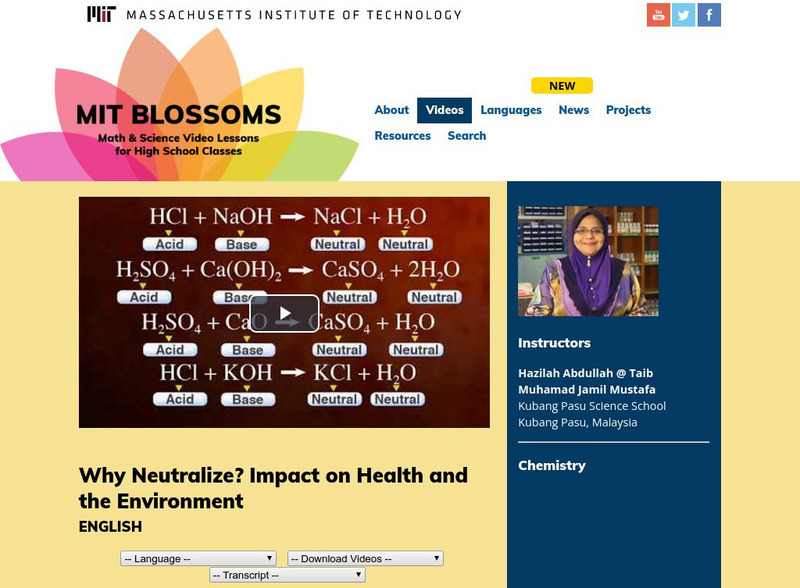
Mit: Blossoms: Why Neutralize? Impact on Health and the Environment
The aim of this lesson is to introduce the concept of Neutralization and its application in our daily lives. Students are encouraged to construct their knowledge of Neutralization through brainstorming sessions, experiments, and mind...
Science for Kids
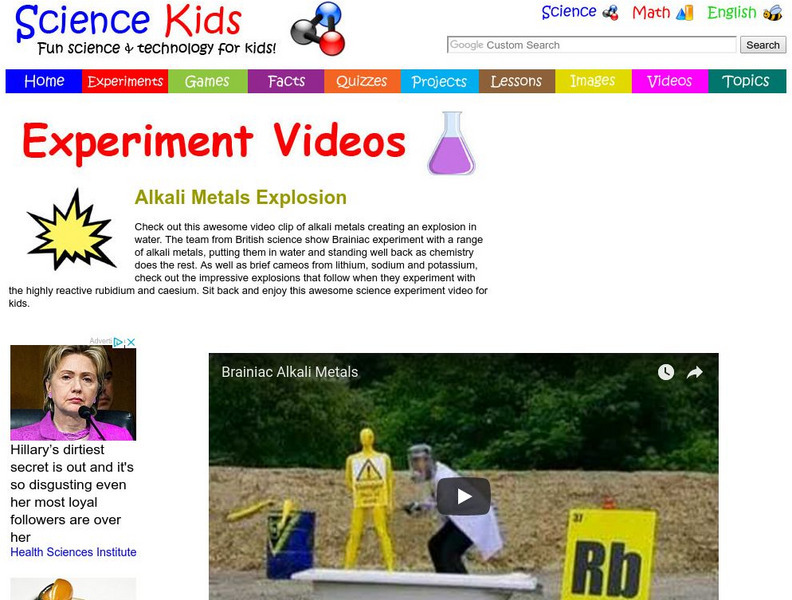
Science Kids: Experiment Videos: Alkali Metals Explosion
Check out this awesome video clip of alkali metals creating an explosion in water. [3:17]
Khan Academy
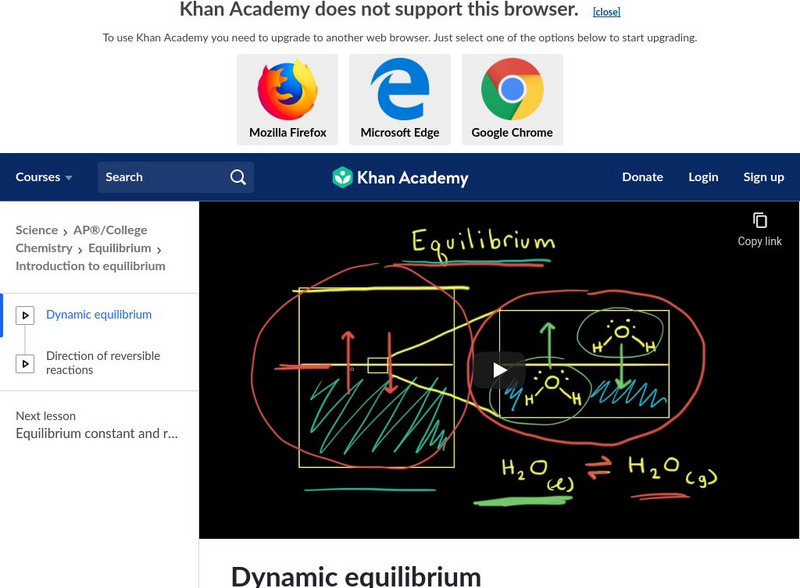
Khan Academy: Reactions in Equilibrium
Use this tutorial to explore equilibrium reactions and constants. [14:50]
Khan Academy
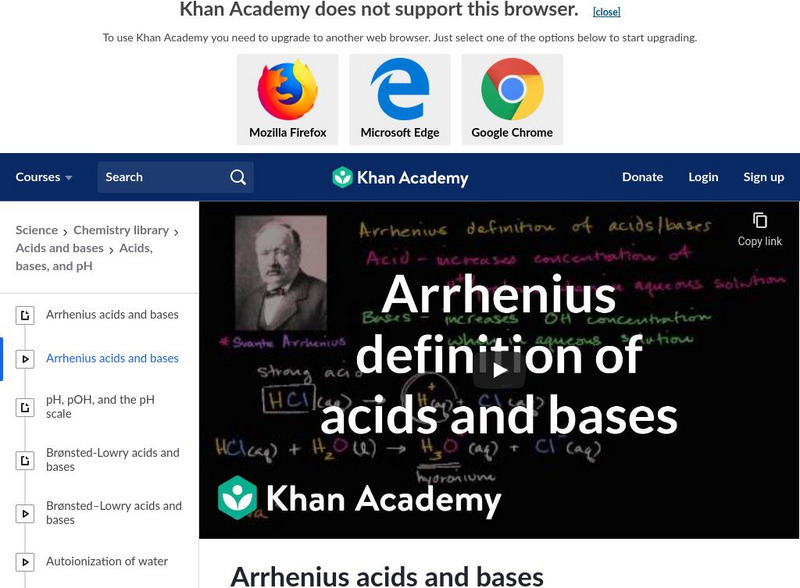
Khan Academy: Arrhenius Definition of Acids and Bases
Arrhenius definition of acids and bases. [7:50]
Khan Academy
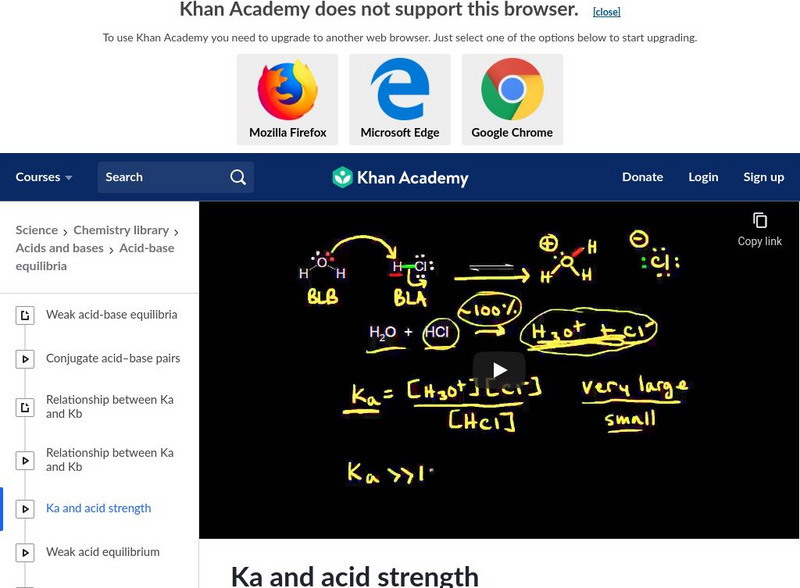
Khan Academy: Ka and Acid Strength
Learn how to write an equilibrium expression for an acid-base reaction and how to evaluate the strength of an acid using Ka. [9:18]

Khan Academy
Khan Academy: Oxidation and Reduction Review From Biological Point of View
Video lecture looks at oxidation and reduction in a biological context and compares it to a chemical context. [13:29]
Khan Academy
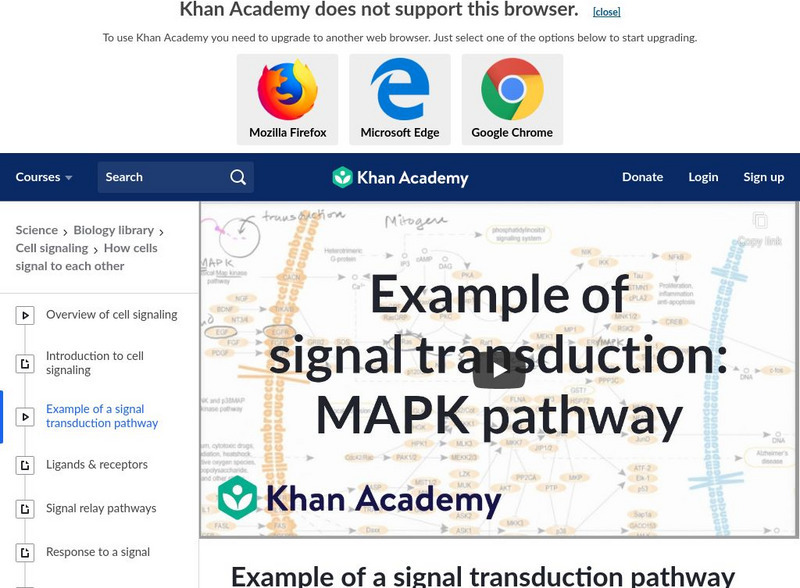
Khan Academy: Example of a Signal Transduction Pathway
Video lecture illustrates the complexity of signal transduction with a MAPK pathway and how transduction can actually occur. Also, looks at how mutations in the pathway are linked to cancer. [6:34]
Massachusetts Institute of Technology
Mit: Open Course Ware: Tech Tv: Death of a Gummy Bear
Watch as the instructor shows what happens when a gummy bear is heated in a test tube. Figure out how much energy is produced. [6:18]
Howard Hughes Medical Institute
Hhmi: Bio Interactive: Which Balloon Has Hydrogen?
Discovery how chemical reactions can fuel scientific discovery. [5:55]