Hi, what do you want to do?






Flipping Physics
Introductory Perfectly Inelastic Collision Problem Demonstration
A perfectly inelastic collision is demonstrated and analyzed.
Curated Video
Catalysts and Enzymes: Enhancing Chemical Reactions
This video explains catalysts, exploring the concept of activation energy and how catalysts can lower it to speed up reactions. The video covers the use of catalysts in industry and domestic applications, including the catalytic...
Professor Dave Explains
Kinetic Molecular Theory and its Postulates
We learned about ideal gases and the ideal gas laws, and we briefly touched on kinetic molecular theory, which puts these laws in context. But let's now go through this theory more rigorously, analyzing each postulate one at a time.
Curated Video
Understanding Pressure in Gases: The Effect of Volume and Temperature
This video lecture focuses on how the volume of a gas affects its pressure. It first explains how temperature affects pressure and then delves into the example of how a fixed mass and temperature of gas stored in a piston react to...
FuseSchool
Diffusion Of Gases
Learn the basics about Diffusion of gases. How are gases diffused? What methods are used to diffuse gases? Find out more in this video!
FuseSchool
Rates of Reaction - Part 2
Learn the basics about rates of reaction. Chemical reactions can only happen if reactant particles collide with enough energy. How do you measure the rates of a reaction? Find out more in this video!
FuseSchool
What is Brownian motion?
Learn the basics about what is the Brownian motion? what is it used for? Find out more in this video!
Professor Dave Explains
Energy Diagrams, Catalysts, and Reaction Mechanisms
It's time to learn a little more about a chemical reaction. How do molecules have to be arranged and how much energy do they have to collide with? What's a catalyst? Lots of great tidbits in this one.
Flipping Physics
AP Physics C: Momentum, Impulse, Collisions and Center of Mass Review (Mechanics)
Calculus based review of conservation of momentum, the momentum version of Newton’s second law, the Impulse-Momentum Theorem, impulse approximation, impact force, elastic, inelastic and perfectly inelastic collisions, position, velocity...

TED-Ed
Why is NASA Sending a Spacecraft to a Metal World?
Can we journey to outer space to learn more about inner Earth? Discover the method to NASA's madness with an enlightening short video. The narrator explains the composition of the asteroid the resource is studying, what scientists hope...

National Science Foundation
Safety Gear—Science of the Winter Olympics
Safety first! A science video explores the design of safety helmets. It considers both elastic and inelastic collisions.

JFR Science
Factors Affecting Rate: Controlling the Rate of a Reaction
Why was neon mad at fluorine? Because it was always overreacting! Science scholars discover how scientists control chemical reactions thanks to a video from the JFR Science playlist. The example-filled resource explains why not all...
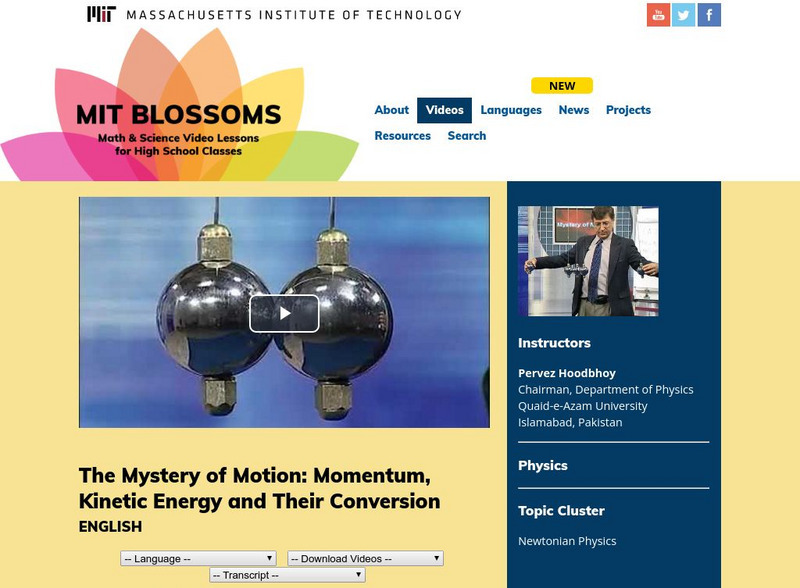
Massachusetts Institute of Technology
Mit: Blossoms: The Mystery of Motion: Momentum, Kinetic Energy & Conversion
In this video lesson, the concept of momentum applied to hard-body collisions is explained using a number of simple demonstrations, all of which can be repeated in the classroom. Understanding Newton's Laws is fundamental to all of...

Sophia Learning
Sophia: Vector Addition & Complex Collisions
This lesson demonstrates how to find the direction of an object's momentum, after a collision, using vector addition.

Sophia Learning
Sophia: Vector Subtraction & Complex Collisions
This lesson demonstrates how to find the direction of an object's momentum, after a collision, using vector subtraction.

Bozeman Science
Bozeman Science: Conservation of Linear Momentum
In the following video Paul Andersen explains how linear momentum is conserved in all collisions. In completely elastic collisions the kinetic energy of the objects is also maintained. Several examples and demonstrations are included....

Sophia Learning
Sophia: Bouncing & Impulse
This lesson explains why bouncing objects impart a greater impulse.

Sophia Learning
Sophia: Elastic Collisions
Watch this narrated screencast which explains the physics of collisions when applying Newton's second law of motion. [4:12]
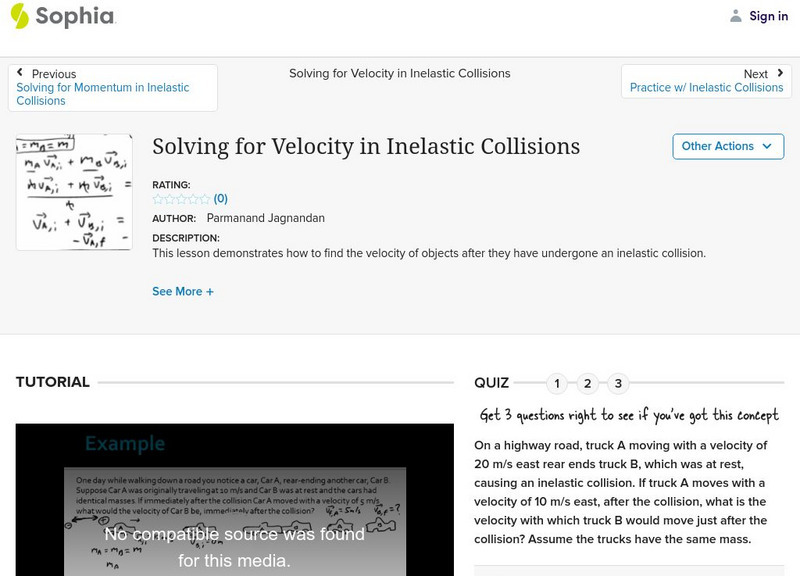
Sophia Learning
Sophia: Solving for Velocity in Inelastic Collisions
Watch this guided screencast, and learn how to figure the velocity of two objects after an inelastic collision. [5:40]
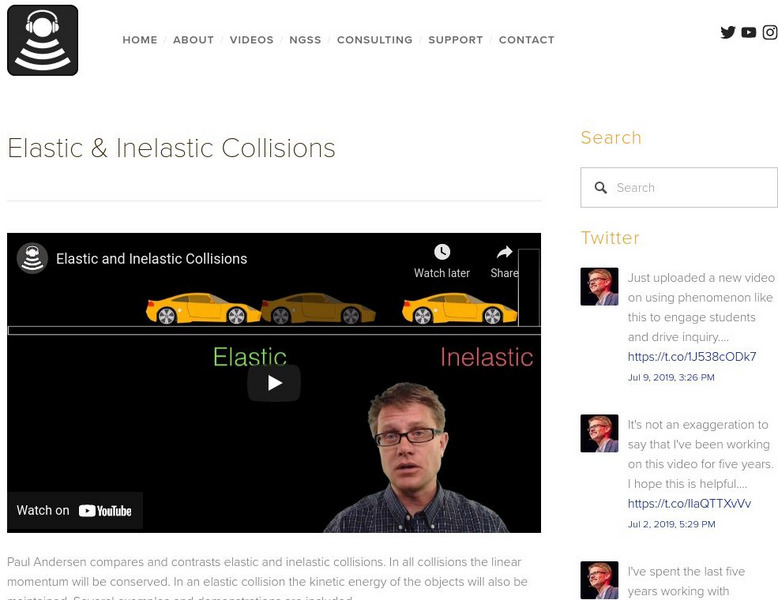
Bozeman Science
Bozeman Science: Elastic and Inelastic Collisions
In the following video Paul Andersen compares and contrasts elastic and inelastic collisions. In all collisions the linear momentum will be conserved. In an elastic collision the kinetic energy of the objects will also be maintained....

Crash Course
Crash Course Physics #10: Collisions
COLLISIONS! A big part of physics is understanding collisions and how they're not all the same. Mass, momentum, and many other things dictate how collisions can be unique. In this video episode of Crash Course Physics, Shini sits down to...

Khan Academy
Khan Academy: Bouncing Fruit Collision Example
David shows how to use conservation of momentum for a situation where two objects bounce off of each other. [9:12]

Khan Academy
Khan Academy: Particle Collisions (Video)
What happens when particles hit each other or a surface? To learn more about what happens when particles collide, watch this video [3:24]

Khan Academy
Khan Academy: Smooth Collisions
This video [2:07] focuses on how to make realistic water by softening the particle collisions.