Hi, what do you want to do?






Curated OER
Electrical Generators
Students study what an electric generator does and its history. In this energy instructional activity students complete several experiments including building their own electric generator.

Curated OER
TE Activity: The Beat Goes On
Learners determine what the pulse is before examining how to measure the heart rate in different situations. They build a simple device that measures the heart rate, take heart rates, and record them on a worksheet. They discuss how...

Curated OER
Watch It Slide!
Students work together to examine inclined planes. They create a plan to raise rocks to build pyramids. They discover the changes that occur when the angle is increased or decreased.

Curated OER
Time Train
Students are read a short book "Time Train" by Paul Fleischman. Using the text, they identify the clues to let them know the train is traveling back in time. They make a time line of the trip and make a cutout of meat-eating and...

Curated OER
Wheel & Axle Tractor
Students design and build a tractor using LEGO materials. They write and draw their designs.

Curated OER
Environmental Studies: The Power of Wind
Investigate the prospect of wind as a renewable resource. Second and third graders make a pinwheel, answer critical thinking questions, and then attempt to use wind power to wind string. I would be more apt to use this lesson in a 1st or...

Curated OER
Robots
Students play the parts of robots and their controllers. In this robot lesson plan, students learn about robots, and use verbal commands to simulate how a robot would command to it's controller.

Curated OER
Four Forces of Flight
Students explore the four forces of flight. They investigate the four forces of flight: lift, drag, thrust and weight (gravity). They experiment with flight-testing various objects commonly found around the house and constructing paper...

TeachEngineering
Teach Engineering: Simple Machines From Pyramids to Skyscrapers
Simple machines are devices with few or no moving parts that make work easier, and which people have used to provide mechanical advantage for thousands of years. Students learn about the wedge, wheel and axle, lever, inclined plane,...
TeachEngineering
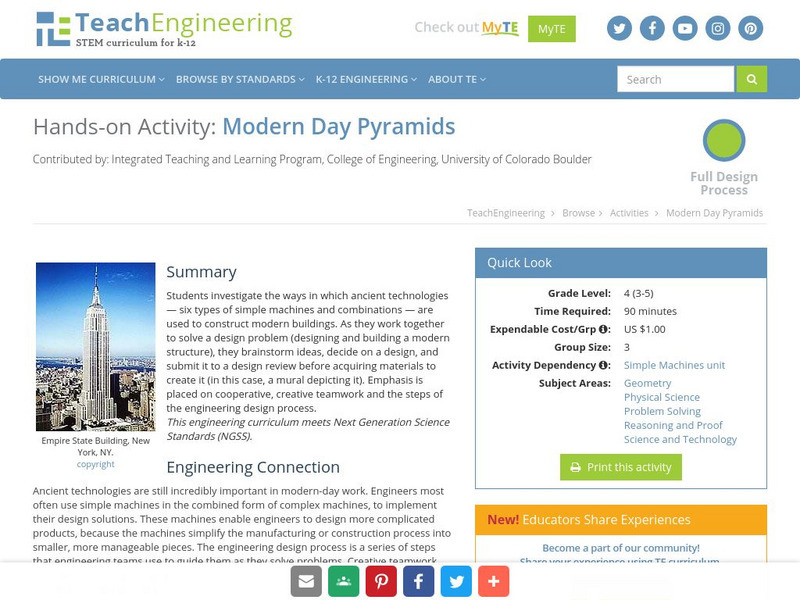
Teach Engineering: Modern Day Pyramids
Students investigate the ways in which ancient technologies - six types of simple machines and combinations - are used to construct modern buildings. As they work together to solve a design problem (designing and building a modern...
TeachEngineering
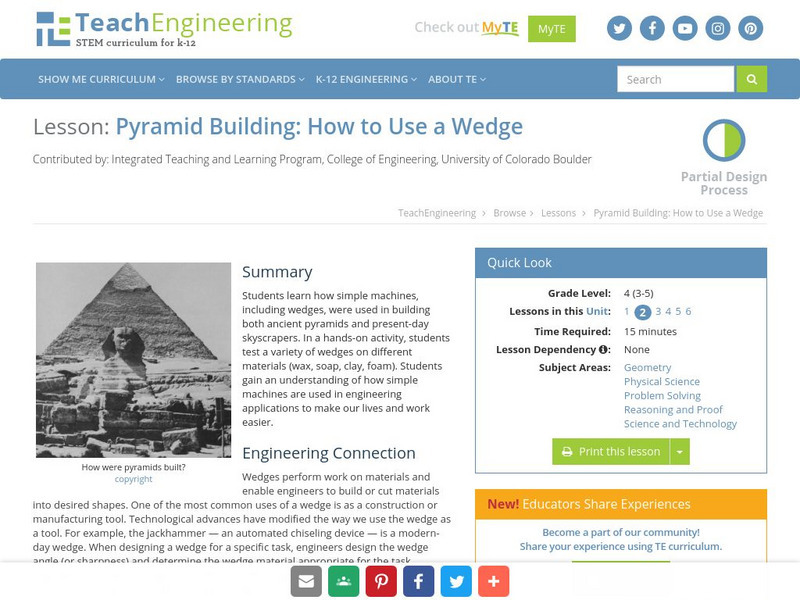
Teach Engineering: Pyramid Building: How to Use a Wedge
Students learn how simple machines, including wedges, were used in building both ancient pyramids and present-day skyscrapers. In a hands-on activity, students test a variety of wedges on different materials (wax, soap, clay, foam)....
TeachEngineering
Teach Engineering: The Power of Mechanical Advantage
Students learn about the mechanical advantage offered by pulleys in an interactive and game-like manner. By virtue of the activity's mechatronic presentation, they learn to study a mechanical system not as a static image, but rather as a...

Science Buddies
Science Buddies: Give It a Lift With a Lever
Simple machines allow us to do difficult tasks like lifting objects heavier than our body weight. In this science project you'll build a tabletop lever and measure how much effort it takes to lift an object by altering the length of the...
TeachEngineering
Teach Engineering: Solid Rock to Building Block
Students continue their pyramid building journey, acting as engineers to determine the appropriate wedge tool to best extract rock from a quarry and cut into pyramid blocks. Using sample materials (wax, soap, clay, foam) representing...
TeachEngineering
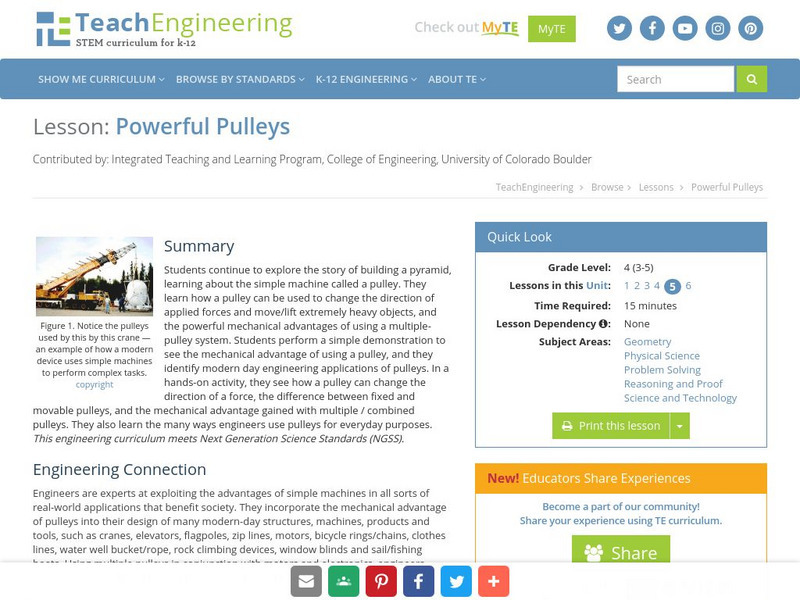
Teach Engineering: Powerful Pulleys
Students continue to explore the story of building a pyramid, learning about the simple machine called a pulley. They learn how a pulley can be used to change the direction of applied forces and move/lift extremely heavy objects, and the...
TeachEngineering
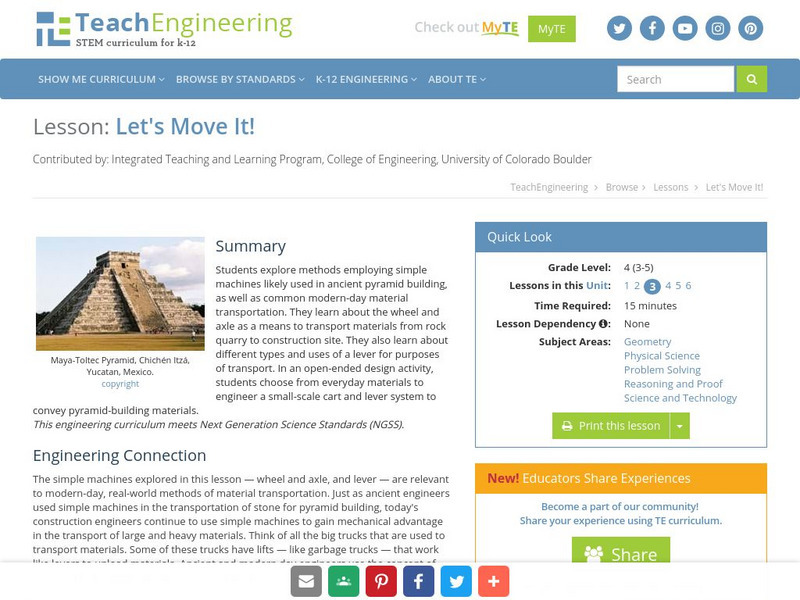
Teach Engineering: Let's Move It!
Young scholars explore methods employing simple machines likely used in ancient pyramid building, as well as common modern-day material transportation. They learn about the wheel and axle as a means to transport materials from rock...
TeachEngineering
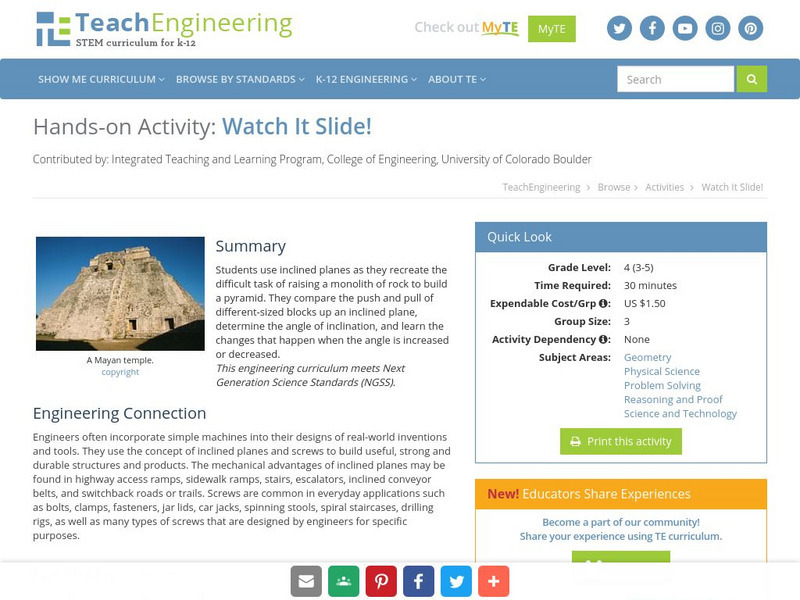
Teach Engineering: Watch It Slide!
Students use inclined planes as they recreate the difficult task of raising a monolith of rock to build a pyramid. They compare the push and pull of different-sized blocks up an inclined plane, determine the angle of inclination, and...
Other
How to smile.org: Building Pulleys
An activity where students use pulley systems to pick up a paint can and move an eraser from the ground to the top of a desk. After completing this activity, students will understand how pulley systems can help us do work.
TeachEngineering
Teach Engineering: Wheeling It In!
In an open-ended design activity, students use everyday materials (milk cartons, water bottles, pencils, straws, candy) to build a small-scale transportation device. They incorporate the use of a wheel and axle, and lever into their...
![Maryland Science Center: March Madness Finger Basketball [Pdf] Activity](https://static.lp.lexp.cloud/images/attachment_defaults/resource/large/FPO-knovation.png "Maryland Science Center: March Madness Finger Basketball [Pdf] Activity")
Maryland Science Center
Maryland Science Center: March Madness Finger Basketball [Pdf]
Build a miniature basketball court, and use a spoon lever to shoot balls into the basket. Experiment with different materials to see which one works the best.
TeachEngineering
Teach Engineering: Slide Right on by Using an Inclined Plane
Students explore building a pyramid, learning about the simple machine called an inclined plane. They also learn about another simple machine, the screw, and how it is used as a lifting or fastening device. During a hands-on activity,...

PBS
Pbs Teachers: Rube Goldberg Invention Ii
Explore motion, force and energy by building a complicated contraption to pour milk into a glass.