Hi, what do you want to do?






Curated OER
Tune Up Your Ears!
Students discuss meaning of pitch, listen for different sounds in classroom, hallway, and outdoors, and listen to sounds played on piano and on computer to determine high or low pitch.

Curated OER
Electrical motors
Students investigate and experiement with a 9-volt motor. They will use the connecting wire and battery pack to discover fans.

Curated OER
NOVA Online/Einstein Revealed
Welcome to the companion Web site to the NOVA program "Einstein Revealed," originally broadcast in October, 1996. This two-hour special presents a penetrating profile of Albert Einstein, who contributed more than any other scientist to...

Curated OER
The Sun Safety Activity Guide
Students examine the sun safety guide. They identify the dangers of getting too much sun and not protecting themselves. They participate in hands-on activities to finish the lesson.

Curated OER
Here Comes the Sun
Third graders watch a video on the solar system and examine the role of the sun. As a class, they complete a KWL chart and make different color temperature pockets to use during their experiment. In groups, they make predictions about...
Ducksters
Ducksters: Physics for Kids: Energy
Kids learn about the science behind Energy including its different forms such as chemical, electrical, heat, and gravitational. When is energy considered renewable or nonrenewable?
Ducksters
Ducksters: Physics for Kids: Kinetic Energy
Kids learn about kinetic energy in the science of physics. The energy of motion can be calculated using mass and velocity. The standard unit is the joule. How it is different from potential energy.
Ducksters
Ducksters: Physics for Kids: Potential Energy
Kids learn about potential energy in the science of physics. The energy of position and state can be calculated using mass, gravity, and height. The standard unit is the joule. How it is different from kinetic energy.
Fundación Cientec
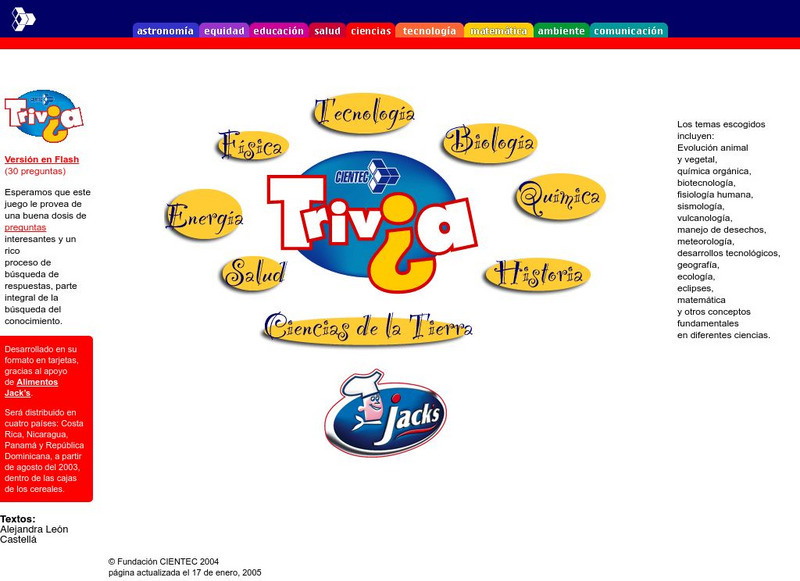
Trivia: 30 Preguntas! Ciencias
Thirty questions to test your knowledge of upper elementary / middle level science (in Spanish). Covers energy, health, physics, technology, biology, chemistry, history of science, and earth sciences. You can choose between a Flash or...
Ducksters
Ducksters: Physics for Kids: Nuclear Energy and Fission
Kids learn about nuclear energy and fission in the science of physics including E=mc2, power plants, uses of nuclear power, and fusion.
Ducksters
Ducksters: Physics for Kids: Motion Glossary and Terms
Kids learn about glossary and terms in the science of physics and motion. Definitions for words such as momentum, force, work, energy, gravity, scalar, vector, power, and more.
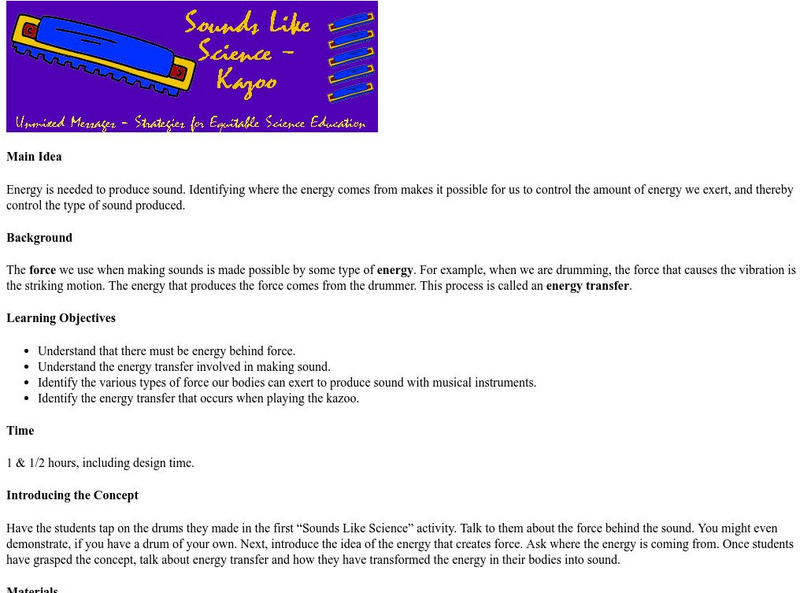
Michigan Reach Out
Sounds Like Science: Kazoo
At this site explore the energy transfer that is involved in making sound through playing a kazoo.This activity is wonderful for both science and music teachers.
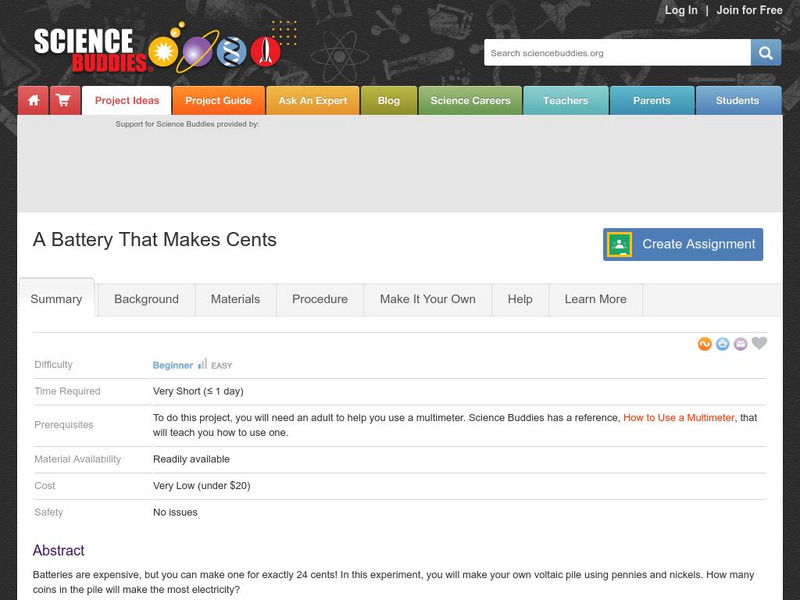
Science Buddies
Science Buddies: A Battery That Makes Cents
Batteries are expensive to purchase in a store, but you can make one your self for exactly 24 cents. In this experiment, you will make your own voltaic pile using pennies and nickels and determine how many coins in a pile will make the...
Other
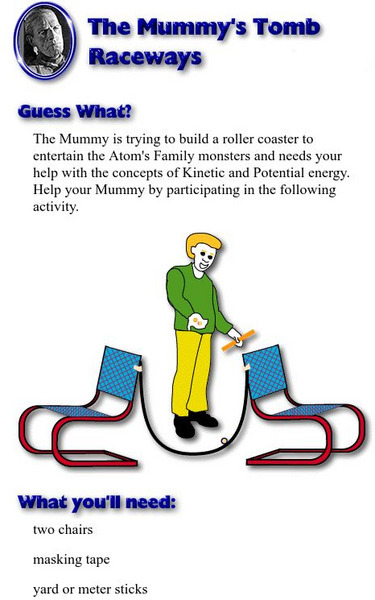
Puhinui School: The Atoms Family: The Mummy's Tomb: Raceways
Help the Mummy build a rollercoaster to entertain the Atoms Family monsters by investigating the concepts of kinetic and potential energy.
Ducksters
Ducksters: Physics for Kids: Photons and Light
Kids learn about photons in the science of physics, the particles of energy that make up light including properties and how they interact with matter.

American Museum of Natural History
American Museum of Natural History: Ology: See the Light
Reflection, refraction, and the colors that make up white light is explored through lab activities after reading a brief background about light energy.
Other
Center for Education Partnerships: The Marble Roll
In this Science-athon, students try to make their marble roll the farthest across a flat surface, using their knowledge of forces, motion, and energy to guide them through their apparatus design. Teachers must enroll online.
Ducksters
Ducksters: Physics for Kids: Light
Kids learn about the science of light. Energy made of waves and particles called photons traveling at the top speed in the universe. What is refraction? The difference between transparent, translucent, and opaque.
Science and Mathematics Initiative for Learning Enhancement (SMILE)
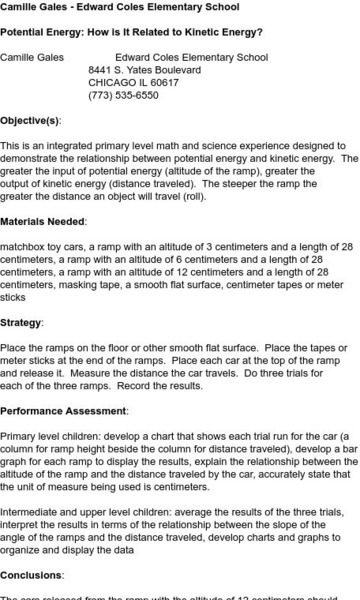
Smile: Potential Energy: How Is It Related to Kinetic Energy
After creating three different ramps with various heights, young scholars will release toy cars from the tops of each ramp. Based on the elementary age level, students will collect data and analyze it.
Fundación Cientec
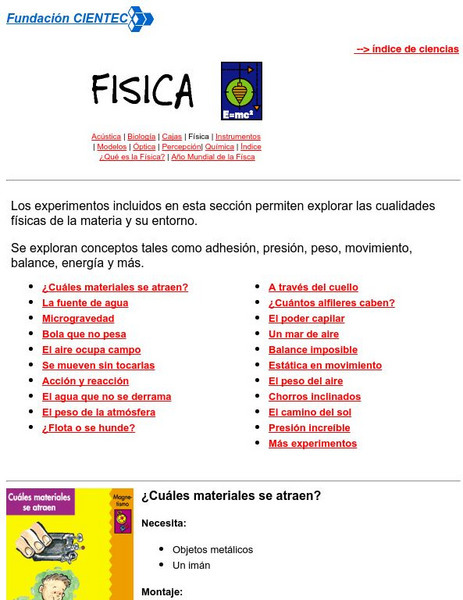
Cientec: Fisica
Different step by step experiments in Physics. It explorer concepts such as adhesion, pressure, weight, movement, balance, energy and more.
Ducksters
Ducksters: Astronomy for Kids: The Universe
Kids learn about the universe in the science of astronomy including expansion, size, dark matter and energy, age, and fun facts.