Hi, what do you want to do?






Curated OER
EcoKids Web Site: Food Chain Game
Students use the EcoKids web site to explore food chains and the associated terminology. They answer the questions about food chains and their importance. Students use the Kidspiration program to add information to an Animal Fact Web.

Curated OER
Worm Composting: Vermiculture
Learners compost in a limited space and describe the decomposing process. Students convert unwanted, organic matter, particularly food scraps and paper into fertile soil.

Curated OER
Adaptable Mandibles
Students define adaptation and highlight example of adaptation in birds and other animals. They study feeding techniques of seabirds and investigate the effect that trash has on wildlife.

Curated OER
Ecological Citizen
Students examine the interconnectedness of living and non-living things that constitute an ecosystem. They examine fallen trees,insects, living trees, leaves, food webs, and forests. They conduct various activities and write poems about...

Curated OER
Designing Our Own Inventions
Third graders use research from a previous lesson plan to design their own inventions. In groups, they brainstorm a product they would like to see built and share them with the class. They must explain how each one would serve a purpose...

Curated OER
What does AG have to do with me?
Young scholars practice alphabetizing while categorizing sources of basic agricultural products. They discuss agricultrual products, discover where they are grown and draw a simple agricultural scene on poster board.

Curated OER
Food Chains
Students investigate how food chains work. In this food chains instructional activity, students construct a food web for a pear tree habitat. The interactive whiteboard is an optional tool in this instructional activity.

Curated OER
Global Economy: A Simple Activity
Pupils explore the global economy. In this economics lesson, students examine clothing labels in search of the countries the clothing was made in. Pupils consider the implications of a global economy.

Curated OER
Providing a Helping Hand
Students examine the concept of philanthropy. In this service learning lesson plan, students create charts that display how corporate sponsorships benefit communities.

Curated OER
Animal Electronic I.D.
Students discover ways to keep the animals in our environment safe by examining electronic I.D. tags. In this animal safety lesson, students participate in a role-playing activity in which they are monitored by an electronic I.D....

Curated OER
Multiplying Whole Numbers
In this multiplication of whole numbers worksheet, students follow step by step directions to multiply two pairs of numbers without using a calculator.

Curated OER
Mushroom Prints
Students create a mushroom spore design on paper while studying the facts on fungi.

Curated OER
March Market
Students role play a living wetland food web. They trace the food web associated with the items in their lunch.

Curated OER
Food Chain Poster Instructions
In this food chain worksheet, students follow a set of 9 steps to create a food chain poster. Page has no additional activities.

Curated OER
Webbing the Food Chain
Students compose a visual representation of the food chain cycle using Inspiration educational software.
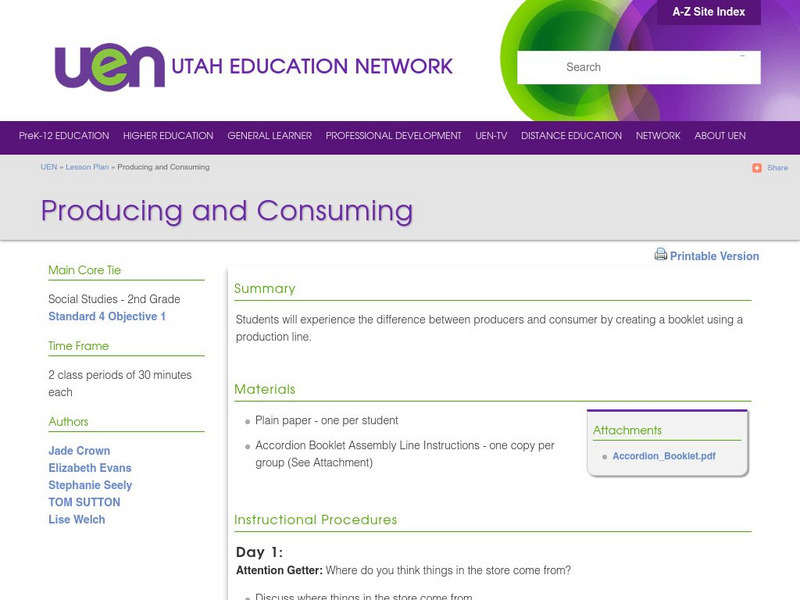
Utah Education Network
Uen: Producing and Consuming
Lesson that helps students understand the difference between producers and consumers. Students create booklets, making them producers, and then use the booklets to complete the lesson, making them consumers.

Louisiana Department of Education
Louisiana Doe: Louisiana Believes: Social Studies: Grade 3: Producers and Consumers
Read and study the sources about the roles that different people have in the Louisiana economy. As you read the three sources, think about what would happen if some people gave up those roles.

Sheppard Software
Sheppard Software: Parts of the Food Chain: Producers, Consumers, Decomposers
Learn how scientists classify different types of organisms in an ecosystem or in a food chain by their role and function as either a producer, a consumer, or a decomposer. Then play a game that tests your understanding of these important...
Annenberg Foundation
Annenberg Learner: The Habitable Planet: Ecology Lab
Create the parameters of your own ecosystem by choosing which producers and consumers live there. Visualize how the food web operates and species populations change. This simulator mimics the food web within a typical ecosystem and gives...
SMART Technologies
Smart: Economic Review Lesson
This activity reviews goods, services, producers, and consumers. The lesson consist of sorting, fill in the blank, writing, and racing car review quiz.
Council for Economic Education
Econ Ed Link: We Are Consumers and Producers
This lesson plan is geared toward beginning economics concepts. "In this lesson you are going to learn more about how you and others are consumers and producers."

Science Education Resource Center at Carleton College
Serc: Investigation a Food Web: Producers, Consumers, and Decomposers
Being field scientists, students will explore a wooded area in their community and journal about their observations. Students will collect information about producers, consumers, and decomposers in the ecosystem. They will then construct...
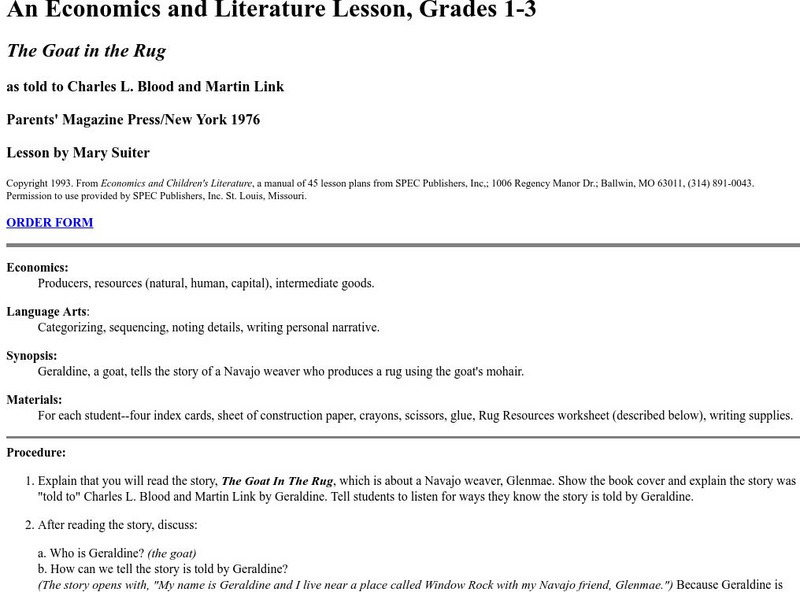
University of Nebraska Omaha
An Economics and Literature Lesson: The Goat in the Rug
This is a lesson plan geared toward first through third grades, cross-curricular, dealing with economics and literature. "Learn about economics: producers, resources (natural, human, capital), intermediate goods; and Language Arts:...
Council for Economic Education
Econ Ed Link: Bringing the Market to the Farm
This printable lesson discusses producers and consumers from an agricultural perspective. It focuses on choices that the consumer has with regard to purchasing agricultural goods (e.g. fruits and vegetables). As an example, it uses...