Hi, what do you want to do?






Ducksters
Ducksters: Physics for Kids: Simple Machines
Kids learn about the science behind simple machines such as levers, wheels, pulleys, inclined planes, and screws. How they work together to make complex machinery.

The Franklin Institute
Spotlighting Simple Machines
Simple machines such as inclined planes in wedges and screws are explained.
NASA
Nasa: Simple Machines
A lesson plan site that contains activities designed to give grades 3 and 4 experiences in using simple machines.

TeachEngineering
Teach Engineering: Simple Machines and Modern Day Engineering Analogies
Young scholars apply the mechanical advantages and problem-solving capabilities of six types of simple machines (wedge, wheel and axle, lever, inclined plane, screw, pulley) as they discuss modern structures in the spirit of the...
TeachEngineering
Teach Engineering: Powerful Pulleys
Students continue to explore the story of building a pyramid, learning about the simple machine called a pulley. They learn how a pulley can be used to change the direction of applied forces and move/lift extremely heavy objects, and the...

TeachEngineering
Teach Engineering: Pulley'ing Your Own Weight
Using common materials (spools, string, soap), students learn how a pulley can be used to easily change the direction of a force, making the moving of large objects easier. They see the difference between fixed and movable pulleys, and...
University of Houston
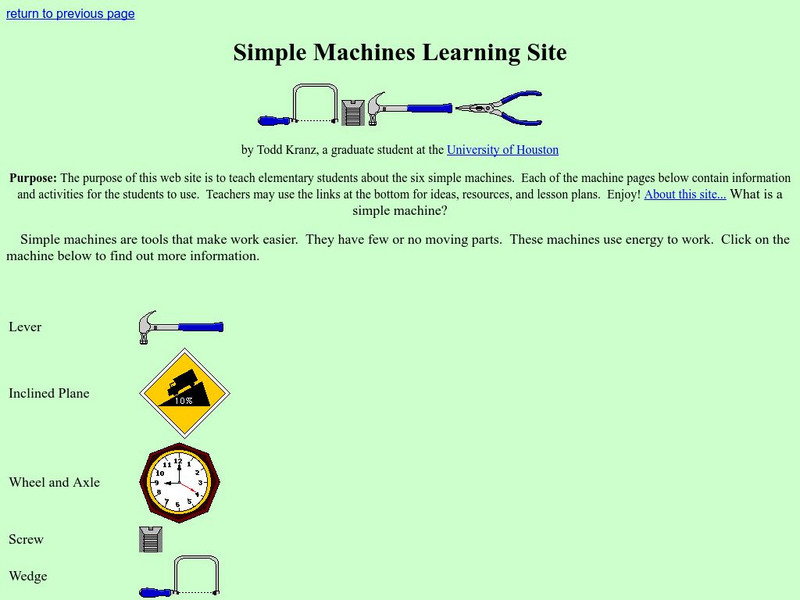
University of Houston: Simple Machines Learning Site
Simple descriptions and drawings of simple machines. Click on each image for a further explanation and examples.

ClassFlow
Class Flow: Simple Machines Quiz
[Free Registration/Login Required] This flipchart consists of a humorous quiz on identifying simple machines and forces of motion such as gravity and inertia.
Science Struck
Science Struck: Examples of Pulleys in Daily Life
Learn how pulleys work and their many uses in everyday life, industry, recreation, and other activities. Includes many pictures of pulleys and pulley systems.
TeachEngineering
Teach Engineering: The Power of Mechanical Advantage
Students learn about the mechanical advantage offered by pulleys in an interactive and game-like manner. By virtue of the activity's mechatronic presentation, they learn to study a mechanical system not as a static image, but rather as a...
Other
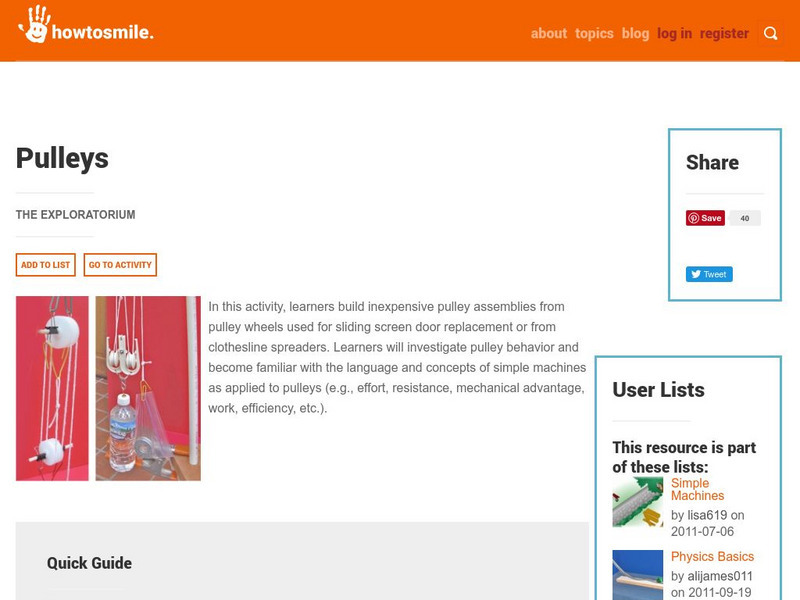
How to smile.org: Building Pulleys
An activity where students use pulley systems to pick up a paint can and move an eraser from the ground to the top of a desk. After completing this activity, students will understand how pulley systems can help us do work.
Science and Mathematics Initiative for Learning Enhancement (SMILE)
Smile: Simple Machines
Good combination of teacher demonstration and student interaction for this simple machine lesson. Great for talking about force and work. Plans are for grades 2-4, yet are adaptable.

NASA
Nasa: Simple Machine Resource Chart
This site provides a chart that lists the six simple machines, defines them, explains how it helps and gives examples.
Other
Professor Beaker's Learning Lab
This site provides information on simple machines in machines and features links to a question and answer section as well as a learning lab.
PBS
Pbs Teachers: Secrets of Lost Empires I Colosseum
Discover how to use pulleys to change the direction of force, compare different pulley designs and discuss the advantages and disadvantages of a pulley.