Hi, what do you want to do?






TeachEngineering
Teach Engineering: Simple Machines From Pyramids to Skyscrapers
Simple machines are devices with few or no moving parts that make work easier, and which people have used to provide mechanical advantage for thousands of years. Students learn about the wedge, wheel and axle, lever, inclined plane,...

TryEngineering
Try Engineering: Simple Machines
The purpose of this lesson is to learn about the different types of simple machines and their uses. PDF (requires Adobe Reader) and RTF (requires Word or Notebook).

Scholastic
Scholastic: Study Jams! Science: Force and Motion: Simple Machines
A slideshow and a short quiz on simple machines and how they reduce the amount of work or effort needed to complete a task.
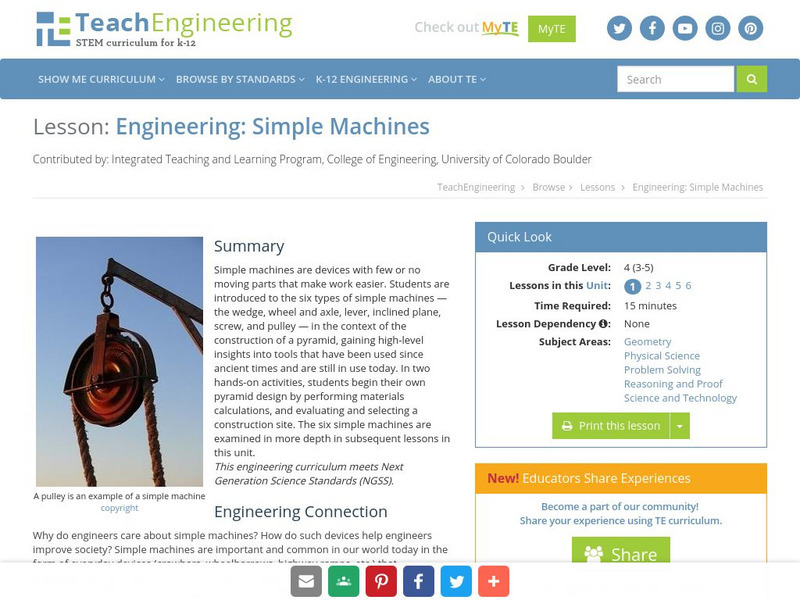
TeachEngineering
Teach Engineering: Engineering: Simple Machines
Simple machines are devices with few or no moving parts that make work easier. Students are introduced to the six types of simple machines - the wedge, wheel and axle, lever, inclined plane, screw, and pulley - in the context of the...

Science Buddies
Science Buddies: Balancing the Load: The See Saw as a Simple Machine
Have you ever tried to pull out a nail out of wood with your bare hands? Or have you tried to shove a staple through a stack of papers without a stapler? A hammer's claw, a stapler, a pair of pliers and a shovel are each examples of...
The Franklin Institute
Spotlighting Simple Machines
Simple machines such as inclined planes in wedges and screws are explained.
NASA
Nasa: Simple Machines
A lesson plan site that contains activities designed to give grades 3 and 4 experiences in using simple machines.

Ducksters
Ducksters: Physics for Kids: Simple Machines
Kids learn about the science behind simple machines such as levers, wheels, pulleys, inclined planes, and screws. How they work together to make complex machinery.
Utah Education Network
Uen: Force, Energy, and Motion: Complex Machines for Simple Tasks!
Designed for Grade Eight, this collection of lessons provides information, examples and quizzes related to simple machines. Elementary students studying this topic will find this site informative as well.
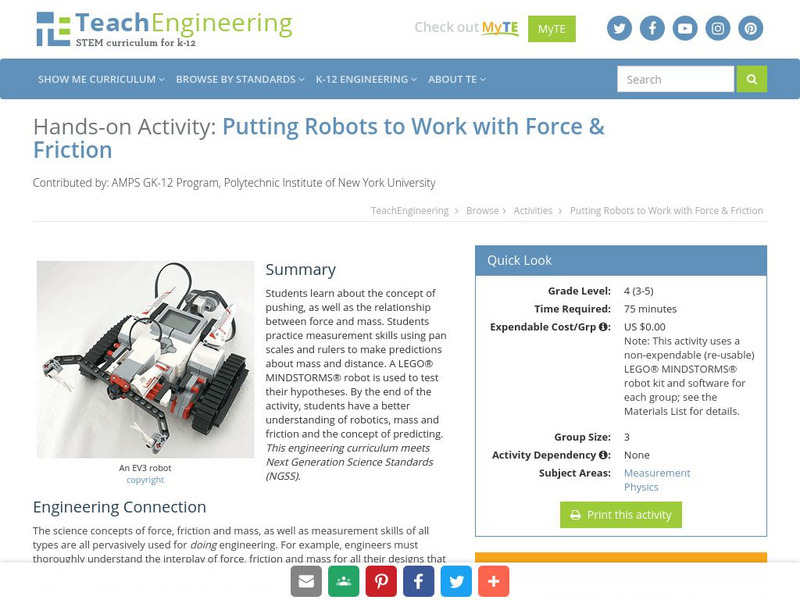
TeachEngineering
Teach Engineering: Putting Robots to Work With Force & Friction
Students learn about the concept of pushing, as well as the relationship between force and mass. Students practice measurement skills using pan scales and rulers to make predictions about mass and distance. A LEGO MINDSTORMS NXT robot is...
TeachEngineering
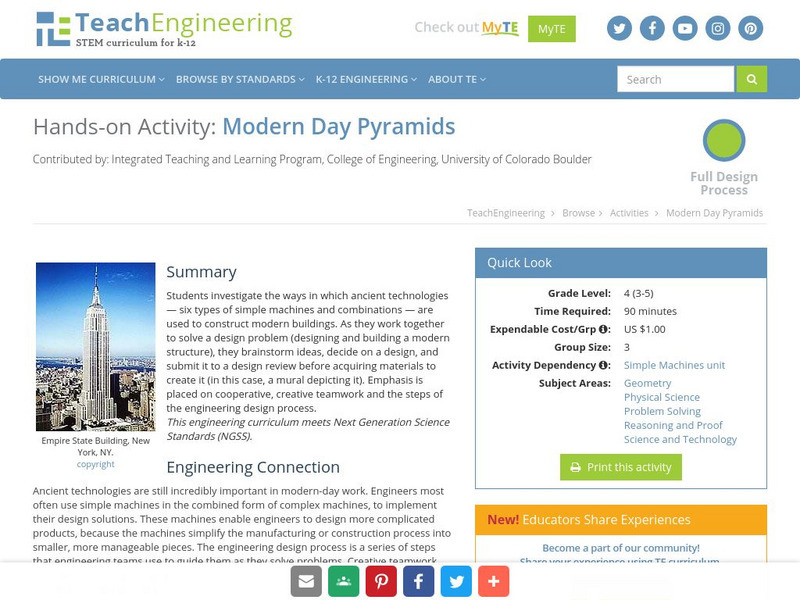
Teach Engineering: Modern Day Pyramids
Students investigate the ways in which ancient technologies - six types of simple machines and combinations - are used to construct modern buildings. As they work together to solve a design problem (designing and building a modern...
Utah Education Network
Uen: Trb 3:3 Investigation 3 Weighty Mistakes
Understand the concept of "work" and the use of levers.
TryEngineering
Try Engineering: Simple Kitchen Machines
Team instructional activity focuses on the different types of simple machines, how they work, and how they can be found in daily life.

ClassFlow
Class Flow: Simple Machines
[Free Registration/Login Required] Simple machines are all around and make many of the jobs we do easier. Investigate the six simple machines and how they help you work. Discover how they reduce the amount of force we use or can change...
Science and Mathematics Initiative for Learning Enhancement (SMILE)
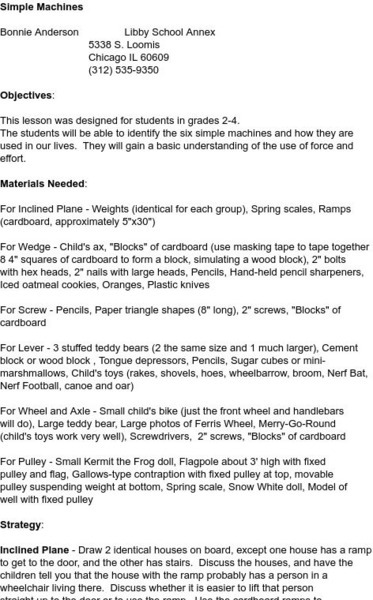
Smile: Simple Machines
Good combination of teacher demonstration and student interaction for this simple machine lesson. Great for talking about force and work. Plans are for grades 2-4, yet are adaptable.
TeachEngineering
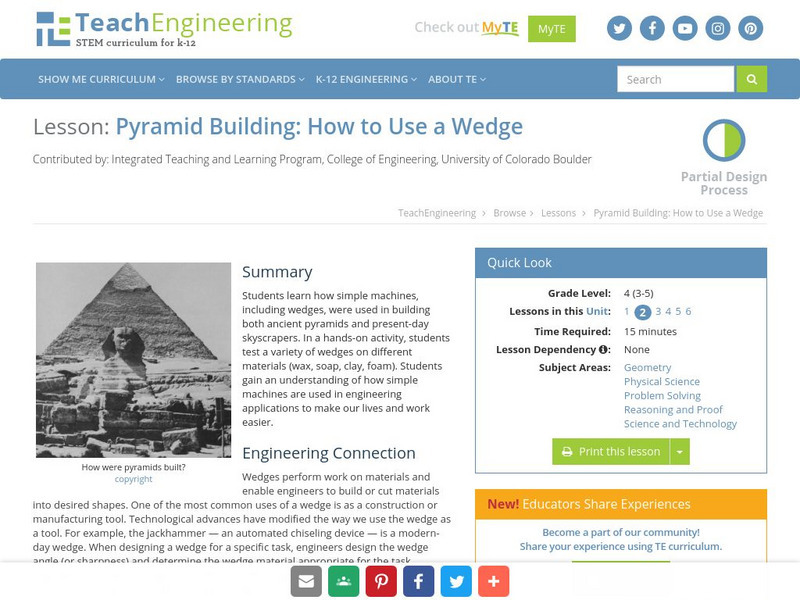
Teach Engineering: Pyramid Building: How to Use a Wedge
Learners learn how simple machines, including wedges, were used in building both ancient pyramids and present-day skyscrapers. In a hands-on activity, students test a variety of wedges on different materials (wax, soap, clay, foam)....
Science Buddies
Science Buddies: Gears Go Round!
Music boxes, bicycles, and clocks all have one thing in common: GEARS. You might say that gears make the world turn, since they are in so many mechanical instruments. How do they work and how do you know which gears to use? Find out in...

TeachEngineering
Teach Engineering: Pulley'ing Your Own Weight
Using common materials (spools, string, soap), students learn how a pulley can be used to easily change the direction of a force, making the moving of large objects easier. They see the difference between fixed and movable pulleys, and...
My Science Site
Finding Examples of Machines [Pdf]
Ready, set, go! Send your students racing to find examples of machines with this reproducible. A great way to enhance student learning on an unit on work and machines. This resource is in PDF form; requires Adobe Reader.
Scholastic
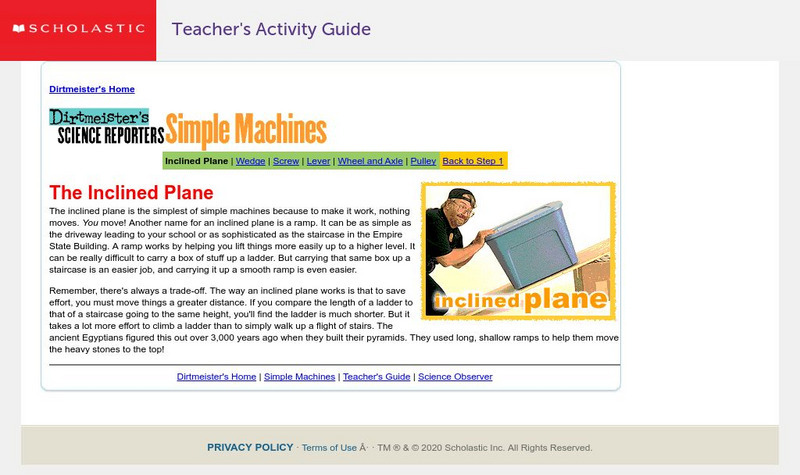
Scholastic: Dirtmeister: The Inclined Plane
This site from Dirtmeister gives information on how the Ancient Egyptians used the inclined plane. Dirtmeister explains the inclined plane and its uses.
Other
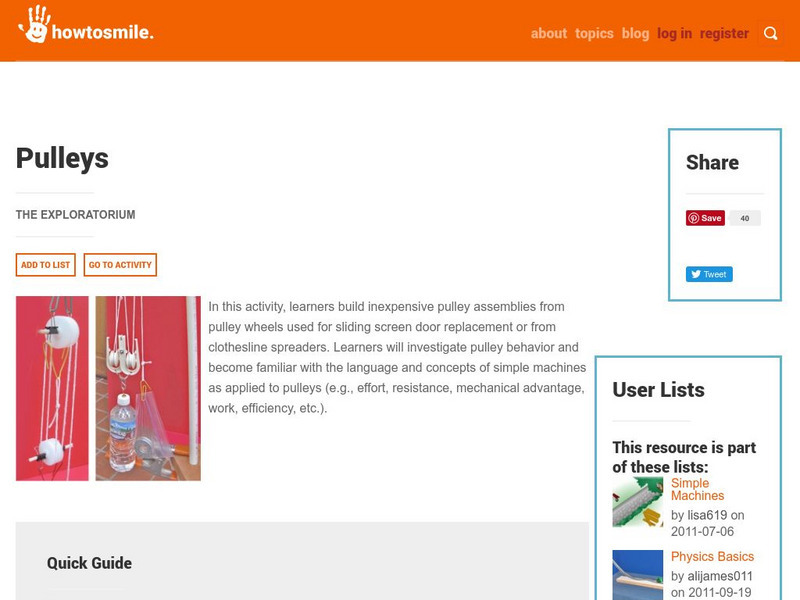
How to smile.org: Building Pulleys
An activity where young scholars use pulley systems to pick up a paint can and move an eraser from the ground to the top of a desk. After completing this activity, students will understand how pulley systems can help us do work.
Science Education Resource Center at Carleton College
Serc: First Class Levers
Through observation and inquiry, students are given various objects to investigate how levers work and why they might be useful.
Science Struck
Science Struck: Examples of Pulleys in Daily Life
Learn how pulleys work and their many uses in everyday life, industry, recreation, and other activities. Includes many pictures of pulleys and pulley systems.
Science Education Resource Center at Carleton College
Serc: Investigating the Inclined Plane Through Inquiry
In this activity, learners will use different materials to find the most effective way to use an inclined plane (in other words, moving an object with as little force as possible). This is a guided inquiry. Although the students will be...