Hi, what do you want to do?





Science Buddies
Science Buddies: Tough Beans: Which Cooking Liquids Slow Softening the Most?
Beans are important to the diets of many people, that is why you always find it cooked a specific way or in a specific dish in different cultures. Here you will learn how the liquid that beans are cooked in affects how quickly or slowly...
Science Buddies
Science Buddies: Too Much of a Good Thing? Effects of Fertilizer on Algal Growth
Algae is a good thing, but too much is a bad thing. In this environmental science fair project, grow algae in several concentrations of fertilizer and observe its effect on algal growth.

Science Struck
Science Struck: Make Invisible Ink for Your Science Fair Project
Three methods of making invisible ink are demonstrated with illustrations and step-by-step instructions.
Science Bob Pflugfelder
Science Bob: The Scientific Method
Gives an overview of the scientific method as it relates to a science fair project.

Other
Canadian Mathematical Society: Math Projects for Science Fairs
Online resource if you want to do a math project for your science fair. French available by going to the Homepage.
Other
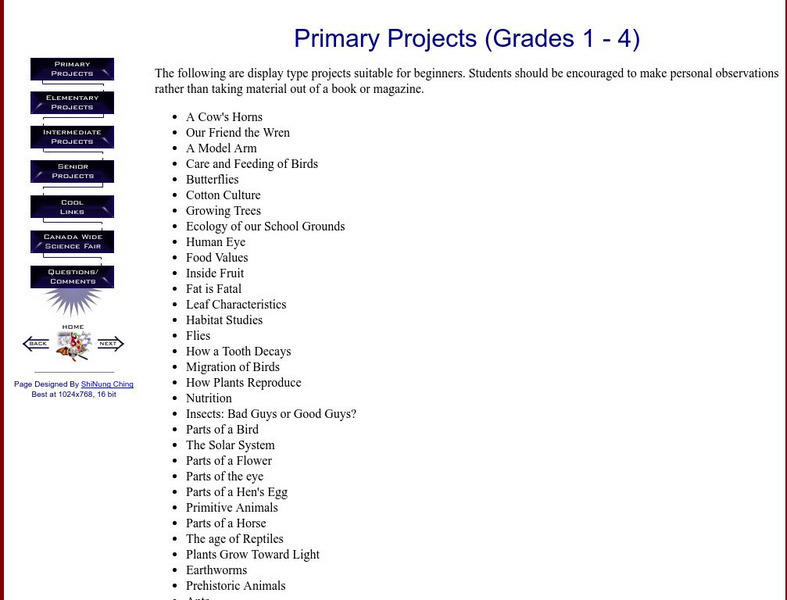
Science Fairs: Ideas for Primary Projects: Grades 1 4
This resource from Science Fairs is a wonderful resource for a wide variety of science fair starter ideas. Use an idea from here and build your own project.

Science Buddies
Science Buddies: Tee Time: How Fast Is Your Golf Swing?
Determine how golf club head velocity affects shot distance. Make your next trip to the driving range educational by conducting this experiment.
Science Buddies
Science Buddies: When Science Is Sweet: Growing Rock Candy Crystals
Though rock candy seems to be a simple enough treat, it is also pretty interesting to make. Crystallized sugar that can be grown from a sugar-water solution is just how rock candy is made. In this experiment, you will learn to make your...
Science Buddies
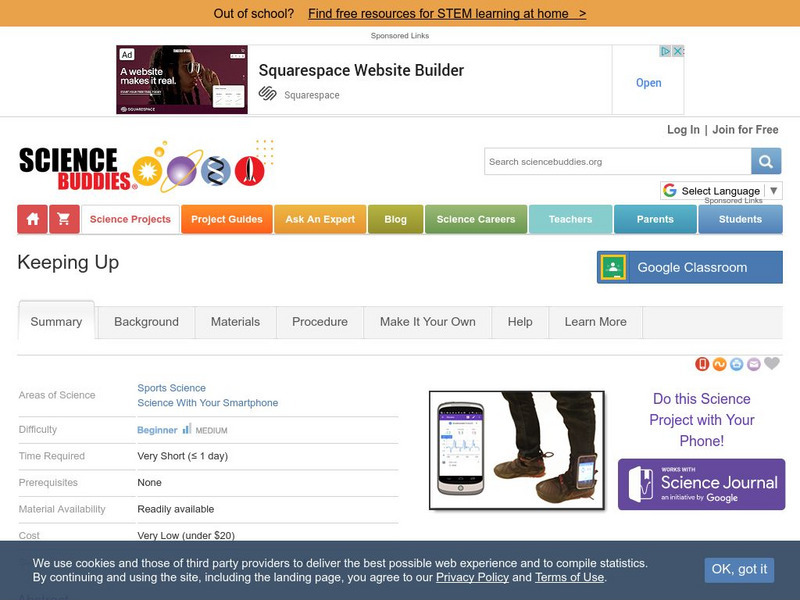
Science Buddies: Keeping Up
Do you ever feel like you need to walk faster than your parents just to keep up with them? This is because of the difference in leg length between you and your parents. In this experiment you will test if the height of a person is...
Science Buddies
Science Buddies: The Pixel Puzzle: Why Video Game Characters Look Better Today
Video games today look better than video games from the 80's, this is because now the number of pixels, or dots on the screen, used to represent video game objects has greatly increased. In the 80's, Mario was no more than 16 pixels tall...
Science Buddies
Science Buddies: Think Fast!
Are you a piano player or a video gamer? Then you might have a quick reaction time that can come in handy while playing sports. Find out how to measure your reaction time and compare it to your friends and family with this fun experiment.
Science Buddies
Science Buddies: Are Laminates Stronger?
If you love to hit the half pipe with your snowboard or skateboard, then you have tested the strength and durability of laminates. Laminates are sandwiches of different materials that are glued together in layers to give strength and...

Science Buddies
Science Buddies: Digital Photo Resolution
Do you have a favorite picture? When you have a photo that you treasure, you want it to look as good as possible. Find out how the resolution of a digital photo effects the way it looks when you print it out. How does the quality of the...
Science Buddies
Science Buddies: A Puzzling Parallax
Did you know that ancient astronomers could measure the distance to other stars? They could also distinguish between stars and planets. How could they do that without modern technology of telescopes? See if you can discover the link...

Science Buddies
Science Buddies: Color Saturation
Lively, vivid colors can add pizzazz and turn a dull photo into a work of art. Learn how changing the saturation levels of the colors in your photo can really make it pop.
Science Buddies
Science Buddies: Digital Photo Contrast
What do you do if you take a photo and it turns out too dark or too bright? You can use your computer to fix it for you. In this experiment you will investigate how changing the contrast of a digital photo will change the colors and...

Science Buddies
Science Buddies: Color Profiles
Did you know that the same digital photo you see on a computer monitor may not look as good in print? When it comes to color profiles, there are a lot of options: RGB, CMYK, grayscale and indexed color are just a few. Learn how to choose...

Science Buddies
Science Buddies: Bit Depth, Colors and Digital Photos
How many bits of information are in a digital photo? It depends on how many possible colors there are. Learn how to choose the right number of colors and bits to post your photo on the web or send it to your best friend.
Science Buddies
Science Buddies: Pinholes, Light and Aperture Size
Pinhole cameras are not a thing of the past. Even compared to all of the latest technology, a pinhole camera still gets beautiful results. Find out how this very simple aperture design works to control the way light enters the lens of...
Science Buddies
Science Buddies: Macro for Micro?
If the prefix "macro" means large and "micro" means small, then why will the macro setting of a digital camera help take a better picture of a small object? Do this experiment and get the big picture.

Science Buddies
Science Buddies: Yogurt Cultures
Find out in this experiment how good bacteria can turn milk into a treat by investigating the optimal starter cultures for making yogurt from whole milk.

Science Buddies
Science Buddies: How Well Do Disinfectants Work?
Germs are everywhere. We try and clean our home with disinfectants, but do we really get rid of all the germs? Find out with this "hands-on" experiment.
Science Buddies
Science Buddies: Getting Critical Over Colloids
What is a colloid? If you have made Oobleck out of corn starch and water, then you know that a colloid is a mixture that acts like a solid and a liquid at the same time. This activity helps you determine the critical factors that...
Science Buddies
Science Buddies: Timing the Tides
Have you ever been to a tide pool during low tide? Some intertidal animals in the low tide zone are left in a tiny pool of water when the tides go out. Other intertidal animals that live in high tide zones may be left to dry out during...
Other popular searches
- Science Fair Projects Ideas
- Science Fair Projects Topics
- Motion Science Fair Projects
- Coke Science Fair Projects
- Food Science Fair Projects
- Sports Science Fair Projects
- Cool Science Fair Projects
- Csi Science Fair Projects
- Edible Science Fair Projects
- Casi Science Fair Projects