Hi, what do you want to do?





Science Buddies
Science Buddies: Where Did All the Stars Go?
If you live in a big city or urban area it is hard to see many stars at night. In most urban areas only the most brilliant stars, planets and the moon can be seen. This is because of something called light pollution which is the...

Science Buddies
Science Buddies: The Moon and the Stars
When you are in the city, only a few of the brightest stars are visible. But when you are in the country, you can see many more stars than you can count. Sometimes you can even see the bright belt of our galaxy, the Milky Way. In this...

Science Buddies
Science Buddies: Sorting Out Sedimentation
Sedimentary rock forms in layers that are deposited one after the other over long periods of time. Oftentimes, sedimentary rock contains fossils and other debris that are deposited within the layers. Use this experiment to investigate...

Science Buddies
Science Buddies: Bottled Up Buoyancy
Sure you understand what makes submarines cool, they allow us go underwater and explore the sea! But understanding how they function is a completely different matter. This lab will help you investigate how submarines dive and surface by...
Science Buddies
Science Buddies: Riprap: It's Not Hip Hop but Erosion Stop
The Grand Canyon serves as an excellent example of just what water can do over a period of millions of years. This week long lab will help you understand how erosion works, how engineers work to help prevent erosion.
Science Buddies
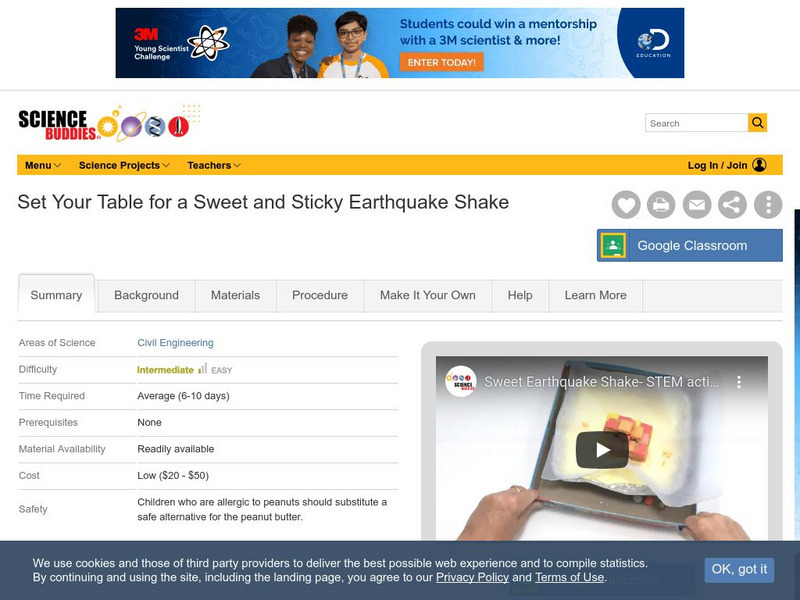
Science Buddies: Set Your Table for a Sweet and Sticky Earthquake Shake
Earthquakes can have different affects depending on their location. This week long exercise asks you to build a model house and a special table to shake it on, and see how different soil types can amplify shaking.
Science Buddies
Science Buddies: You've Got Permission to Be a Backseat Driver!
You can see what happens to your car's fuel efficiency when it takes you downtown to see a movie, up a hill for a great view, or out for a cruise on a flat country road. This is because a car's fuel efficiency does not remain the same...
Science Buddies
Science Buddies: Are There Bugs Under Your Feet?
Within the grass there are millions of micro-invertebrates. Learn how to catch them by making a Berlese funnel in this fun project that will teach you about soil.

Science Struck
Science Struck: Water Cycle Project Ideas
A collection of ideas for creating a science fair project on the water cycle.
Science Bob Pflugfelder
Science Bob: Science Fair Ideas!
Pick your topic using these ideas to get you started. Even if you don't like any, they may inspire you to come up with one of your own. Remember, check all project ideas with your teacher and parents, and don't do any project that would...
Science Buddies
Science Buddies: Hey, There's Corn in My Candy!
In candy making, corn syrup is known as an "interfering agent." You can find out just what this agent does by making two batches of lollipops, one with corn syrup and one without and examining the differences between the two. Once you...
Other
Easy Science Experiments: Clouds in a Bottle
How does a cloud form? This resource demonstrates how to create a cloud in a bottle. This makes a great experiment for a science fair project.
Other
Kids' Science Challenge: Fun Educational National Competition!
A nationwide annual science competition for elementary and intermediate school students. Winning students are given the opportunity to work with a scientist to help bring their idea to life. Contest prizes include science trips, science...

Science Buddies
Science Buddies: Make Your Own Markers
Do you ever wonder how markers are made? Where do all of those colors come from? Many of the colorful dyes we use come from plant pigments. Pigments are what make the world around us so colorful. How do chemists turn those natural plant...
Science Buddies
Science Buddies: Craters and Meteorites
Have you ever heard that the moon is made of cheese? Even though the craters on the surface of the moon resemble holes in Swiss cheese, we know that this common myth is not true. Find out how craters are formed and why they are different...
Science Buddies
Science Buddies: Do Preferences Bias Our Choices?
In this science project you will test whether color preference will affect repetitive tasks that require fine motor coordination, like picking up small objects very quickly. Find out if your color preferences will bias these repetitive...
Science Buddies
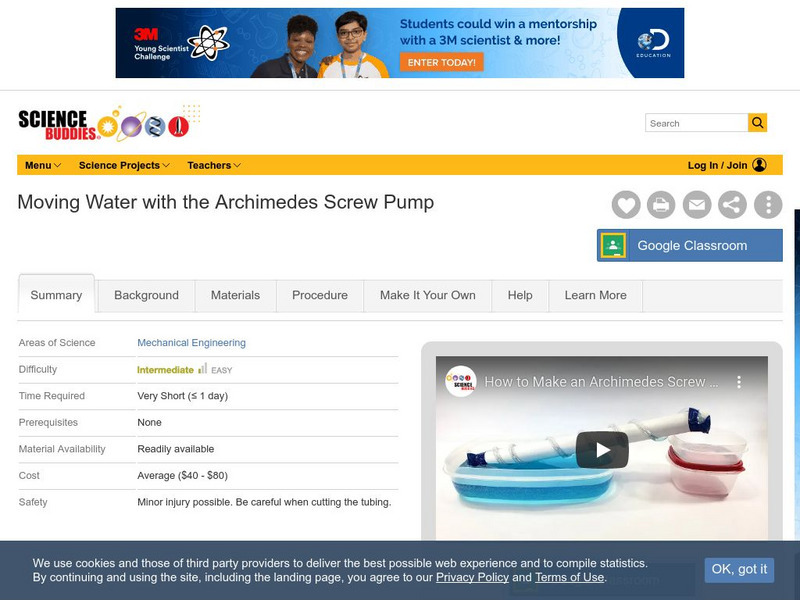
Science Buddies: Moving Water With the Archimedes Screw Pump
Amaze your friends and family by moving water with just a few turns of your wrist, this is known as an Archimedes screw. In this science project, you will build a very simple Archimedes screw, to transfer water from a low-lying location...

Science Buddies
Science Buddies: What Color Are the Leaves Really Turning?
Everyone loves the beautiful colors of fall, but where they come from and how they change color is a mystery. In this project, you will uncover the hidden colors of fall by separating plant pigments with paper chromatography.
Science Buddies
Science Buddies: Shape Changing With the Cyber Squad
In this project, you will make 2-dimensional templates, called nets, that fold up into 3-dimensional (3-D) shapes. By making shapes of different sizes, you will be able to see how 3-D shapes change with size. In your findings you will...
Science Buddies
Science Buddies: What Are You Blubbering About?
Baby Beluga may swim in the deep blue sea, but the song doesn't mention how cold it is out there. Find out in this short project how a bit of blubber can be a useful adaptation when the water is ice cold.
Science Buddies
Science Buddies: Growing, Growing, Gone! An Experiment on Nitrogen Fertilizers
Plants need nitrogen to build proteins and nucleic acids to grow healthy stems and leaves. Though the Earth's atmosphere is made up of 79% nitrogen, the form of nitrogen found in the atmosphere cannot be used by plants. In this...
Science Buddies
Science Buddies: Fun or Frustrating?
Video games have different difficulty settings, from easy to hard mode. Ask volunteers who have never played the game before to try it out. Some of them should use the easy mode and others should use the hard mode, this will ensure that...
Science Buddies
Science Buddies: A Magnifying Discovery
Have you ever looked through a magnifying lens? Why do things look bigger when you look at them through the magnifying lens? Even though the object appears to get larger, it really stays the same size. Each lens has its own unique power...
Ducksters
Ducksters: Kids Science: Projects and Experiments
Kids learn by experimenting with science. Ideas for scientific projects on weather, sound, electricity, ecology.
Other popular searches
- Science Fair Projects Ideas
- Science Fair Projects Topics
- Motion Science Fair Projects
- Coke Science Fair Projects
- Food Science Fair Projects
- Sports Science Fair Projects
- Cool Science Fair Projects
- Csi Science Fair Projects
- Edible Science Fair Projects
- Casi Science Fair Projects