Hi, what do you want to do?






Curated OER
Will There be Enough Water?
Students investigate water usage, water available, and water demand historically in the local area. They use projections of water usage, availability and demand up to the year 2050. Students use graphs to relate as well as compare and...

Curated OER
Water - Planning for the Future
Students explore and examine the increases and/or decreases for water user groups: irrigation, municipal, manufacturing, steam electric power generation cooling, livestock, and mining. They utilize percentage changes during their...

Curated OER
Geometry Scavenger Hunt
Students use the digital camera, identify geometric shapes (in nature as well as man-made), and gain a better understanding of geometric vocabulary. They search for and recognize geometric shapes in unusual settings

Curated OER
Stars and Stripes
Learners design a United States flag using reasoning. They describe their design to make it easy for it to be duplicated. They share their designs with the class.

Curated OER
Eye From the Sky
Students are introduced to the concept of aerial perspective and scale. Students will use satellite technology to view their neighborhoods and sketch the area surrounding their schools. They will take part in a neighborhood walk to view...

Curated OER
Pumped Up Gas Prices
Students spend one month keeping track of the mileage and gasoline amounts they or their family has used. Information is entered into a spreadsheet to help calculate the average gas prices over time.

Curated OER
MOBILITY, Traveling Lightly: What’s My Footprint?
Students calculate their carbon footprint. In this environmental technology lesson, students listen to a lecture on climate change. Students brainstorm solutions to reduce environmental impact based on travel options. Students calculate...

Curated OER
Properties of Fractals
Young scholars build a working definition of a regular fractal, they measure the concepts of dimensions and scale, they explore the concept of a logarithm and they attempt to solve simple exponential equations for the exponent both by...

Curated OER
Problem Solving
In this problem solving worksheet, students solve and complete 4 different types of word problems. First, they determine the responses to various questions as described. Then, students find the amount of an item needed to complete...

Curated OER
Snail Car
Students design and create robotic cars using Legos and the Robolab program. They hold a "snail race" where the slowest car that can be determined to be actually moving is the winner.

Curated OER
Different Perspectives of Oregon's Forest Economic Geography
Learners locate the many forests located in Oregon. In groups, they use the internet to research employment data on wood products made in the state. They discuss how looking at information presented in a different way can change their...

Curated OER
Tides of Change
Students use the Internet to gather information on tides and then use this information to determine the period of revolution of the moon around the earth (part 1) and the relative pull of the sun and the moon on the tides (part 2).

McGraw Hill
Glencoe: Self Check Chapter Test Ratio, Proportion, and Percent
The interactive assessment examines ratios, proportions, and percents. Students complete 18 questions created by Glencoe. Hints and solutions are included.

McGraw Hill
Glencoe: Self Check Chapter Test Exploring Ratio, Proportions, and Percent
The interactive assessment examines ratios, proportions, and percents. Students complete 14 questions created by Glencoe. Hints and solutions are included.

McGraw Hill
Glencoe: Self Check Chapter Test Ratio, Proportions, and Percent 20 Questions
The interactive assessment examines ratios, proportions, and percents. Students complete 20 questions created by Glencoe. Hints and solutions are included.
Government of Alberta
Learn alberta.ca: Math Interactives: Rate/ratio/proportion (Object Interactive)
This highly interactive resource uses the backdrop of digital photography to explore equivalent forms of 3-term ratios. Printable activities, solutions, and learning strategies are also provided.

McGraw Hill
Glencoe: Self Check Chapter Test Ratio, Proportion, and Percent
Use Glencoe's randomly generated self-checking chapter test to assess your knowledge on ratios, proportions, and percents. Each question has a "Hint" link to help. After completing the test students can click the "Check It" button and...

PBS
Pbs: Recognize and Represent Proportional Relationships Between Quantities: Ratio, Proportion, Cross Multiply, Divide
In this Cyberchase media gallery, learn about ratio and proportion and how to use an algebraic shortcut to solve proportion problems. In the accompanying classroom activity, students play a game called the "Pom-Pom Nose Push," in which...
AAA Math
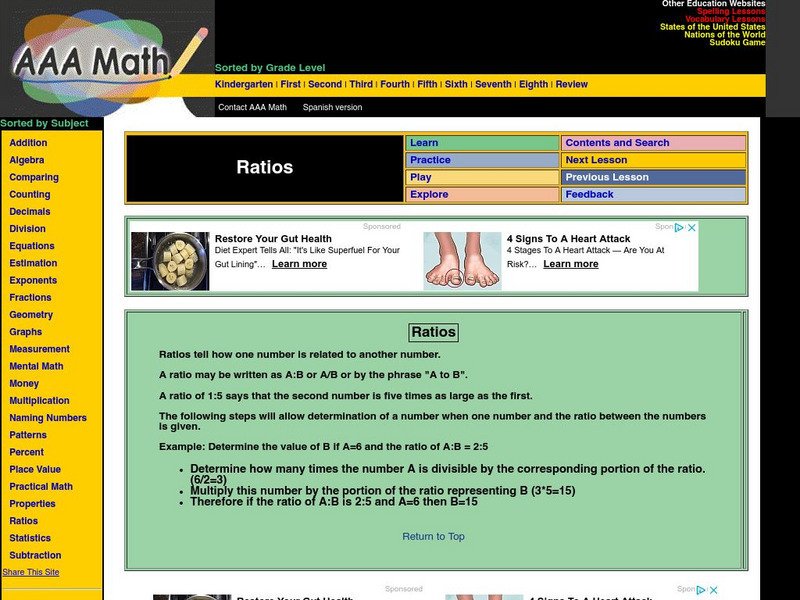
Aaa Math: Ratios
This short exercise gives the student a ratio in reduced terms, and then gives the students a replacement value for one part of the ratio. The student is then to input the other part of the replacement ratio so as to keep the two ratios...

McGraw Hill
Glencoe: Self Check Chapter Test Ratios and Proportions
The mathematics resource consists of an assessment with hints and solutions. Students answer questions that review ratios and proportions.

McGraw Hill
Glencoe: Self Check Chapter Test Using Proportional Reasoning
The mathematics resource consists of an assessment with hints and solutions. Students answer questions that review proportional reasoning.

Lawrence Hall of Science
The Math Page: Skill in Arithmetic: Ratio and Proportion
The Math Page tutorial explains and defines ratio and proportion and includes this practice section at the end of the lesson.
Ducksters
Ducksters: Kids Math: Ratios, Fractions, and Percentages
This page explores how ratios can be written as fractions. The site also discusses proportions and reducing ratios with problems and examples.
Khan Academy
Khan Academy: Identify Proportional Relationships
Practice telling whether or not the relationship between two quantities is proportional by analyzing word problems. Students receive immediate feedback and have the opportunity to try questions repeatedly, watch a video or receive hints.