Hi, what do you want to do?






Smithsonian Institution
National Museum of Natural History: American Mammals: Mexican Long Nosed Bat
The Mexican long-nosed bat feeds mainly on the nectar and pollen of agaves, and is found in Texas in June and July when the plants are in bloom there. Then it migrates southward into Mexico, where it lives in pine-oak forests and...
Smithsonian Institution
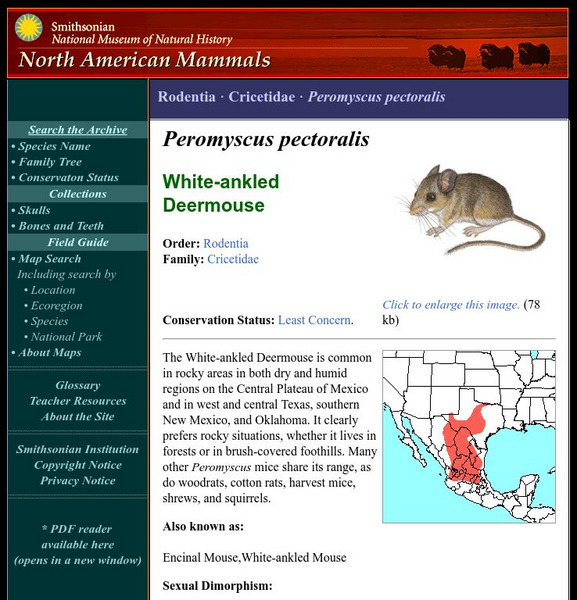
National Museum of Natural History: American Mammals: White Ankled Mouse
The White-ankled Mouse is common in rocky areas in both dry and humid regions on the Central Plateau of Mexico and in west and central Texas, southern New Mexico, and Oklahoma. It clearly prefers rocky situations, whether it lives in...
Smithsonian Institution
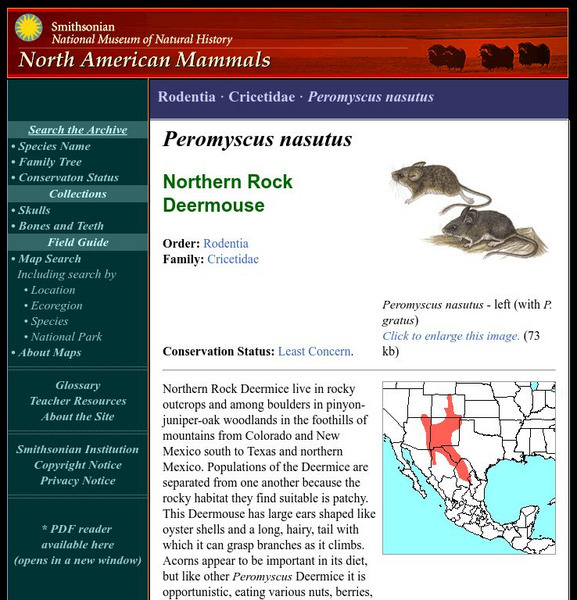
National Museum of Natural History: American Mammals: Northern Rock Deermouse
Northern Rock Deermice live in rocky outcrops and among boulders in pinyon-juniper-oak woodlands in the foothills of mountains from Colorado and New Mexico south to Texas and northern Mexico. Populations of the Mice are separated from...
Smithsonian Institution
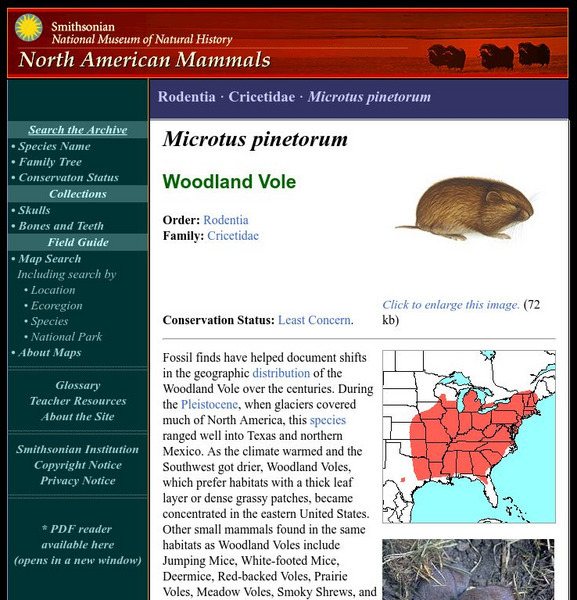
National Museum of Natural History: American Mammals: Woodland Vole
Fossil finds have helped document shifts in the geographic distribution of the Woodland Vole over the centuries. During the Pleistocene, when glaciers covered much of North America, this species ranged well into Texas and northern...

Smithsonian Institution
National Museum of Natural History: American Mammals: Southeastern Myotis
The southeastern myotis occurs as far west as northeastern Texas and southwestern Oklahoma. Its preferred daytime roosts are caves with pools of water. Learn more about the Myotis austroriparius, more commonly known as a Southeastern...
Smithsonian Institution
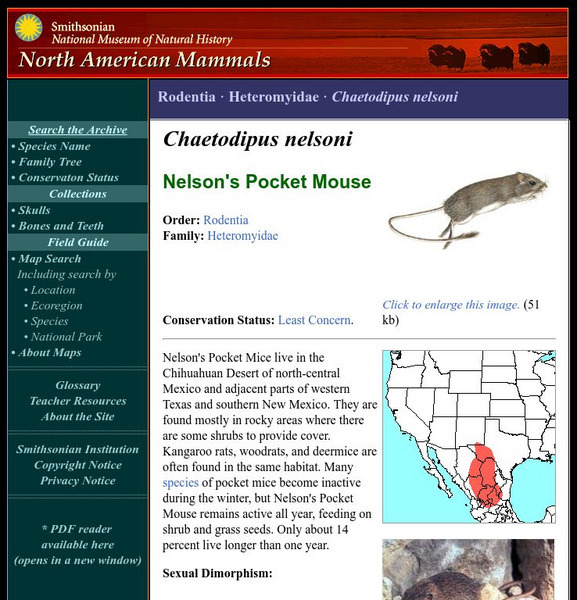
National Museum of Natural History: American Mammals: Nelson's Pocket Mouse
Nelson's Pocket Mice live in the Chihuahuan Desert of north-central Mexico and adjacent parts of western Texas and southern New Mexico. They are found mostly in rocky areas where there are some shrubs to provide cover. Learn more about...
Smithsonian Institution
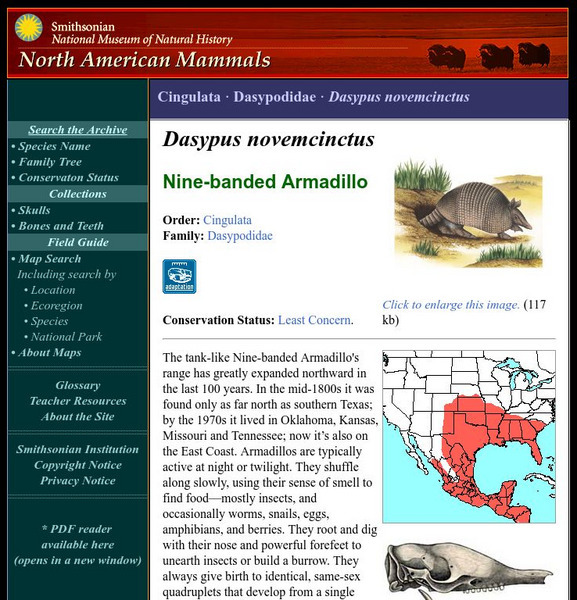
National Museum of Natural History: American Mammals: Nine Banded Armadillo
The tank-like Nine-banded Armadillo's range has greatly expanded northward in the last 100 years. In the mid-1800s it was found only as far north as southern Texas; by the 1970s it lived in Oklahoma, Kansas, Missouri, and Tennessee; now...
Smithsonian Institution
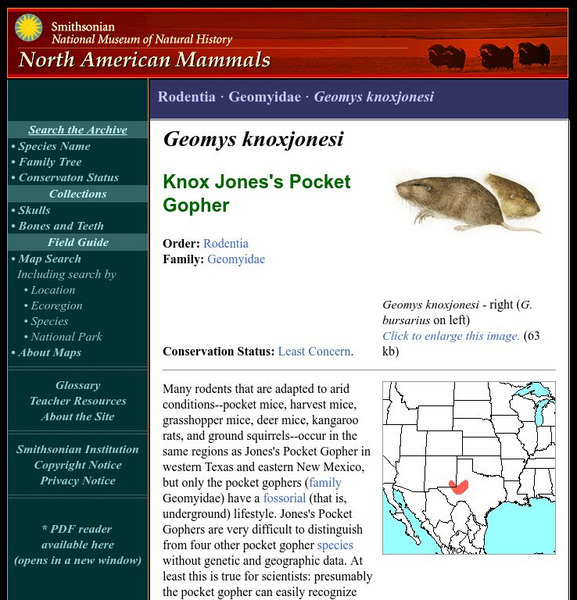
National Museum of Natural History: American Mammals: Jones's Pocket Gopher
Many rodents that are adapted to arid conditions--pocket mice, harvest mice, grasshopper mice, deer mice, kangaroo rats, and ground squirrels--occur in the same regions as Jones's Pocket Gopher in western Texas and eastern New Mexico,...
Houghton Mifflin Harcourt
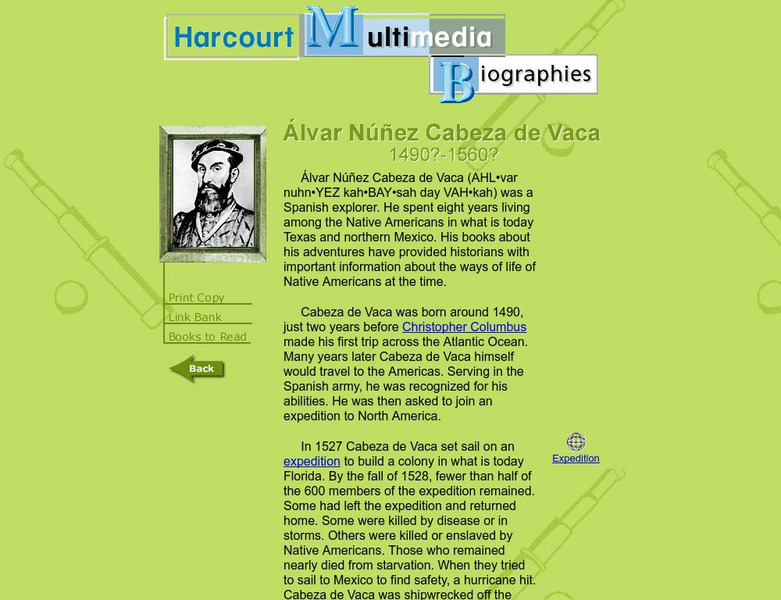
Harcourt: Biographies: Alvar Nunez Cabeza De Vaca
Gain insight into the life and adventures of Spanish explorer, Cabeza de Vaca, whose expeditions led him to Texas and Mexico.
Houghton Mifflin Harcourt
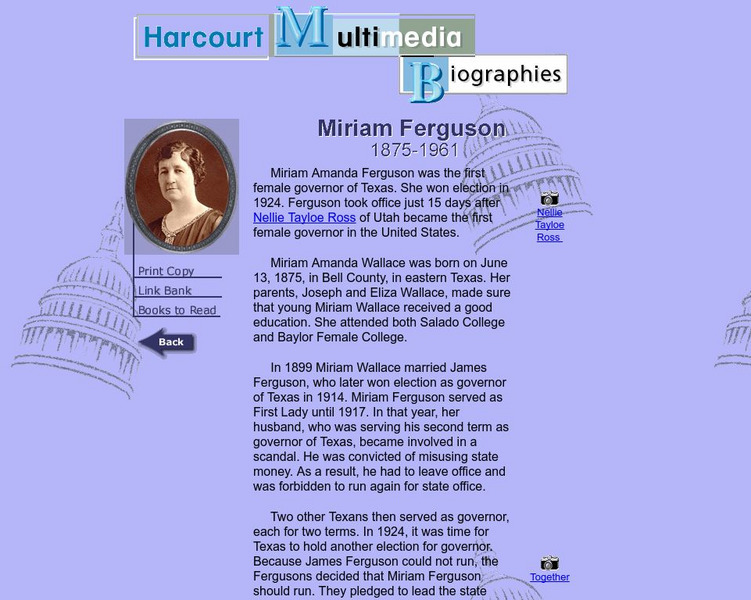
Harcourt: Biographies: Miriam Ferguson 1875 1961
This brief biography offers information about the first female governor of Texas who worked to pass anti-Klan laws and offer services for needy citizens.

Other
Pbs Teachers: Harding Black (Master Potter): An American Treasure
Search a collection of lesson plans, written by Texas art educators, about San Antonio-based potter Harding Black. Each lesson corresponds to a video clip from a feature-length program about the artist. Topics covered include balance and...
Houghton Mifflin Harcourt
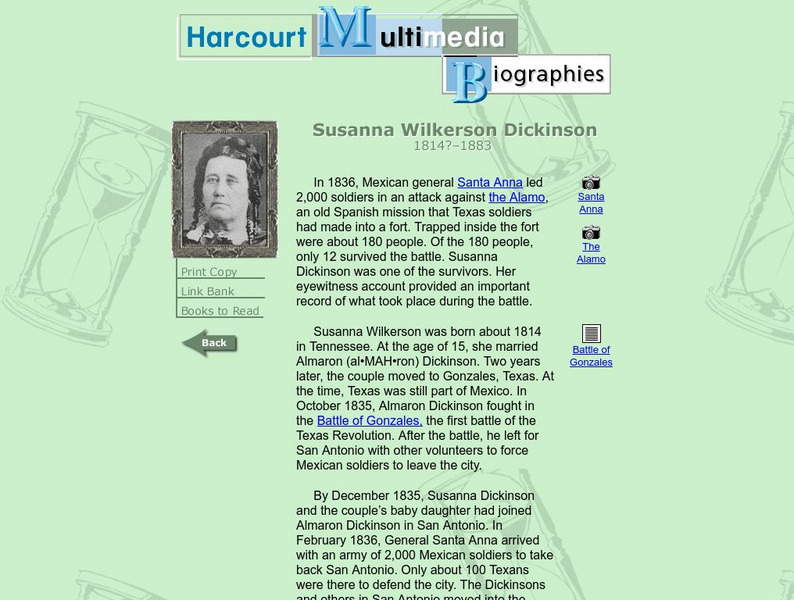
Harcourt: Biographies: Susanna Wilkerson Dickinson 1814? 1883
Explore this site to read the life history of Susanna Dickerson, one of only 12 survivors of the Alamo. She provided an eyewitness account of what happened during the battle. Be sure to view the photos of the battles.
Other
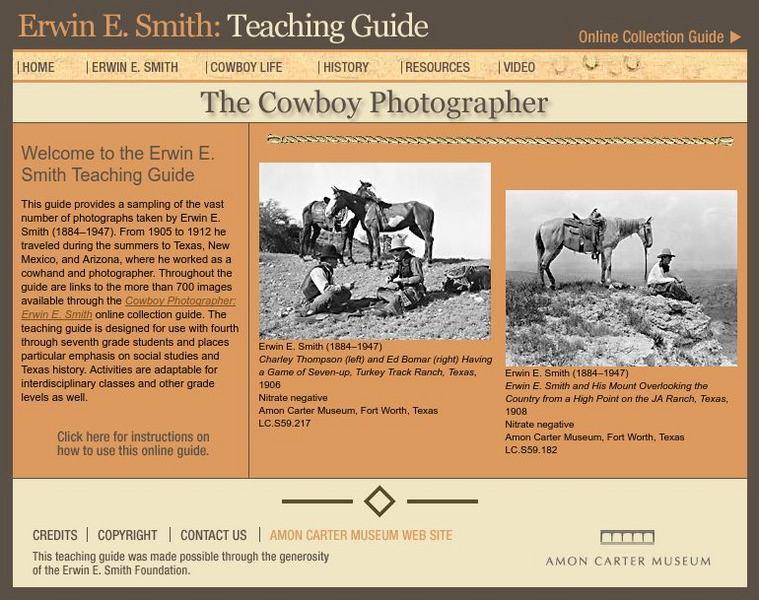
Erwin E. Smith, Cowboy Photographer (Teaching Guide)
This guide provides a sampling of the vast number of photographs taken by Erwin E. Smith (1884?1947). It is designed for use with fourth through seventh grade students and places particular emphasis on social studies and Texas history....

Houghton Mifflin Harcourt
Harcourt: Biographies: Oveta Culp Hobby 1905 1995
Elected to both the Texas and National Women's Hall of Fame, Oveta Culp Hobby led an accomplished life in politics, in the military, and government. here you can learn about her journey.
Lone Star Junction
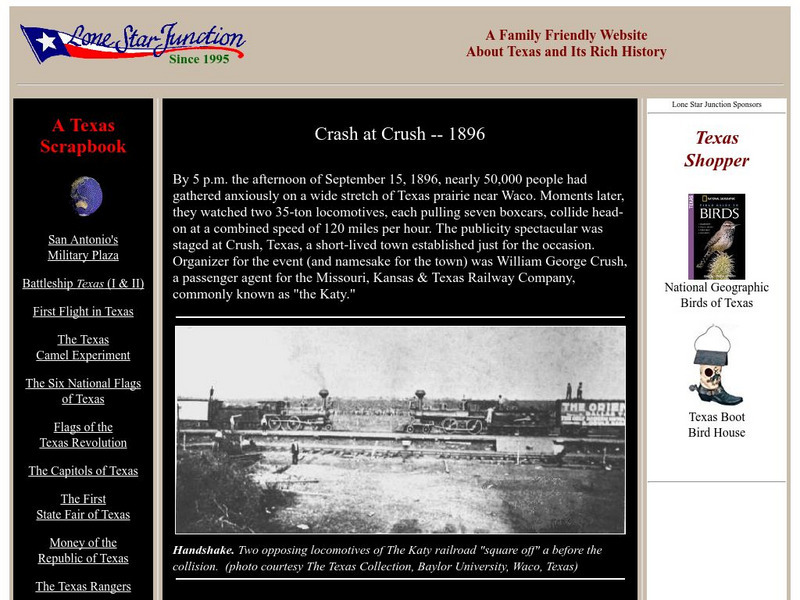
Lone Star Junction: Crash at Crush 1896
Describes a publicity stunt at Crush, Texas in 1896, that was put on by the Missouri, Kansas & Texas Railway Company. Two locomotives were made to collide head-on before an audience of almost 50,000 people. The event took a bad turn...

Lone Star Junction
Lone Star Junction: The First Lone Star State Fair
The first state fair of Texas was held in Corpus Christi in 1852, with mixed success. Read about the history of this fair and the ambitious people who initiated it and oversaw it.
Lone Star Junction
Lone Star Junction: The Battle of Galveston (1 January 1863)
Describes what took place at the Battle of Galveston on New Year's Day, 1863.

Other
Mr. Palm: Economic Activities Used by Early American Indians
A brief overview of three ways early Native Americans engaged in economic activities. These included farming, trading goods, and hunting.

Other
Mr. Palm:positive/negative Consequences of Human Modification of the Environment
A short slideshow explaining several ways that changes to the environment can have both positive and negative consequences.
Other
The Alamo: The 1836 Battle
A description of the battle of the Alamo, and the significance this event still has in the hearts of Texans.
Other popular searches
- Texas History
- Texas State History
- Military History Texas
- 4th Grade History Texas
- Women History Texas
- 7th Grade Texas History
- History Texas Flags
- Elementary Texas History
- East Texas History
- Texas History Projects
- Texas History Units
- Art History Timeline Texas