Hi, what do you want to do?






Curated OER
Universal Gravity and Kelper's Laws Worksheet
High school physicists apply their knowledge of planetary motion. Using Kepler's three laws, Newton's law of universal gravitation, and the provided properties of the moon, sun, and Earth, they proceed to solve 23 problems. An...

Voyage Solar System
Round and Round We Go — Exploring Orbits in the Solar System
Math and science come together in this cross-curricular astronomy lesson plan on planetary motion. Starting off with a hands-on activity that engages the class in exploring the geometry of circles and ellipses, this lesson...

K12 Reader
Why Does the Moon Orbit Earth?
Have you ever looked up at the moon and wondered why it looks different every night? Learn about the moon's orbit and the lunar cycle with a reading comprehension exercise. Using context clues, kids find the definitions of unfamiliar...

McGraw Hill
Escape Velocity Interactive
How hard do you need to throw a ball in the air so that it never returns? Scientists call this measure the escape velocity. Classes can explore this concept through an intriguing interactive lesson. Pupils adjust velocities and observe...

Laboratory for Atmospheric and Space Physics
Looking to the Future
New Horizons set forth on a mission to Pluto in 2006. Ten years later, the spacecraft is still on its way. Here, enthusiastic scholars predict what they will be like—likes, dislikes, hobbies, etc.—when New Horizons arrives at its...

American Museum of Natural History
A Closer Look at Mars
A website looks at how we know so much about Mars—telescopes, robots, and spacecraft—and the search for martian life. Following the informational text are three questions that quiz pupils about possible life on Mars.

American Museum of Natural History
Journey to the Stars
Fifteen detailed pictures and informative captions delve deep into the exploration of stars—their life cycle and importance in the universe.

American Museum of Natural History
Cosmic Connection
Do you see what I see? Individuals view eight images from the Hubble Space Telescope and then determine exactly what is being shown in the images. The pictures range from the rings of Saturn to views of billions of galaxies that take up...

American Museum of Natural History
One-on-One With The Sun
Follow along as Stella Stardust interviews the sun. A fun and informative interview provides scholars with information about the sun.

CK-12 Foundation
Newton's Cannon
Gravity does more than keep our feet on the ground — it holds a satellite in orbit, too. Help learners understand the effects of gravity on an orbiting object through a simulation activity. Individuals adjust a launch speed and watch as...
University of Colorado
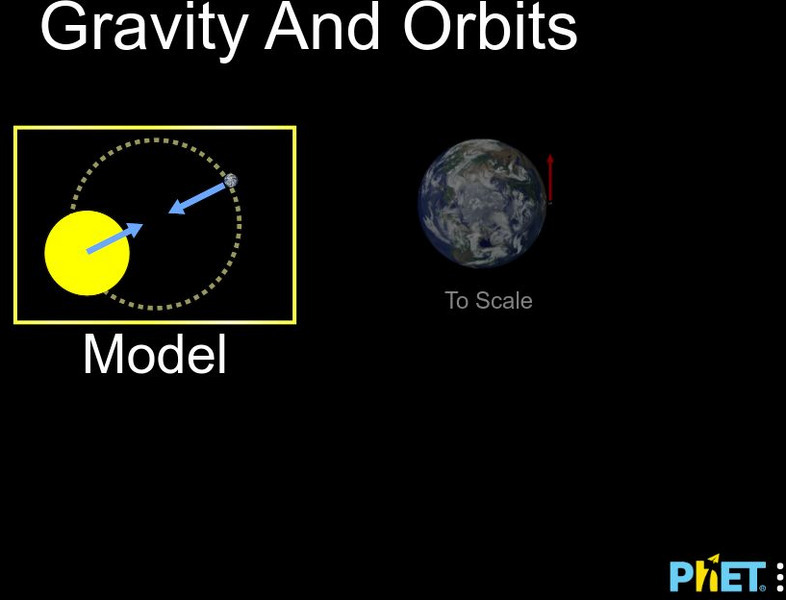
University of Colorado: Ph Et Interactive Simulations: Gravity and Orbits
Move the sun, earth, moon, and space station to see how it affects their gravitational forces and orbital paths. Visualize the sizes and distances between different heavenly bodies, and turn off gravity to see what would happen without it.
Texas Education Agency
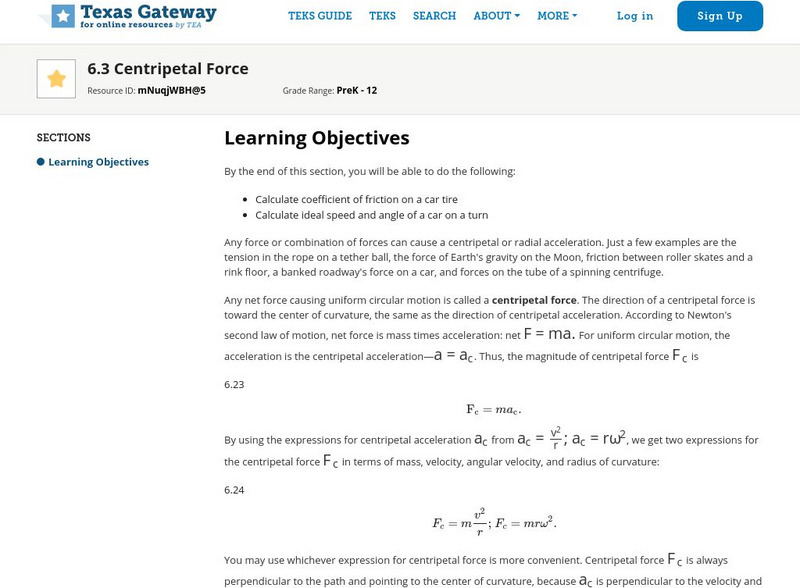
Texas Gateway: Uniform Circular Motion and Gravitation: Centripetal Forces
By the end of this section, you will be able to calculate coefficient of friction on a car tire and to calculate ideal speed and angle of a car on a turn.

CK-12 Foundation
Ck 12: Fifth Grade Science: Earth Science: Gravity
Do you know how gravity affects you? This module defines gravity and explains how gravity affects the motion of objects.
Georgia State University
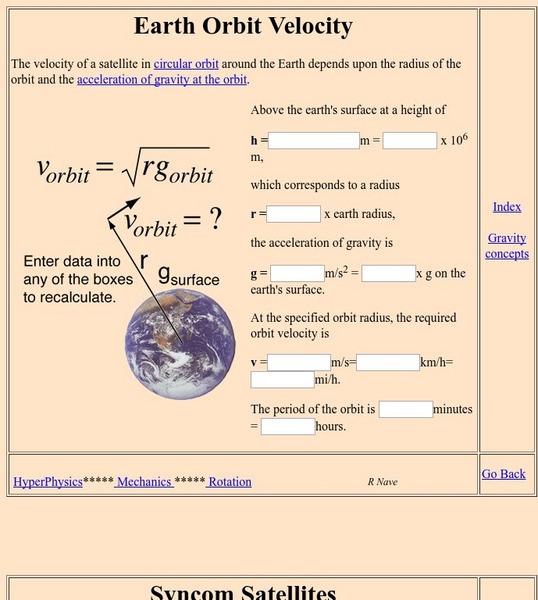
Georgia State University: Hyper Physics: Earth Orbit Velocity
A discussion and statement of an equation for orbital speed. An interactive JavaScript form allows the user to investigate the relationship between orbital height and orbital speed. A very good opportunity to practice and receive...
Project Britain
Primary Homework Help: Earth and Space Quiz
This resource provides information about Earth and space. In addition, there is a quiz provided.
CK-12 Foundation
Ck 12 Exploration Series: Simulations: Physics: Newton's Cannon
[Free Registration/Login Required] Learn about orbits and how an object can stay in orbit under the influence of gravity. By adjusting launch velocities users will understand how to successfully put a virtual satellite into orbit without...
Physics Classroom
The Physics Classroom: Circular Motion Principles for Satellites
From The Physics Classroom. Uses easy- to-understand language to discuss how circular motion principles apply to the motion of satellites. Describes the tangential velocity and centripetal acceleration of a satellite. Includes many...
Physics Classroom
The Physics Classroom: Mathematics of Satellite Motion
The mathematics associated with the motion of satellites is described. Equations (for period, velocity, acceleration and force) are stated, symbols described, and sample problems solved. Includes five practice problems with solutions and...
Physics Classroom
The Physics Classroom: Kepler's Three Laws
The three laws of planetary motion as described by Kepler are stated and elaborated upon. Useful graphics and an easy-to-understand language are used to explain the nature of planetary motion. Both conceptual and mathematical. Includes a...