Hi, what do you want to do?






Core Knowledge Foundation
Classification of Animals Tell It Again!™ Read-Aloud Anthology
Animal classification is the theme of a three-week read-aloud anthology. Scholars listen to and discuss a reading and complete extension activities throughout nine lessons. Writing opportunities delve deep into the process of writing an...

K5 Learning
The Life Cycle
Studying plant, animal, or insect life cycles? Pair a science unit with a reading comprehension worksheet on life cycles. The passage touches briefly on butterfly, plant, frog, and dog life cycles before prompting readers to answer six...

Montclair Art Museum
Eric Carle: Animals and Friends
Celebrate Eric Carle’s beloved children’s books, especially those about animals. Teachers and readers alike engage in Carle’s books as they explore the art and color in each of his stories, and how these elements support comprehension.

Curated OER
Butterfly Life Cycle
Focused little scientists will flitter their arms back and forth across the room with excitement as they learn the life cycle of a butterfly and how living things grow and change over time.

Agriculture in the Classroom
A Rafter of Turkeys
How did that turkey get from the early Aztec culture to your table? Learn about the history of wild and domesticated turkeys in North America, as well as their inclusion in Thanksgiving traditions, with a two-part agricultural science...

Curated OER
The Marvels of Mud
Young scientists roll up their sleeves and get a little dirty in this three-day earth science investigation. Following the scientific method, children monitor the growth of algae in pond water samples in order to determine...

Columbus City Schools
You Can’t Sneeze On This Tissue
Take your class' understanding of cells to the next level... or levels! Demonstrate the levels of organization using a variety of engaging methods. The teacher's guide includes the materials you'll need to execute a flower...

Curated OER
The Chesapeake Bay in Captain John Smith's Time
When Captain John Smith visited the Chesapeake Bay in the summer of 1608, what types of animals and habitats did he encounter? Your young historians will analyze primary source documents to answer this question, as well as compare...

Lerner Publishing
Meet the Dinosaurs
Take your class of youngsters on a prehistoric adventure with this four-lesson series on dinosaurs. Accompanying the Meet the Dinosaurs books by Don Lessem, these lessons engage children in writing their own dinosaur books,...

Core Knowledge Foundation
A Time for All Seasons - Fall
The weather is cooling down and the leaves are starting to change color; fall is right around the corner. Celebrate this special time of year with this earth and life science lesson series that teaches children about the...

Lerner Publishing
Teaching Habitats
What makes up a habitat? Use this resource to engage first graders in the exploration of desert, wetland, forest, and ocean habitats. Youngsters classify plants and animals into the four distinct habitats through drawings and cutting and...

K12 Reader
Taiga Ecosystems
Introduce your class to another type of ecosystem, the taiga ecosystem, through a reading passage. Class members read the text and then respond to five reading questions about the content of the passage.

American Museum of Natural History
Finding Fossils
How does one go about finding fossils? Find out with an informative webpage that looks at the digging process, showcases rocks and common fossils, helpful tips, and a list of archeological do's and don'ts.

Core Knowledge Foundation
A Time for All Seasons - Winter
As the days get shorter and a chill enters the air, it's time to start teaching your little ones about the wondrous winter season. Through a series of teacher demonstrations, whole-class read alouds and discussions, and hands-on...

World Wildlife Fund
Arctic Food Chain
Explore the food chains that support Arctic ecosystems. A class discussion on interdependence and the different roles plants and animals play in ecosystems provides students with the knowledge to complete a worksheet asking them to...

K12 Reader
Ecosystems
Examine how living and non-living things work together in a reading passage about ecosystems. Class members read the text and then respond to five response questions that relate specifically to the content of the passage.

Core Knowledge Foundation
A Time for All Seasons - Summer
The sun is shining and the birds are singing, what better time to teach young learners about the fun season of summer. In this week-long science series, children learn how the rotation and orbit of the earth influence...

Baylor College
Water in Your Body
Do you know how much water you have had in the last 24 hours? Do you know how much your body needs? In this hands-on activity, your class members will estimate how much water our bodies lose each day by filling and emptying one-liter...

Curated OER
Nonfiction Genre Mini-Unit: Persuasive Writing
Should primary graders have their own computers? Should animals be kept in captivity? Young writers learn how to develop and support a claim in this short unit on persuasive writing.

Michigan State University
All About Rodents
Get to the know the common house mouse and the Norway rat with an activity that reinforces reading comprehension skills. Scholars read a three-page document detailing key information about mammals, specifically rodents, and use their...

E-learning for Kids
E Learning for Kids: Science: Hawaii: What Are the Life Processes in Animals?
Kamoku is a boy from Hawaii who is interested in the seven life processes. Do you know what these are? Join Kamoku and discover them with him.
Utah Education Network
Uen: Themepark: Cycles
This is a large collection of resources on cycles of nature and the Earth. There is a constant exchange of the elements between air, earth, water, plants, and animals. Most biological processes wind up back where they started. These...
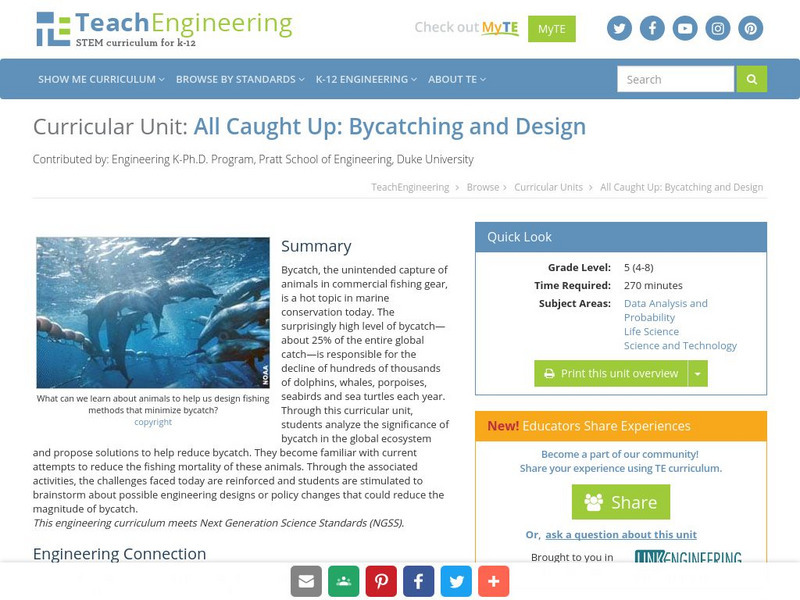
TeachEngineering
Teach Engineering: All Caught Up: Bycatching and Design
Bycatch, the unintended capture of animals in commercial fishing gear, is one of the hottest topics in marine conservation today. About 25% of the entire global catch is bycatch. This surprisingly high level of bycatch is responsible for...

CK-12 Foundation
Ck 12: Fourth Grade Science: Life Science: Habitat Destruction
Looks at ways plants and animals, including humans, can impact the environment in this learning module.