Hi, what do you want to do?






Concord Consortium
Forming a Molecular Bond
They say two's company, but three's a crowd... unless you're talking about molecular bonding! Chemistry scholars experiment with two- versus three-atom bonding in an engaging simulation. Learners must place the third atom in a location...

Concord Consortium
Breaking a Molecular Bond
Breaking up is hard, especially with a third part involved! Watch as molecules of hydrogen, oxygen, and nitrogen try to keep it together as a neutral third atom bombards them. Users control the reactive molecules and the velocity of the...

Spark Notes
Review of Chemical Bonding: Review Test
This is an online exercise in which chemistry learners answer a series of multiple choice questions about bonding. Topics addressed include ionic and covalent bonds, electronegativity, ions, valence electrons, resonance structure, and...

Concord Consortium
Making and Breaking Bonds: The Effect of Temperature
Time to turn the heat up on your next bonding lesson! Young chemists explore temperature, kinetic energy, and bonding through an interesting interactive. The controls allow individuals to vary the temperature, as well as pause progress...

Santa Monica College
Lewis Structures and Molecular Shapes
Learners practice drawing Lewis dot structures, build molecules with model kits, and predict molecular shapes using VSEPR theory. The combination of written work and hands-on reinforcement benefits young scientists.

Royal Society of Chemistry
Shapes of Molecules—Distortion from the Pure Geometry
Ready to introduce the realities of molecular geometry to chemistry pupils? Use a logic-based interactive! Perfect as individual practice, the puzzles explore the bond angles and repulsions present in three common molecular shapes.

Concord Consortium
Reaction Between Hydrogen and Oxygen Molecules
When molecules of hydrogen and oxygen are combined, how does water form? Science scholars observe changes in kinetic and potential energy during a chemical reaction in an interactive. The resource features easy controls that allow users...

Concord Consortium
Polarization
This is one cool resource for teaching about polarity! Chemistry scholars observe electron distribution and molecular shape as they select different non-metals and form bonds. The interactive offers two views, surface charge and electron...

Royal Society of Chemistry
Shapes of Molecules—Geometry of Central Atom
How is a molecule's shape determined? Explore bond angles, lone pairs, and VSEPR theory through a logic-based activity. Chemists pull together information about the major molecular shapes, then use it to solve puzzles.

Concord Consortium
Elements and Polarity
Take a look at some molecules that are so cool, they're polar! Scholars examine the effect polarity has on a molecule's shape and charge. Change up the view and choose between an opaque or transparent molecular surface, complete with...

Concord Consortium
Unshared Electrons and the "Bent" Shape
Why is water always so bent out of shape? Scholars investigate the molecular geometry of the water molecule using a 3-D resource. The interactive features options such as rotation and the ability to view electron pairs.

Concord Consortium
Making Molecules
It's molecule magic! Skillful scholars explore the effects of different atoms on molecular polarization using an intuitive interactive. The resource displays the charge at different locations on the molecule, then adapts as the user...

Aquarium of the Pacific
Lego Molecules
Young scientists construct an understanding of molecular compounds in this hands-on science lesson. Using LEGO® to model the atoms of different elements, students build molecules based on the chemical formulas of common compounds.

Royal Society of Chemistry
Shapes of Molecules—Hybrid Orbitals
Take your chemistry class' knowledge of molecular geometry to the next level! Introduce orbital hybridization with a series of related games. Individuals complete a data table in the first activity, then solve Sudoku-like puzzles using...

Concord Consortium
Boiling Point
Is it getting hot in here? Observe boiling from inside a beaker in an engaging interactive. Chemistry scholars heat and cool polar and non-polar solids and observe how molecules react to temperature changes. Your class' misconceptions...

Concord Consortium
Ceramic Forces
Why are bricks more likely to break than bend? Young science scholars peer inside a ceramic block and examine the effects of downward force at the molecular level. Learners can apply three different levels of force before observing their...

Serendip
Cells as Molecular Factories
Cells are both made of molecules and make molecules all at the same time! An exploratory lesson provides a means for scholars to research the components of cells made of molecules and also investigate the molecule-producing power of...

Mr. E. Science
Acids, Bases and Solutions
If you are not part of the solution, then you are part of the precipitate. The presentation covers solutions, suspensions, solubility, dissociation, and acid/base reactions. This is the 19th lesson in a series of 26.

Concord Consortium
Concord Consortium: Forming an Molecular Bond (Conceptual Version)
Create a molecular bond and observe energy over time.
Concord Consortium
Concord Consortium: Breaking a Molecular Bond
Can you break the bond between the two atoms?
Concord Consortium
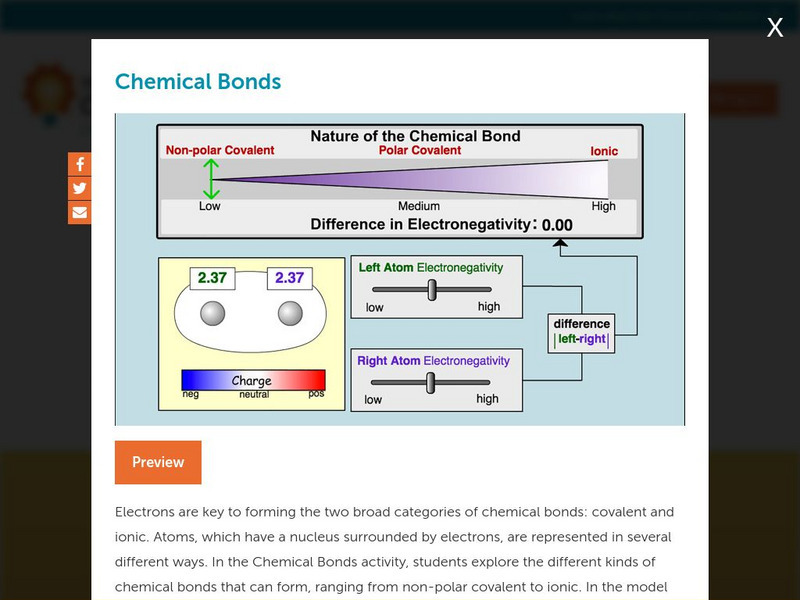
Concord Consortium: Stem Resources: Chemical Bonds
By working through this web-based activity, students differentiate between ionic, non-polar covalent, and polar covalent bonds. Specifically, distinctions are made between bonding types based on orbital shapes and electronegativity...
Concord Consortium
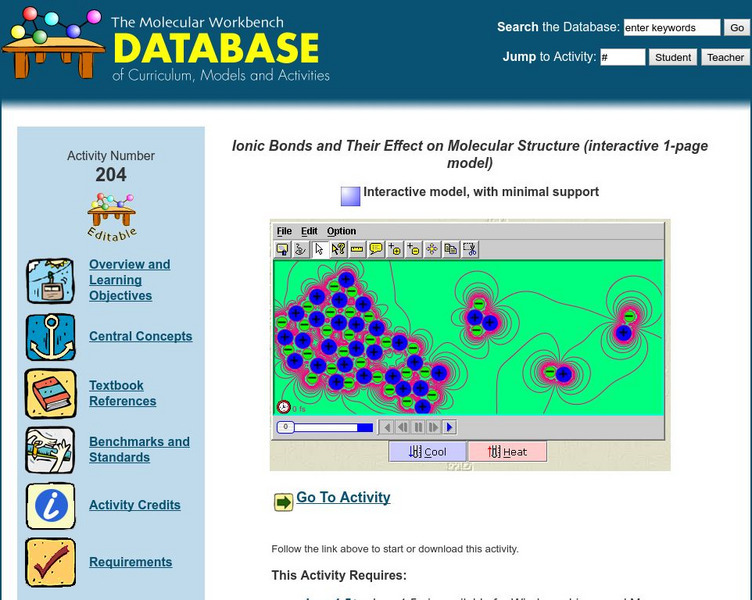
The Molecular Workbench Database: Ionic Bonds
In this simulation observe ionic bonds and how they affect the structure of the molecule.

CK-12 Foundation
Ck 12: Plix Series: Pi: Molecular Geometry
[Free Registration/Login Required] Use your knowledge of molecular geometry to analyze the structures, and determine which of them accurately illustrates the trigonal planar molecule Boron Trifluoride. Then answer two challenge questions...
Concord Consortium
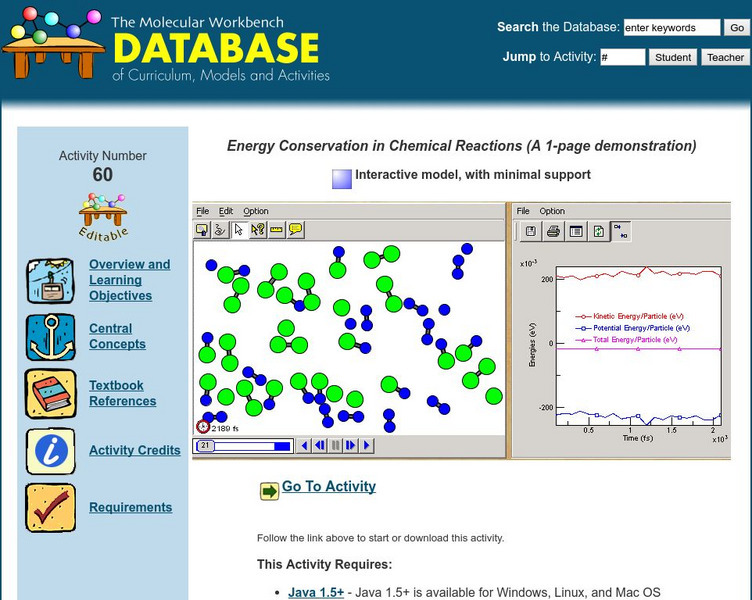
The Molecular Workbench Database: Energy Conservation in Chemical Reactions
Follow the energy conversion from potential to kinetic in this interactive activity that explores total energy in chemical reactions.